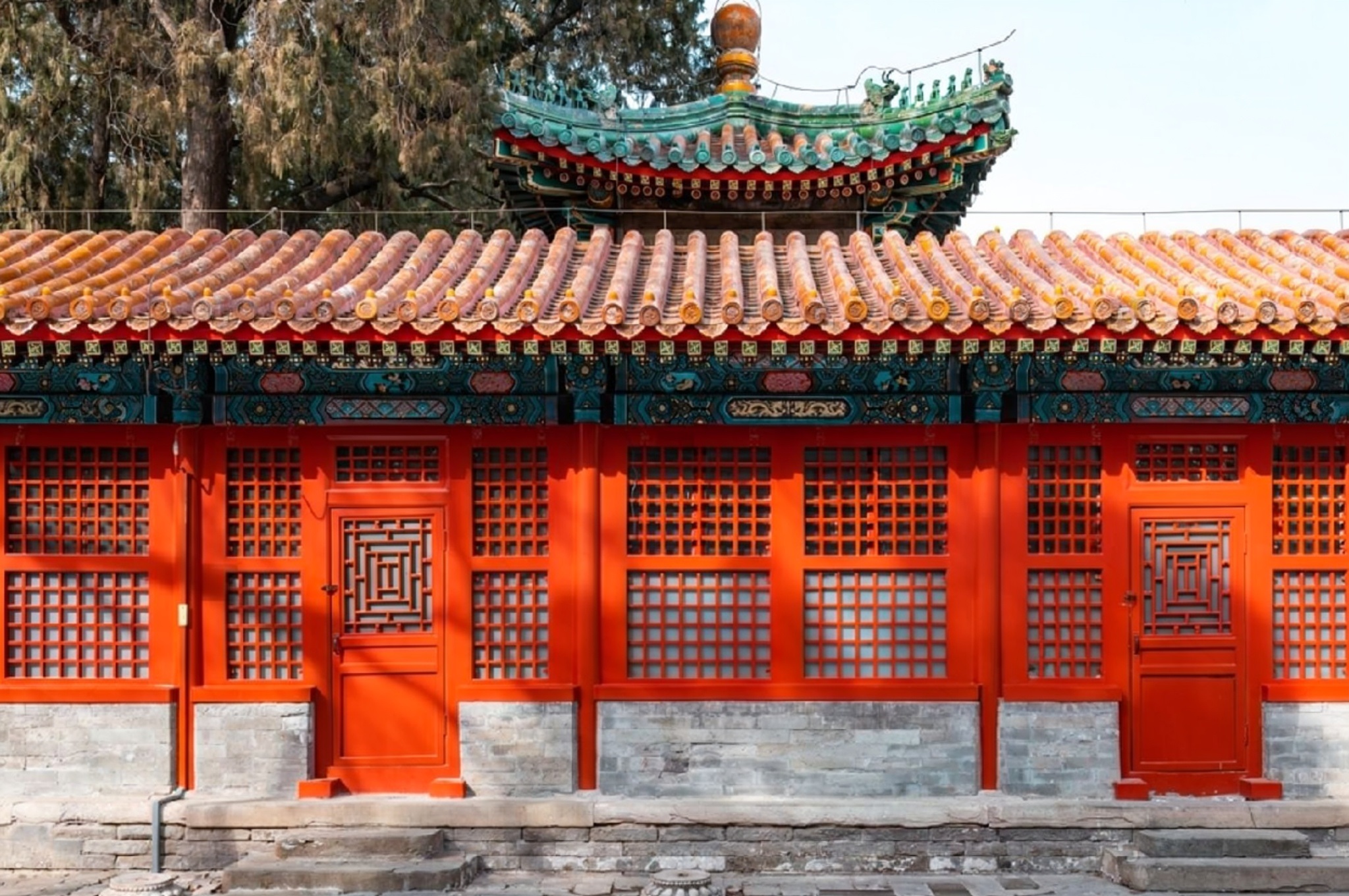
Behind an unremarkable wall on a narrow street in Suzhou, a universe waits. Step through the modest gate and the city vanishes — its traffic, its commerce, its noise replaced by the whisper of bamboo, the dark mirror of a pond, the impossible geometry of a scholar's rock rising from moss like a frozen cloud. You have entered a 园林 (yuánlín), a Chinese classical garden, and you have crossed a threshold not merely spatial but metaphysical. You have stepped from the world of ten thousand dusts into a world where a single acre contains the whole of nature, where a man may sit in his study and inhabit the mountains.
The Chinese garden is not a garden in any Western sense. It is not a collection of plants arranged for decorative effect. It is not a park for recreation. It is a philosophical argument rendered in stone, water, wood, and living green — a three-dimensional poem composed over decades, sometimes generations, by scholars who believed that the arrangement of a garden was as serious an intellectual act as the writing of a treatise on ethics or cosmology.
The Philosophy: A Microcosm of the Dao
The theoretical foundation of the Chinese garden lies in the Daoist principle that the macrocosm is contained in the microcosm — that the entire universe can be apprehended in a grain of sand, a drop of water, a single stone. The garden designer does not imitate nature; he distills it. He does not reproduce a mountain; he captures the mountain's essence in a single weathered rock, placed at precisely the angle that suggests infinite height and geological time.
This principle is expressed in the phrase 壶中天地 (húzhōng tiāndì) — "heaven and earth within a gourd." The allusion comes from a Daoist legend of an immortal who carried an entire paradise inside a small gourd, entering it each night by shrinking himself to pass through the neck. The garden is that gourd: bounded, finite, yet containing within its walls an infinity of experience for the mind that knows how to enter.
"Though made by human hands, a garden should appear as if opened by heaven itself."
— Ji Cheng, The Craft of Gardens (园冶, Yuányě), 1631
Ji Cheng's seventeenth-century treatise remains the bible of garden design. Its central paradox — that the highest art is to conceal all art — governs every decision a garden maker undertakes. A path must appear to wander naturally, yet every curve is calculated to control the visitor's pace, sightlines, and emotional rhythm. A rock must seem to have stood for ten thousand years, yet its position was debated for months.
Borrowing Scenery: The Garden Without Walls
The most sophisticated technique in the Chinese garden designer's repertoire is 借景 (jièjǐng), "borrowing scenery." The principle is deceptively simple: a garden need not contain everything it shows. If a distant pagoda rises beyond the garden wall, the designer frames it through a window, incorporates it into the composition, makes it part of the garden's experience. The boundary between inside and outside dissolves; the garden expands to encompass the horizon.
Borrowing scenery operates on multiple scales. A moon gate — a circular opening in a whitewashed wall — frames a glimpse of bamboo and stone as a living painting, changing with the seasons, the weather, the hour. A lattice window transforms a corridor into a gallery, each opening revealing a different "scroll" of garden view. The designer borrows not only space but time: the morning mist, the autumn moon, the sound of rain on banana leaves, the fragrance of winter plum blossoms. All are "borrowed" into the garden's composition without being owned or controlled.
This technique reflects a profound philosophical stance: that beauty is not a possession but a relationship. The garden does not own the mountain it borrows; it enters into dialogue with it. The viewer, standing at the precisely calibrated vantage point, becomes the third term in that dialogue — the consciousness through which garden and landscape recognize each other.
Suzhou: The Garden City
No city embodies the garden tradition more completely than Suzhou, the ancient capital of Wu, where over sixty classical gardens survive from a tradition that once numbered nearly two hundred. The city's prosperity as a center of silk trade and scholarly culture, combined with its flat terrain and abundant water, made it the ideal ground for garden cultivation from the Song dynasty onward.
The 拙政园 (Zhuōzhèng Yuán), the Humble Administrator's Garden, is the largest and most celebrated. Created in 1509 by Wang Xianchen, a disgraced official who retreated from politics to cultivate his garden, it sprawls over thirteen acres of ponds, pavilions, and carefully orchestrated vistas. Its name, drawn from a Pan Yue essay about the contentment of humble retirement, is itself a statement of values: the garden is an alternative to the court, a world where a man may be "humble" and yet possess everything that matters.
The 留园 (Liú Yuán), the Lingering Garden, achieves its effects through compression and sequence. Its entrance corridor is deliberately long, dark, and narrow — a compression that makes the sudden opening into the main garden space feel like an exhalation, a release, an arrival. The designer manipulates the visitor's body as a musician manipulates an audience: tension, release, anticipation, surprise.
The 网师园 (Wǎngshī Yuán), the Master of Nets Garden, is the smallest of the great Suzhou gardens and perhaps the most perfect. In barely over an acre, it contains a complete world: a central pond reflecting the sky, a study courtyard of austere elegance, a rockery that suggests an entire mountain range, and a tiny pavilion where one may sit and watch the moon rise over the water. It is the gourd containing heaven and earth.
The Four Elements: Rock, Water, Architecture, Plants
Every Chinese garden is composed from four fundamental elements, each carrying symbolic weight. The rocks (石, shí) are the bones of the earth — ancient, enduring, shaped by time. The scholar's rocks (太湖石, tàihú shí) from Lake Tai, riddled with holes and hollows, were prized above gold by Song dynasty collectors. Their perforations represent the interpenetration of solid and void, form and emptiness. A single great rock, standing alone in a courtyard, is a portrait of the universe in miniature.
Water (水, shuǐ) is the blood of the garden — flowing, reflecting, nourishing, connecting. A garden without water is considered lifeless. The pond is never geometric; its edges curve and indent to suggest a natural shore, and its surface serves as a mirror that doubles the garden, creating a second world below the first.
Architecture (建筑, jiànzhù) provides the human frame through which nature is viewed. Pavilions, corridors, bridges, and studios are not separate from the garden but integral to it — they are the eyes through which the garden is seen, the bodies that inhabit it. A pavilion named "Listening to Rain" is not merely a shelter; it is an instrument for transforming weather into music.
Plants (花木, huāmù) are chosen not for color alone but for symbolic resonance and seasonal rhythm. Bamboo represents integrity — hollow yet unbreakable. The plum blossom represents courage — flowering in the depths of winter. The pine represents longevity. The lotus represents purity — rising unstained from muddy water. A garden's planting scheme is a moral vocabulary, read by the educated visitor as naturally as text on a page.
Gardens as Three-Dimensional Poetry
The ultimate ambition of the Chinese garden is to achieve what poetry achieves in language and painting achieves in ink: the expression of a complete emotional and philosophical world through carefully chosen, precisely arranged elements. The garden is a poem you walk through. It has rhythm — the alternation of open and enclosed, high and low, bright and shadowed. It has imagery — the recurring motifs of moon, water, stone, and cloud. It has meaning — the scholar's meditation on impermanence, retirement, and the proper relationship between humanity and nature.
To visit a great Chinese garden is not to sightsee. It is to read — slowly, attentively, with the whole body. It is to understand that a civilization which could compress the cosmos into an acre of land, which could make a single rock contain a mountain, which could name a pavilion "With Whom Shall I Sit?" and mean it as both a question about companionship and a quotation from Su Shi — such a civilization understood something about the relationship between space and consciousness that our own age of infinite digital expansion has forgotten. The garden asks: what if enough is everything? What if the smallest space, perfectly arranged, contains more than the largest space carelessly filled?
The answer is written in stone, reflected in water, and whispered by the bamboo. It has been waiting behind that unremarkable wall for five hundred years. You need only step through the gate.