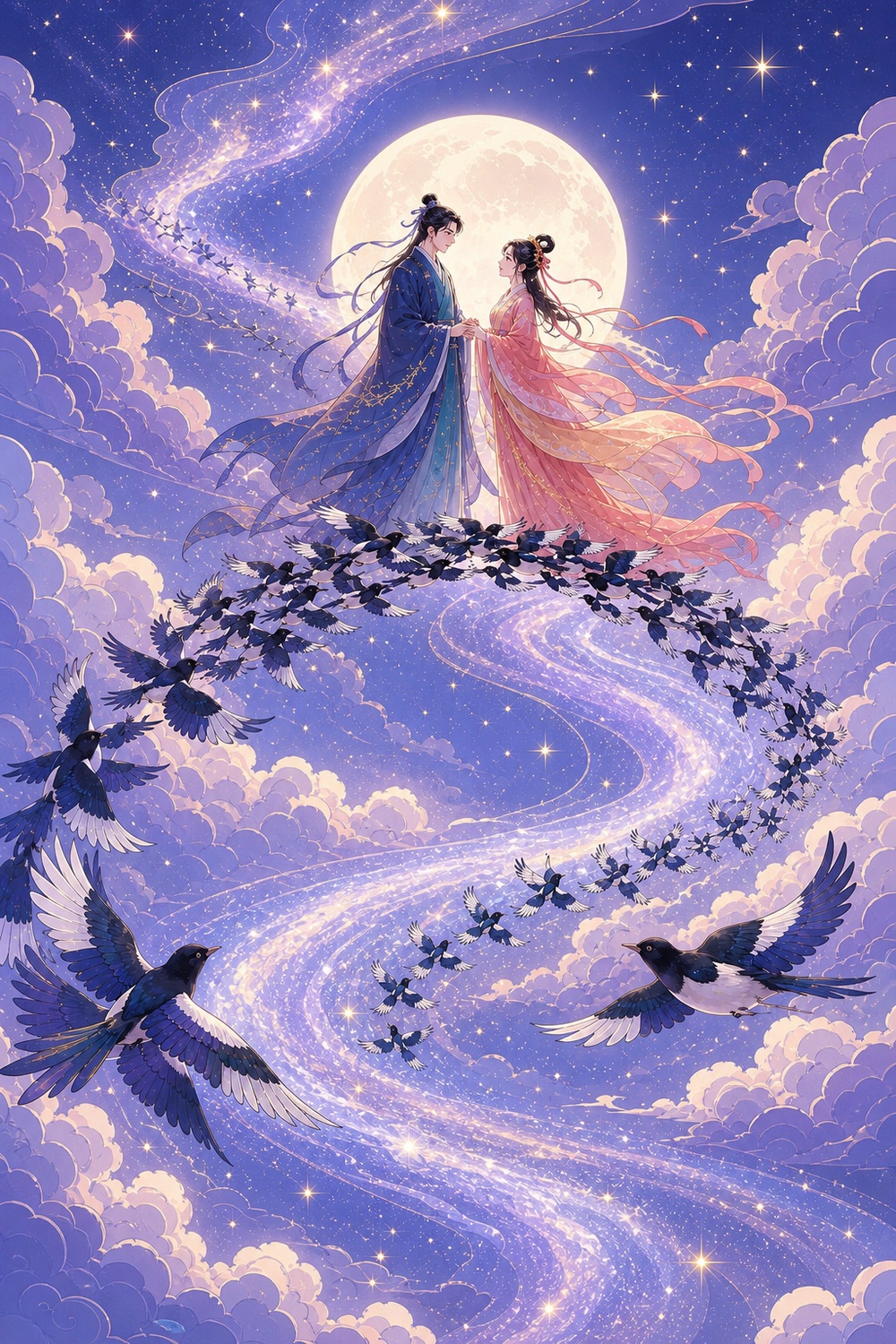
Today, August 19, 2026, is the seventh day of the seventh month in the traditional Chinese calendar. It is Qixi—the Evening of the Seventh. For one night, an old story asks people to look past the city glow and toward two bright stars on opposite sides of the Milky Way.
One star is Vega, imagined as Zhinü, the Weaver Girl. The other is Altair, imagined as Niulang, the Cowherd. The celestial river stands between them. In the legend, they are husband and wife, divided by the authority of heaven and permitted to meet only once each year, when magpies rise into the sky and join their wings to make a bridge.
That romance is why Qixi is often introduced as “Chinese Valentine’s Day.” The phrase is convenient, but incomplete. Qixi is also a festival of stargazing, women’s ingenuity, needlework, wishes for a capable life, and the power of fidelity over distance. Its meaning was woven over centuries rather than invented in a single moment.
Before the Lovers, There Were Stars
The oldest layer of Qixi lies in the night sky. Agricultural communities watched the annual movement of stars with practical attention: the heavens marked time, weather and the turning of seasons. Vega and Altair were especially vivid in the summer sky, bright on opposite banks of the Milky Way. Chinese observers gave them human identities—the Weaving Maiden and the Oxherd—and poetry gradually gave those identities emotion.
Early references did not yet contain every episode of the folktale familiar today. Instead, images accumulated. A celestial weaver worked at her loom. A herdsman waited across the River of Heaven. Separation became longing; longing became a yearly reunion. By the Han period, celebrations on the double-seventh date and customs of asking for skill had taken recognizable form. Later records from the Eastern Jin, Tang, Song and Yuan periods show an increasingly rich festival culture around the night.
This layered history matters. Qixi did not begin merely as a romance attached to a calendar. Star lore, women’s work, court ceremony, household ritual, poetry and popular storytelling all helped create the festival people inherited.
The Cowherd and the Weaver Girl
There is no single authorized version of the tale. Names, parentage and details change from region to region and from one era to another. Yet the central movement remains remarkably stable: heaven and earth meet, love creates a family, authority tears that family apart, and compassion opens one narrow path back across the sky.
A Weaver in Heaven
Zhinü is a celestial weaver, sometimes described as the daughter or granddaughter of the ruler of heaven. Her labor gives order and beauty to the firmament. In poetic retellings, she weaves cloud brocade, the colors of dawn, or the robes of the immortals. Her skill is not decoration; it is a cosmic responsibility.
Niulang is her opposite in station but not in virtue. He is a mortal cowherd, often an orphan treated harshly by his elder brother. His only true companion is an old ox. The animal is more than livestock: in many versions it is a banished celestial being that understands Niulang’s loneliness and guides him toward the event that changes his life.
A Marriage Between Heaven and Earth
The ox leads Niulang to a place where celestial maidens descend to bathe. Retellings disagree about exactly how Niulang and Zhinü meet; some include a hidden celestial robe, while others soften the episode into a destined encounter and mutual choice. What follows is the part generations have cherished: Zhinü remains on earth, marries Niulang, and builds an ordinary household with him.
He farms and tends cattle; she weaves. They have two children. Their happiness is described through work rather than luxury—the rhythm of fields, loom, meals and family. The legend’s emotional force comes from this small domestic world. A heavenly being discovers that mortal life, though difficult and finite, can be warm enough to choose over immortality.
The River Cut Across the Sky
Heaven eventually discovers Zhinü’s absence. The Queen Mother of the West descends and takes her back. Niulang cannot follow until the old ox, near death, tells him that its hide will carry him into the sky. With his son and daughter in baskets at either end of a shoulder pole, Niulang flies after his wife.
He almost reaches her. Then the Queen Mother draws a hairpin across the heavens. The stroke becomes a vast silver river—the Milky Way—separating the couple on opposite banks. Zhinü weeps from one side; Niulang waits with their children on the other.
Their grief moves the magpies. On the seventh night of the seventh lunar month, the birds gather over the celestial river and form a bridge with their bodies. For that one night, the family meets again. Some traditions say rain at Qixi is Zhinü’s tears: tears of reunion, tears of parting, or both at once.
“If two hearts can endure through time, why must they remain together morning and night?”
— A sense of the closing line from Qin Guan’s “Immortal at the Magpie Bridge”
Why a Bridge of Magpies?
Magpies carry auspicious associations in Chinese culture. Their name is linked in popular imagination with the arrival of joy, and their lively calls can be heard as good news approaching. A bridge made from these birds therefore turns the natural world into an ally of faithful love.
The image also solves the legend’s impossible geometry with tenderness rather than force. Niulang does not defeat heaven in battle. Zhinü does not abandon every obligation. Instead, countless small lives cooperate to create a temporary passage. The bridge lasts only long enough for a meeting, which makes the gift more precious.
Qiqiao: Asking Not Only for Love, but for Skill
For much of its history, Qixi was also called Qiqiao—the festival of “begging for skill.” Young women made offerings to Zhinü and asked for dexterity, intelligence and mastery of textile work. In societies where spinning, weaving and embroidery were economically and socially important, skillful hands represented competence, creativity and the ability to shape one’s future.
Customs varied by period and place. Women threaded needles under moonlight, displayed embroidery, arranged fruit and flowers, or interpreted delicate shadows cast by a needle floating on water. Some observed spider webs as signs of ingenuity. Friends gathered in courtyards, looked toward Vega and shared wishes. Marriage could be one hope among many, but it was never the whole festival.
This women-centered inheritance complicates the modern Valentine’s label in a useful way. Qixi honors romantic devotion, but it also honors artistry, patience and aspiration. In 2006, Qixi was included in China’s first national list of intangible cultural heritage, recognizing the festival as a living body of customs rather than a single love story.
How to Find the Story in the Sky
On an August evening, look for three bright stars forming the Summer Triangle. Vega is the brilliant star in Lyra; Altair is the bright star in Aquila; Deneb completes the triangle. Under a dark sky, the pale band of the Milky Way runs between Vega and Altair. That visible separation gave the story its celestial stage.
The real stars are not close neighbors: Vega and Altair are viewed from Earth along different lines of sight, and the Milky Way is not a literal river between two people. Myth does something other than astronomy. It takes a recurring pattern in the sky and turns it into a human question: how long can affection survive absence?
What Qixi Can Mean in 2026
Modern Qixi includes flowers, dinners, jewelry and declarations of love. There is nothing false about celebrating romance. Yet the older festival offers more imaginative ways to mark the night: learn a handcraft, mend something carefully, write to someone far away, share work made by hand, or simply find Vega and Altair.
Most of all, Qixi gives love a different measure. Its lovers do not prove devotion through constant proximity. They endure a year of distance for one meeting, and the meeting matters because time is scarce. The story does not deny sorrow; it insists that sorrow and fidelity can occupy the same sky.
So on August 19, 2026, look up if the weather is clear. Somewhere above the lights, the Weaver Girl and the Cowherd still face each other across the River of Heaven. The magpies are already on their way.
Sources and further reading
- Hong Kong Observatory: 2026 Gregorian–Lunar Calendar Conversion Table
- China Intangible Cultural Heritage: Qixi traditions and national heritage status
- China Culture: the festival’s historical development and traditional practices
- China Culture: the Cowherd and Weaver Girl in folklore, poetry and the stars
- Shanghai Government: an accessible account of the Qixi story and Qiqiao customs