The sound arrives before the sight — a shimmering, liquid cascade of silver on silver, hundreds of tiny bells and hanging ornaments catching the mountain wind. Then they emerge from the morning mist between the wooden houses of the village: young women in pleated skirts so dense with embroidery they seem woven from the earth itself, their crowns of hammered silver rising like the horns of water buffalo above faces painted with festival joy. The men blow the lusheng, those great bamboo pipes whose droning chords vibrate in the chest, and the whole mountainside becomes a stage for a pageant that has been rehearsed, unbroken, for a thousand years.
This is a Miao festival in the highlands of Guizhou, and nothing in the modern world quite prepares you for it. In an age of fast fashion and digital ephemera, here is a people who wear their entire history on their bodies — beaten into silver, stitched into cloth, sung into the cold mountain air.
Who Are the Miao?
The Miao are one of China's largest ethnic minorities, with a population exceeding eleven million, making them the fourth-largest minority group in the country. Their homeland stretches across the karst mountains and river valleys of southwest China, with the heaviest concentrations in Guizhou, Yunnan, Hunan, and Guangxi provinces. Guizhou alone is home to nearly half of all Miao in China, and it is here, in villages perched on ridgelines above terraced rice paddies, that the oldest traditions remain most vivid.
Internationally, many Miao are known as Hmong — a term used primarily by the diaspora communities in Southeast Asia, the United States, and France. Within China, the Miao themselves recognize numerous sub-groups, often distinguished by elements of dress: the Long Skirt Miao, whose pleated skirts trail to the ankle; the Short Skirt Miao of the Leishan hills, whose miniskirt-like garments predate any Western fashion revolution by centuries; the Black Miao, named for their indigo-dyed cloth; and the Flower Miao, whose geometric cross-stitch blazes with color. These are not rigid categories but living identities, each with distinct dialects, songs, and ceremonial customs.
A History Written in Migration
The Miao story is, at its core, a story of movement. Oral traditions and migration songs place their ancestral homeland in the middle reaches of the Yangtze River, in what is now Hubei and Hunan. The legendary leader Chi You — a horned, bronze-skinned warrior who battled the Yellow Emperor in mythic antiquity — is claimed by many Miao as a founding ancestor, a figure of defiance against the forces that would displace them.
Over two millennia, successive waves of Han Chinese expansion pushed Miao communities southward and westward, from the fertile river plains into the mountainous interior. Each migration left its mark in song. The great Migration Songs (Bangx Yangx) of the Hmong-Miao tradition encode geographic memory in verse: rivers crossed, mountains climbed, the places where ancestors rested, the directions one must face to find the old country. These songs are not mere folklore. They are navigational charts rendered in melody, a people's refusal to forget.
The most recent great dispersal came in the twentieth century, when the upheavals of war carried Hmong communities from Laos and Vietnam to refugee camps in Thailand, and ultimately to Minnesota, California, and the suburbs of Paris. Today the Miao-Hmong diaspora spans the globe, yet the spiritual center of gravity remains in the mountains of Guizhou, where the ancestors finally stopped walking and built their villages among the clouds.
"We do not write our history in books. We wear it. Every stitch is a sentence. Every silver horn is a chapter. When a Miao woman dresses for festival, she is reading aloud from the memory of her people."
— Miao saying, Guizhou oral tradition
Silver: The Weight of Beauty
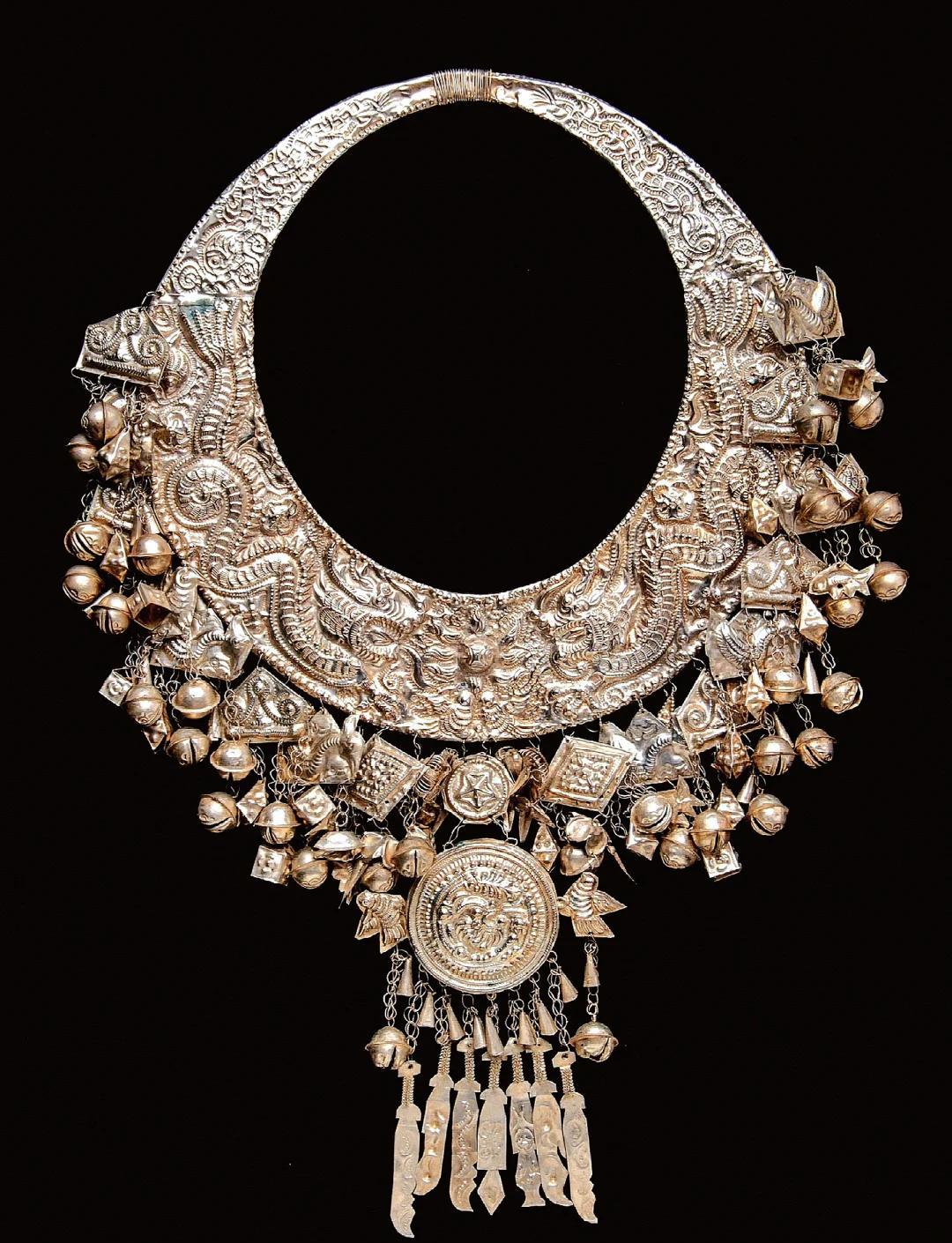
No account of the Miao can proceed far without confronting the silver. In a culture that historically lacked a written script, silver became a store of meaning as well as wealth. A Miao woman's full festival regalia may incorporate ten to fifteen kilograms of silver — a staggering physical burden that transforms the body into a walking treasury and a sculptural monument.
The centerpiece is the headdress: great curving horns of hammered silver, sometimes rising half a meter above the head, adorned with dangling butterflies, birds, and floral clusters that tremble with every step. Below, a broad chest plate — the yinluo — covers the torso in repoussé dragons and phoenixes. Chains, bangles, hairpins, and ear pendants complete the constellation. The total effect, catching sunlight on a festival ground, is almost unbearable in its radiance.
The symbolism is layered. Silver wards off evil spirits, its brightness a shield against the unseen. It announces a family's prosperity and the skill of its smiths. It is beauty made material, the physical form of a mother's love for her daughter — for a Miao family will save for years, even generations, to assemble a daughter's wedding silver. The craft of silversmithing is passed through families, traditionally from father to son, and the great smithing villages of Guizhou — Shidong, Kongbai — guard techniques of chasing, filigree, and granulation that rival any European goldsmith's art.
Embroidery as Scripture
If silver is the Miao's public proclamation, embroidery is their private scripture. Miao needlework is among the most technically accomplished textile traditions on earth, employing cross-stitch, satin stitch, counted-thread work, and appliqué in compositions of extraordinary density and symbolic precision.
The patterns are not decorative in any idle sense. They are a non-written historical record. The spiral motifs encode the routes of ancient migrations. The geometric borders represent the rivers and mountains crossed by ancestors. The celebrated Butterfly Mother — Mais Bangx Mais Lief — appears again and again: the primordial being who, in Miao cosmology, laid the twelve eggs from which all living things hatched, including the first human ancestors. To embroider the Butterfly Mother is to recite a creation narrative in thread.
A single festival skirt may require a year or more of daily stitching. The indigo-dyed cotton is worked so densely that the fabric becomes almost rigid, a textile armor of memory. In 2006, Miao embroidery was inscribed on China's national list of intangible cultural heritage, and UNESCO has recognized its global significance. Yet for the women who stitch by lamplight in the villages above Xijiang, the work needs no institutional validation. It is prayer, diary, and inheritance, all at once.
Festivals: Lusheng, Bullfighting, and Sister's Meal
The Miao ceremonial calendar is dense with festivals, each tied to agricultural rhythms, ancestral veneration, and the social architecture of courtship and community. The Miao New Year, celebrated in October or November after the rice harvest, is the grandest occasion: days of feasting, lusheng music, and the great silver processions that draw thousands.
The lusheng itself — a mouth-blown free-reed pipe instrument, played in ensembles of varying sizes — is inseparable from Miao identity. The Lusheng Dance, performed in spiraling circles on the festival ground, is both musical performance and communal choreography, the dancers' feet stamping patterns that echo the geometry of their embroidery.
Bullfighting festivals, held in spring and autumn, pit village against village in contests that are as much social theater as sport. The bulls are adorned with red cloth and fed rice wine before the contest; the winning village celebrates for days. The Sister's Meal Festival, held in the third lunar month, is essentially a courtship ritual: young women prepare elaborate baskets of colored glutinous rice and offer them to young men they admire. Hidden within the rice are tokens — a pine needle means yes, a garlic clove means no — and the whole village watches, gossips, and celebrates the negotiations of the heart.
The Drum Festival, observed on a cycle of thirteen years in some communities, is the most sacred of all: a multi-day ceremony honoring the ancestral drum, the vessel in which the spirits of the dead reside. Outsiders are rarely permitted to witness its innermost rites.
The Miao Today
The Miao world is changing, as all worlds must. The great terraced villages that once existed in near-isolation are now connected by paved roads and high-speed internet. Xijiang Qianhu Miao Village — the largest Miao settlement in China, with over a thousand households cascading down two hillsides — receives millions of tourists annually. Its wooden stilted houses and evening lantern displays have become iconic, but the commercialization brings tension: are the festivals performed for the ancestors, or for the ticket-buying crowds?
Young Miao navigate a complex negotiation. Many leave the villages for factory work or university in Guiyang, Guangzhou, or Shanghai. Yet there is a visible revival of cultural pride among the younger generation — a reclaiming of traditional dress not as costume but as identity, a resurgence of interest in silversmithing and embroidery as both art form and livelihood. Social media has become an unlikely ally: Miao creators on Douyin and Xiaohongshu showcase festival dress to audiences of millions, and the comment sections overflow with admiration and curiosity.
The Miao have survived two thousand years of displacement, assimilation pressure, and upheaval. They have done so not by building walls or writing manifestos, but by singing, stitching, and hammering silver into shapes that remember. In the mountains of Guizhou, when the mist lifts and the lusheng sounds, the old roads still lead somewhere. The ancestors are still walking. And their descendants, glittering in silver, walk with them.