Dawn breaks slowly at four thousand meters. The first light does not flood the valley so much as seep into it, gilding the upper windows of the monastery while the lower courtyards still swim in blue shadow. Inside the assembly hall, a monk in maroon robes strikes a match and touches it to the wick of a butter lamp. Then another. Then a hundred more, until the darkness is colonized by a constellation of small golden flames that make the painted faces of the buddhas seem to breathe. Outside, prayer flags — blue, white, red, green, yellow — snap and flutter in a wind so cold it feels architectural, as though it were building something invisible against the mountainside. The air is thin. Each breath is a small negotiation. And in this thinness, this luminous austerity, an entire civilization has flourished for over a thousand years.
This is the Tibetan plateau, and the people who call it home have built one of humanity's most remarkable adaptations to an environment that should, by all rights, be nearly uninhabitable. To understand the Tibetans is to understand what happens when a culture does not merely survive at the extremes of altitude and climate, but finds in those extremes a source of spiritual meaning, artistic beauty, and communal strength.
Who Are the Tibetans?
The Tibetan people number approximately seven million, the vast majority living within the borders of China. While the Tibet Autonomous Region is the cultural and political heartland, significant Tibetan populations inhabit the provinces of Qinghai, Sichuan, Gansu, and Yunnan — regions historically known as Kham and Amdo, which together with U-Tsang form the traditional three provinces of the Tibetan world.
The Tibetan language belongs to the Tibeto-Burman family and exists in numerous regional dialects, some mutually unintelligible, though the written literary language — codified in the seventh century — provides a unifying thread across the plateau. It is a language of extraordinary precision, capable of rendering the subtlest philosophical distinctions of Buddhist metaphysics.
Perhaps most remarkably, Tibetans possess genetic adaptations to high altitude that distinguish them from lowland populations. Variants in the EPAS1 gene, inherited from ancient Denisovan ancestors, allow Tibetans to thrive in oxygen levels that would leave most visitors gasping and incapacitated. Where a lowlander's body overproduces red blood cells at altitude — thickening the blood dangerously — the Tibetan body maintains a lean, efficient oxygen transport. This is not acclimatization. This is evolution, written in the blood over thousands of years.
A Civilization Shaped by Altitude
Every element of traditional Tibetan culture bears the imprint of the plateau environment. At an average elevation exceeding four thousand meters, with winters that plunge to minus thirty and a growing season measured in weeks rather than months, the Tibetan world demands a particular ingenuity from its inhabitants. Nothing is wasted. Nothing is frivolous. Every object, every practice, every architectural choice answers to the logic of survival at the roof of the world.
The yak is the foundation upon which this civilization rests. The great shaggy bovine provides butter for lamps and tea, meat for winter sustenance, wool for tents and rope, dung for fuel in a landscape almost entirely devoid of trees, and the physical labor of transport across passes that would defeat any wheeled vehicle. A Tibetan family's wealth was traditionally measured in yaks, and the animal remains central to pastoral life across the plateau.
Where the land permits cultivation — in the river valleys of the Yarlung Tsangpo and its tributaries — barley reigns supreme. Roasted and ground into tsampa, it becomes the staple food: mixed with butter tea, rolled into balls by hand, carried in leather pouches on long journeys. Tsampa requires no cooking, no refrigeration, no preparation beyond the mixing of fingers. It is the perfect food for a people who move between pasture and field, between seasons, between worlds.
Tibetan architecture answers the same environmental logic. Walls of rammed earth or cut stone rise thick as a man's arm-span, tapering inward as they ascend — a form both structurally sound and visually monumental. Flat roofs shed the sparse rainfall while providing drying space for barley and dung fuel. Windows are small and deep-set, minimizing heat loss. The great monasteries — Drepung, Sera, Tashilhunpo — are essentially cities built to this grammar, their white and ochre walls climbing hillsides like geological formations.
Dress of the High Plateau
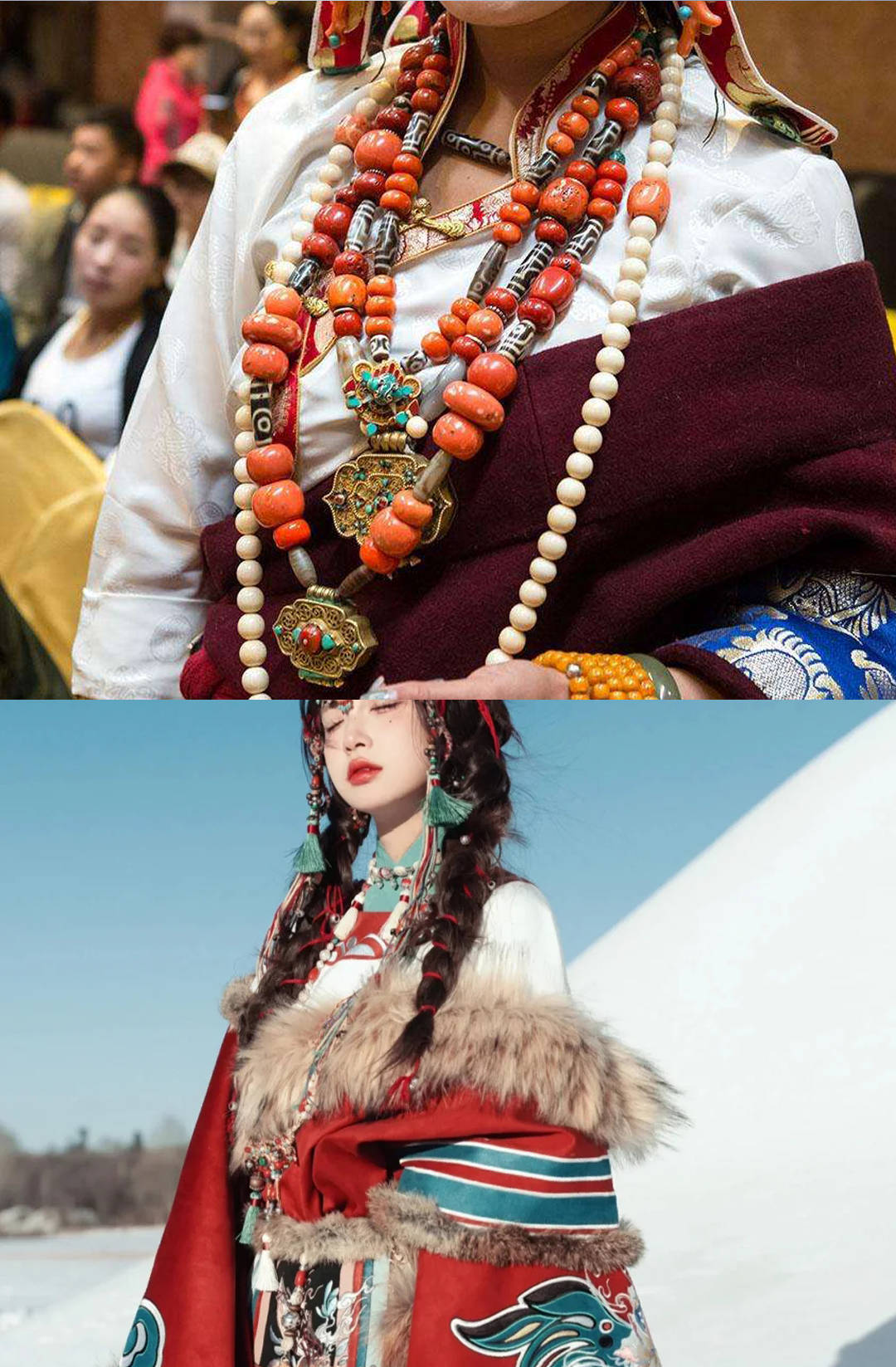
Tibetan clothing is engineered for a climate that can deliver all four seasons in a single day. The fundamental garment is the chuba — a long, full-bodied robe that wraps around the torso and is belted at the waist, creating a voluminous pouch at the chest where one may carry anything from a baby to a bowl of tsampa. In the warmth of midday sun, the chuba is worn with one arm freed, the sleeve hanging empty behind the shoulder. As evening cold descends, the arm returns. The garment is thermostat and wardrobe in one.
Women's dress adds the pangden — a striped apron of woven wool in bold horizontal bands of color, tied over the chuba at the waist. The pangden is instantly recognizable, a signature of married women in central Tibet, its colors varying by region and occasion. In Lhasa, the stripes tend toward refined combinations; in Kham, they blaze with primary intensity.
Jewelry carries both aesthetic and spiritual weight. Coral — imported historically from the Mediterranean through ancient trade routes — signifies life force and protection. Turquoise, the sacred stone of Tibet, represents the sky and the waters. Amber, silver, and gold complete the vocabulary. A Kham woman's festival headdress, festooned with strings of coral and turquoise, may represent a family's accumulated wealth across generations, worn literally on the head as a crown of inheritance.
Regional variation is pronounced. The Lhasa style favors elegance and restraint — fine fabrics, subtle colors, the aristocratic bearing of the old capital. Kham dress is bolder, more martial: men wear their hair in a single great braid wound with red cord, their chubas trimmed with leopard or otter fur, their knives prominent at the belt. Amdo, in the northeast, blends Tibetan and Mongol influences in its felt hats and broader silhouettes.
Tibetan Buddhism: The Heart of Everything
To speak of Tibetan culture without speaking of Buddhism is to describe a body without its heart. Since the religion's second dissemination in the eleventh century, Tibetan Buddhism has permeated every stratum of life — art, medicine, architecture, governance, agriculture, death, and the daily rhythm of hours. It is not a compartment of existence but the medium in which existence occurs.
The monastery system was, for centuries, the organizing institution of Tibetan society. At its peak, roughly one in five Tibetan males was a monk. The great Gelugpa monasteries around Lhasa housed tens of thousands of scholars engaged in a curriculum of logic, metaphysics, and meditation that could span two decades. The sound of debate — monks clapping their hands as they challenge one another's philosophical positions — remains the soundtrack of Sera and Drepung to this day.
Devotion expresses itself in countless physical forms. The mani wheel — a cylinder inscribed with the mantra Om Mani Padme Hum, spun by hand or by water or by wind — sends prayers into the world with each rotation. Mani stones, carved with the same mantra, line paths and pile into cairns at passes. Pilgrims circumambulate sacred sites — the Potala, Mount Kailash — in circuits that may take weeks, some performing full prostrations, measuring the entire route with the length of their bodies.
The sky burial — in which the deceased is offered to vultures on a mountaintop — embodies the Buddhist teaching of impermanence and the generosity of the bodhisattva. The body, emptied of consciousness, is returned to the elements. Nothing is clung to. Nothing is wasted. Even in death, the logic of the plateau prevails.
The tradition divides into four major schools: the Gelug (Yellow Hats), the largest and most politically prominent; the Nyingma (Ancient Ones), guardians of the earliest transmissions; the Kagyu, emphasizing meditation and the lineage of oral instruction; and the Sakya, renowned for its scholarly tradition. Each maintains its own monasteries, practices, and lineages of reincarnate teachers, the most globally recognized being the Dalai Lama of the Gelug tradition and the Panchen Lama.
Festivals of Faith and Season
The Tibetan ceremonial year is a procession of festivals that mark both spiritual observances and the turning of the seasons. Losar, the Tibetan New Year, arrives in February or March with three days of household ritual: the cleaning of homes, the preparation of guthuk noodle soup containing hidden omens, the driving out of the old year's negativity with torchlight and noise. Monasteries perform elaborate cham dances — masked dramas in which wrathful deities trample the forces of ignorance.
The Shoton Festival, held in summer, was originally a retreat-ending celebration when laypeople offered yogurt to monks completing their summer meditation. It has evolved into a grand public spectacle: at Drepung Monastery, a giant thangka — a silk appliqué image of the Buddha, thirty meters tall — is unfurled down the hillside at dawn, visible to tens of thousands of pilgrims below. In Lhasa, the Norbulingka gardens fill with families picnicking beneath poplars while Tibetan opera troupes perform epics that last entire days.
Saga Dawa, commemorating the birth, enlightenment, and death of the Buddha, transforms the fourth lunar month into a period of intensified merit-making. Pilgrimage circuits overflow. Animals are purchased from butchers and released. The butter lamp festival of the fifteenth day fills monastery courtyards with sculptural offerings of colored butter — flowers, deities, mandalas — that melt tragically in the sun, embodying the very impermanence they celebrate.
In Kham, the horse racing festivals of summer — at Litang, Yushu, Nagqu — unleash a different energy. Riders in festival dress thunder across the grasslands; archery, wrestling, and endurance races test the martial traditions of a region that has always prized the warrior alongside the monk. The contrast with the contemplative stillness of a Lhasa monastery could not be starker, yet both are authentically, irreducibly Tibetan.
"If you want others to be happy, practice compassion. If you want to be happy, practice compassion."
— Tibetan proverb, attributed to the Buddhist tradition of the plateau
The Tibetan World Today
The Tibetan plateau is no longer the sealed world it was a century ago. The Qinghai-Tibet Railway, completed in 2006, climbs to over five thousand meters at the Tanggula Pass and delivers travelers from Beijing to Lhasa in under forty-eight hours — a journey that once required months by caravan and carried genuine risk of death. Highways now thread every prefecture. Smartphones glow in nomad tents. The plateau is connected.
Urbanization has transformed Lhasa from a monastic city of modest size into a regional capital of concrete and glass, its population swelling with migrants and its economy increasingly oriented toward tourism. The Potala Palace receives millions of visitors annually; the Barkhor circuit, once the exclusive domain of pilgrims, now shares its flagstones with souvenir vendors and selfie sticks. The tension between preservation and development is palpable and unresolved.
Yet the culture persists with remarkable tenacity. Monastic education continues, albeit in changed circumstances. The Tibetan language is taught in schools, and a vigorous literary tradition — poetry, fiction, essay — thrives in both Tibetan and Chinese. Young Tibetans navigate multiple identities: plateau and city, monastery and university, prayer wheel and smartphone. Many speak of a conscious choice to maintain practice — to spin the mani wheel on the morning commute, to observe Saga Dawa even in a Chengdu apartment.
The global Tibetan diaspora, centered in Dharamsala, India, maintains its own institutions of learning and culture, creating a parallel stream of Tibetan civilization beyond the plateau's borders. Between the two streams — the homeland and the diaspora — the tradition continues to evolve, to argue with itself, to adapt. The butter lamps still burn. The prayer flags still fray and are replaced. The wind still carries the mantra across the passes, thinning it, spreading it, sending it everywhere at once.
At four thousand meters, the air holds less of everything — less oxygen, less warmth, less margin for error. And perhaps this is why the civilization that grew here holds more of everything else: more devotion, more color, more sound, more silence. The Tibetans did not conquer the plateau. They listened to it. And in listening, they built a world that the lowlands have never ceased to marvel at.