In the late afternoon, when the sun drops low enough to send long amber shadows across the mudbrick walls of the old city, a sound rises from an inner courtyard in Kashgar: the bright, plucked cascade of a rawap lute, its five steel strings ringing in rapid arpeggios. Beneath it, the steady pulse of a dap frame drum. Above it, a voice — a man's voice, unhurried, ornamented with quarter-tone melismas that curl like smoke. The smell of naan baking in a tandoor drifts over the wall, dense and yeasty, mingling with the sharper scent of cumin and charcoal from a kebab stall at the lane's end. A child runs past, slapping a pomegranate against the ground to split it open. An old man in a white doppa sits on a low bench, pouring tea from a brass pot into a small bowl, pouring it back, pouring it again — the three pourings that cool the tea and honor the guest who has not yet arrived but certainly will.
This is the world the Silk Road built. And the Uyghurs are its living heirs.
Who Are the Uyghurs?
China's Uyghur population numbers approximately eleven million, the vast majority concentrated in the Xinjiang Uyghur Autonomous Region — a territory of 1.6 million square kilometers in China's far northwest, larger than France, Germany, and Spain combined. Smaller Uyghur communities exist in Hunan, Henan, and Beijing, descendants of historical migrations and modern professional relocation.
The Uyghur language belongs to the Turkic family, specifically the Karluk branch, making it a close relative of Uzbek. It is written in a Perso-Arabic script — right to left, with additional letters to accommodate Turkic vowels — and has served as a literary language for over a millennium. Uyghur poetry, historiography, and religious literature constitute one of the richest written traditions in Central Asia.
What distinguishes the Uyghurs from other Turkic peoples is their geography: they are an oasis civilization. Unlike the nomadic Kazakhs and Kyrgyz of the northern steppe, the Uyghurs settled centuries ago in the string of oasis cities that fringe the Taklamakan Desert — Kashgar, Yarkand, Hotan, Aksu, Kucha, Turpan, Urumqi. Each oasis is a world unto itself, fed by snowmelt from the Tianshan and Kunlun mountains, surrounded by desert on all sides. This geography produced a civilization of traders, farmers, craftsmen, and scholars: people who grew grapes and cotton, who wove silk and hammered copper, who welcomed caravans from Samarkand and Chang'an and absorbed something from each.
They sit, in the deepest sense, at a crossroads. Uyghur culture is a palimpsest of Chinese, Persian, Indian, Turkic, and — historically — Buddhist and Manichaean influences, layered over two thousand years of contact and exchange. To encounter Uyghur music, food, architecture, or dress is to encounter the Silk Road not as a historical abstraction but as a living, breathing, daily reality.
Silk Road Legacy
The Uyghurs' historical roots stretch back to the Uyghur Khaganate of the eighth and ninth centuries — a powerful steppe empire based in what is now Mongolia, which adopted Manichaeism as its state religion and maintained diplomatic relations with Tang Dynasty China. When the Khaganate collapsed in 840 CE, the Uyghurs migrated southwest into the Tarim Basin, where they merged with the existing Indo-European-speaking oasis populations and gradually adopted Islam between the tenth and sixteenth centuries.
This transition — from Manichaean and Buddhist steppe empire to Islamic oasis civilization — is one of the great cultural transformations of Central Asian history. The Buddhist cave temples of Kucha and Bezeklik, with their vivid murals of donors and bodhisattvas, stand as monuments to the pre-Islamic era. The great mosques of Kashgar and Hotan mark the later chapter. Both belong to the Uyghur inheritance; neither can be understood without the other.
The trading culture that defined the Silk Road persisted in Uyghur life long after the overland routes declined. The bazaar — the grand bazaar of Kashgar, the Sunday market of Hotan — remained the economic and social heart of every oasis city. Here, Uyghur merchants traded jade, silk, dried fruits, carpets, and medicinal herbs with partners from across Central and South Asia. The caravanserai tradition — the walled roadside inn where merchants lodged their animals, stored their goods, and exchanged news — shaped Uyghur hospitality into a sacred obligation. A traveler who arrives at your door is not a stranger. He is a guest sent by God, and his comfort is your honor.
The Twelve Muqam: A Musical Universe
"Where there is music, there is no stranger. Where there is a guest, there must be music."
— Uyghur proverb
The Twelve Muqam is not merely a musical tradition. It is a complete cosmological system expressed in sound — a vast, integrated suite of songs, instrumental pieces, and dances organized into twelve modal cycles, each containing between twenty and thirty individual movements. A full performance of all twelve muqams takes over twenty-four hours. The repertoire encompasses more than 360 distinct melodies and draws on a poetic corpus that spans centuries, incorporating verses by the great Uyghur poets Nizari, Lutpi, and Navai alongside anonymous folk lyrics.
UNESCO proclaimed the Uyghur Muqam of Xinjiang a Masterpiece of the Oral and Intangible Heritage of Humanity in 2005, recognizing it as one of the most comprehensive musical systems in the world. Each muqam follows a tripartite structure: an unmetered vocal introduction (mukaddima), a suite of named songs and instrumental interludes (dastan), and a concluding section of dance rhythms (mashrap) that accelerates toward an ecstatic climax.
The instruments of the muqam are themselves a Silk Road anthology. The rawap — a long-necked lute with a resonating body carved from mulberry wood and covered in snake or fish skin — provides the melodic backbone. The dutar, a two-stringed lute with a pear-shaped body, adds warmth and counter-melody. The satar, a bowed lute with sympathetic strings, produces the keening, vocal-like tones that give the muqam its emotional intensity. The dap — a large frame drum with metal ring jingles — drives the rhythmic structure, its patterns growing more complex and urgent as each movement builds.
The muqam is not a museum piece. It is performed at weddings, at harvest celebrations, at the meshrep gatherings that structure community life. Master performers — muqamchi — train for decades, memorizing the melodic and rhythmic structures through oral transmission. The tradition is regional: the Kashgar muqam differs in mood and ornamentation from the Turpan muqam, which differs again from the Hotan tradition. Each oasis has its own voice within the universal framework.
Dress, Dance, and the Art of Celebration
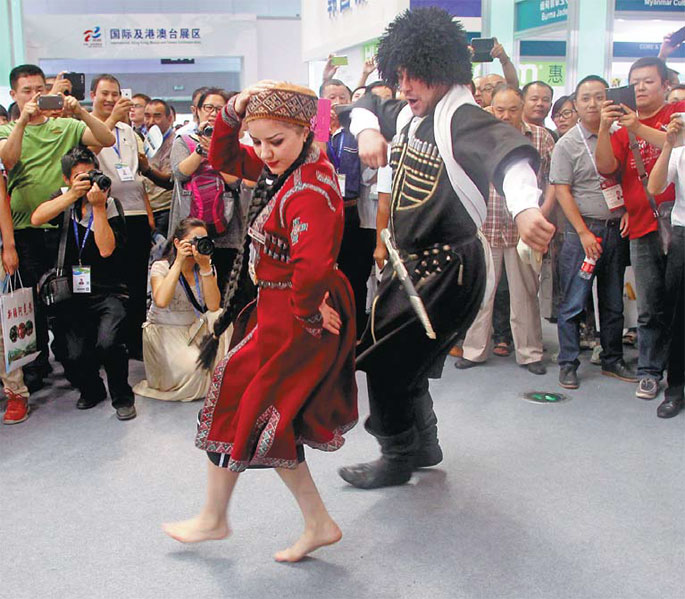
The doppa — the embroidered skullcap worn by Uyghur men and women alike — is the most immediate marker of Uyghur identity. Square or round, with a flat or slightly peaked crown, the doppa is embroidered in silk thread with geometric, floral, or calligraphic motifs, and its specific pattern identifies the wearer's home region. The Kashgar doppa features bold white almond-shaped motifs on a black ground. The Hotan doppa is denser, more floral. The Turpan doppa blazes with red and gold. To remove a man's doppa is a grave insult; to gift one is a mark of deep respect.
Women's ceremonial dress centers on the atlas silk — a vibrant, ikat-dyed fabric in which the warp threads are resist-dyed before weaving, producing a characteristic blurred-edge pattern in jewel tones: emerald, sapphire, fuchsia, gold. An atlas silk dress, full-skirted and fitted at the bodice, worn with a matching headscarf and gold jewelry, is the standard attire for weddings, festivals, and any occasion that calls for beauty. The fabric is produced in Hotan and Yarkand using techniques unchanged for centuries, the dyers' hands permanently stained with indigo and pomegranate rind.
Uyghur dance is inseparable from music. The solo dance — typically performed by a woman at a gathering or celebration — is characterized by rapid wrist rotations, expressive hand gestures, sharp head turns, and a spinning finale that sends the atlas skirt flaring into a disc of color. The dancer's eyes are as active as her hands: wide, bright, locking with the audience, then darting away. Male dancing is more acrobatic, incorporating leaps, shoulder isolations, and deep knee bends. At a wedding, the dance floor never empties; guests take turns in the center of the circle while others clap, sing, and ululate from the periphery.
The meshrep is the institutional form of this celebratory culture. A meshrep is a community gathering — traditionally male, though modern forms include women and children — that combines music, dance, poetry recitation, games, and moral instruction. A meshrep has a designated "judge" who imposes playful penalties on those who violate social norms: the man who has neglected his neighbors, the youth who has shown disrespect to elders. The penalties are theatrical and humorous — the offender must sing, dance, or submit to gentle public mockery. The meshrep is, in essence, a court of social conscience disguised as a party, and its function as a mechanism of community cohesion and moral education has been recognized by UNESCO as an Intangible Cultural Heritage in need of urgent safeguarding.
The Table: Uyghur Cuisine
To sit at a Uyghur table is to understand, in the most immediate and pleasurable way, what the Silk Road meant. The cuisine is a synthesis of Turkic, Persian, Chinese, and Central Asian traditions, filtered through the specific agriculture of the Tarim oases: wheat, rice, lamb, grapes, melons, peppers, cumin, and the incomparable naan bread that anchors every meal.
Polo — the Uyghur pilaf — is the ceremonial dish par excellence. Long-grain rice is cooked in a vast iron cauldron with rendered lamb fat, shredded carrots (yellow and orange), whole heads of garlic, and chunks of bone-in mutton, the whole layered and steamed until the rice is fluffy, golden, and saturated with meat juices. Polo is the dish of weddings, of Eid, of honoring a guest. It is served on a communal platter, and the host places the choicest pieces of meat before the most honored visitor with his own hands.
Laghman — hand-pulled noodles served with a stir-fried sauce of lamb, peppers, tomatoes, celery, and vinegar — represents the Chinese-Uyghur synthesis at its most delicious. The noodles are pulled and stretched by hand, each strand elastic and chewy, and the dish exists in dozens of regional variations: soupy or dry, spicy or mild, with or without the distinctive Uyghur black vinegar. A bowl of laghman is lunch, dinner, and comfort, all at once.
Samsa — flaky, oven-baked buns stuffed with minced lamb, onion, and black pepper — emerge from tandoor ovens in every bazaar, their golden crusts sprinkled with sesame and nigella seeds. The naan comes in over fifty varieties: thick and dimpled, thin and crisp, studded with onion, glazed with egg, shaped into rings or braids. A Uyghur meal without naan is inconceivable; to waste naan is to commit a minor sin.
Kebabs — kawap — are the street food of the oasis: cubes of lamb tail-fat and lean meat threaded on flat iron skewers, grilled over charcoal, and dusted with cumin, chili flakes, and salt. The smoke of a thousand kebab stalls is the incense of Uyghur urban life. And tea — green tea, usually, or the brick-tea boiled with milk and salt in the pastoral tradition — flows without ceasing, poured and repoured in the three-pouring ritual that cools the liquid and warms the relationship.
Uyghur Culture Today
The old city of Kashgar — the labyrinth of mudbrick lanes, carved wooden balconies, and hidden courtyards that was, until recently, one of the best-preserved Islamic urban landscapes in Central Asia — has undergone dramatic transformation. Large sections have been rebuilt or redeveloped, and the tension between preservation and modernization is visible in every street: a newly paved road beside a crumbling caravanserai, a glass-fronted shop selling smartphones next to a coppersmith hammering trays by hand.
Yet the culture persists with remarkable vitality. The grape harvest festivals of Turpan still draw the entire community into the vineyards, where families pick, dry, and celebrate the annual crop of seedless green grapes that have been the oasis's signature product for centuries. The Sunday livestock market of Kashgar still thunders with the sound of ten thousand animals and the shouted negotiations of traders. The muqam still sounds in wedding halls. The doppa still sits on every head. The tandoor still bakes at dawn.
Traditional crafts maintain their practitioners: the jade-carvers of Hotan, the silk-weavers of Yarkand, the knife-makers of Yengisar, the carpet-knotters of Kashgar. These are not tourist performances but living trades, their products used daily in Uyghur homes. A hand-forged Yengisar knife — its blade inlaid with brass, its handle carved from bone or horn — is still the standard gift from a father to a son, a tool and an heirloom in one.
The Uyghur diaspora — communities in Kazakhstan, Kyrgyzstan, Turkey, Germany, and beyond — carries the culture outward, maintaining language schools, publishing literature, performing the muqam, and cooking polo in kitchens far from the Taklamakan. The diaspora's longing for the homeland is expressed in music, in poetry, and in the particular way a grandmother teaches her grandchild to fold a samsa, pressing the dough with the same motion her own grandmother used in a courtyard in Kashgar, under a sky so blue it seemed eternal.
The Uyghurs have always lived at the intersection of worlds. Their music holds the modes of Persia and the rhythms of the steppe. Their food marries the wok and the tandoor. Their language is Turkic, their script Arabic, their poetry Persianate, their homeland Chinese. To reduce them to any single category is to misunderstand them entirely. They are the synthesis itself — the living proof that the Silk Road was never merely a trade route. It was a conversation. And the Uyghurs are still speaking.