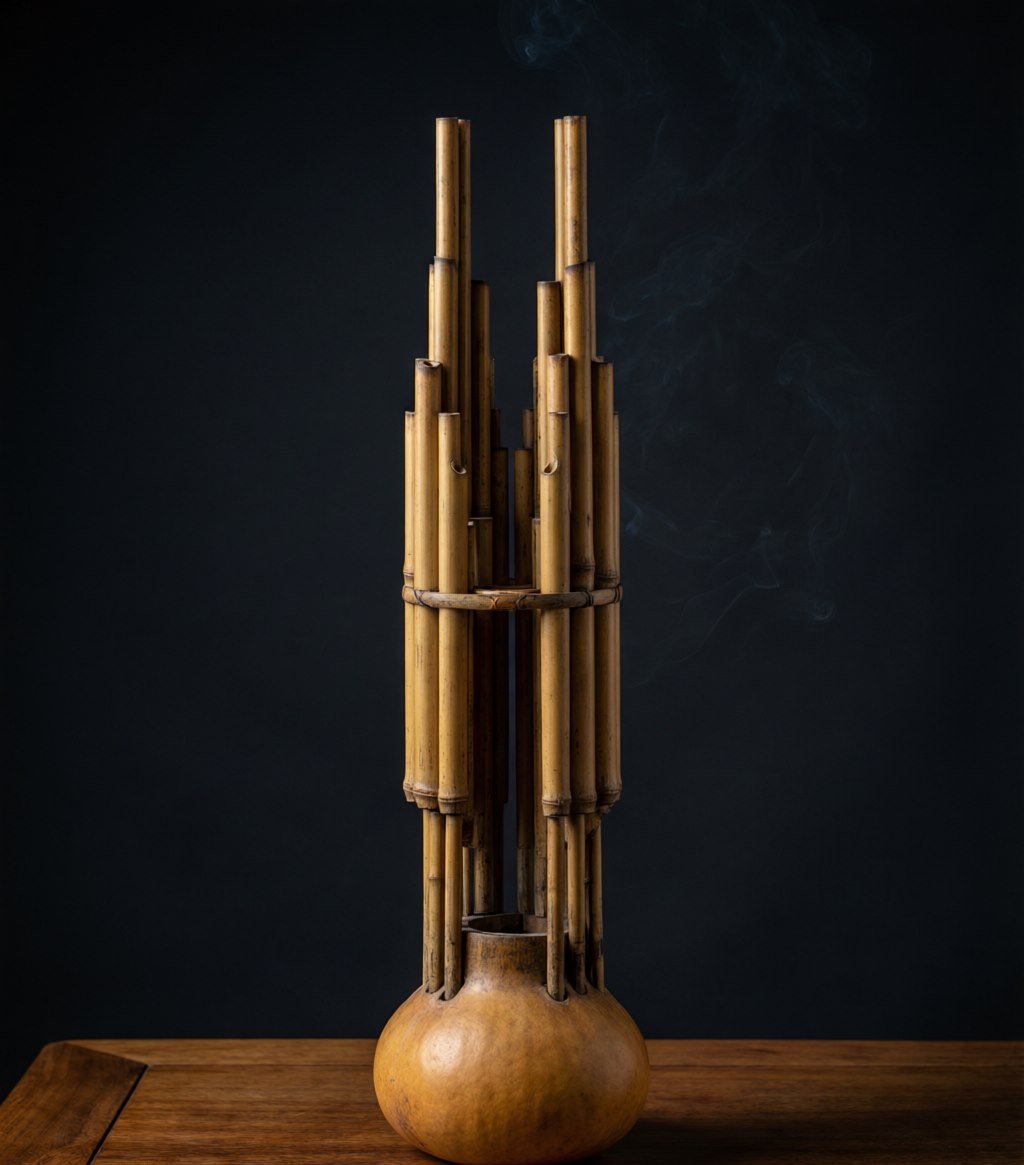
Hold a sheng (笙, shēng) up to the light and you are holding something close to the beginning of music itself. It is a mouth organ: a rounded wind chamber from which a cluster of vertical pipes rises like a small bundle of reeds, or — as the Chinese have always seen it — like the folded wings of a phoenix. Blow into it and several notes sound at once, a soft, reedy, organ-like chord that seems to come from nowhere and fill the room with warm air. The sheng is more than three thousand years old. It is among the oldest continuously played instruments on earth. And it holds a distinction that few instruments anywhere can claim: it was almost certainly the first instrument in human history to play harmony — to sound two or more notes together as a deliberate musical act. Long before Europe discovered chords, the sheng was already breathing them.
Three Thousand Years, and Older Still
The sheng's antiquity is not a matter of legend alone. References to the instrument appear in the Book of Songs (诗经), the great anthology of Zhou-dynasty poetry compiled between roughly the eleventh and seventh centuries BCE, where the sheng is already an established presence at feasts and gatherings: "I have guests; I play the sheng and the huang." Archaeological finds confirm the picture: sheng-like instruments have been recovered from tombs more than two thousand years old, their pipes and reeds preserved well enough to reveal the working principle. By the time of the early dynasties the sheng was a mature instrument with a long history behind it, which means its true origins lie further back still, in the mists of the second millennium BCE or earlier.
Mythology, as usual, pushes the date back further than archaeology dares. The sheng is traditionally attributed to Nüwa (女娲), the goddess who molded humanity from clay and repaired the broken sky — a fitting inventor for an instrument so associated with breath, life, and the harmonizing of separate voices into one. Whatever the truth of that attribution, the sheng's place in the Chinese imagination is fixed: it is the sound of antiquity, of ritual, of the oldest China. In the traditional classification of instruments by the material that produces their sound — the eight categories called bayin (八音), metal, stone, silk, bamboo, gourd, clay, leather, and wood — the sheng belongs to the gourd (匏, pao), because its original wind chamber was made from a dried gourd. It is the representative of that whole category, the voice of the gourd among the eight sounds.
The Phoenix in the Player's Hands
The sheng's construction is as elegant as its history is long. The instrument consists of three parts: a wind chamber (the dou, 斗), a set of pipes, and a mouthpiece through which the player blows and draws breath. In the ancient instrument the wind chamber was a gourd; in later and modern versions it is more often of wood or metal, sometimes lacquered, sometimes fitted with a curved metal mouthpiece. From this chamber rise the pipes — traditionally of bamboo (竹, zhu), now sometimes of metal — arranged in a symmetrical cluster. The number of pipes has varied across history: seventeen was long standard, while modern concert instruments may have twenty-one, twenty-four, or more, expanding the range and chromatic flexibility.
The arrangement is not random. The pipes are set so that the player's fingers can cover and uncover small holes near the base of each pipe, and the overall silhouette — taller pipes in the center, shorter ones tapering to the sides — was deliberately shaped to suggest a phoenix (凤, feng) with folded wings. The Chinese have always described the sheng in these terms: the pipes are the bird's feathers, the wind chamber its body, the whole instrument a stylized phoenix resting in the player's hands. It is a beautiful image, and it carries meaning: the phoenix is the bird of harmony, of auspicious union, and an instrument shaped like it is an instrument meant to make separate sounds agree.
The Free Reed: A Chinese Gift to the World
The sheng's deepest significance, however, lies not in its shape or its age but in a small, almost invisible component hidden inside each pipe: the free reed. Each pipe contains a thin tongue of metal — historically bamboo, later a copper alloy — cut so that a slender flap can vibrate freely within a frame. When air passes over it, the reed vibrates and produces a fixed pitch. Crucially, the pipe sounds only when a fingerhole is covered, completing the acoustic circuit; uncover the hole and that pipe falls silent. This means the player can select which pipes sound and which do not, and — the revolutionary part — can sound several at once.
This free-reed principle is the sheng's great bequest to world music. For most of its long history the sheng was, so far as we know, the only instrument anywhere to use it. Then, in the eighteenth century, the principle traveled west. European missionaries and traders encountered the sheng in China and carried the idea — and examples of the instrument — back to Europe, where it sparked a revolution in instrument design. The free reed became the basis of a whole family of Western instruments: the harmonium (reed organ), the accordion, the concertina, and the harmonica. Every one of these is, in a technical sense, a descendant of the sheng. When an accordion sounds in a Paris café or a harmonica wails in an American blues, the vibrating reed traces its lineage back more than three thousand years to a Chinese mouth organ shaped like a phoenix.
"The sheng sounds several notes at once, and in doing so taught the world that music could be more than a single line. It is the grandfather of the accordion and the great-uncle of the harmonica."
— A common framing of the sheng's historical importance, crediting its free-reed principle as the ancestor of the Western reed-organ family
How It Is Played: Breathing In and Out
Playing the sheng is unlike playing any other wind instrument, because it sounds on both the in-breath and the out-breath. The player blows and inhales alternately, and the reeds respond in both directions, so that the music need never pause for air. This continuous sound — sustained, unbroken, capable of lasting as long as the player can manage the circular exchange of breath — gives the sheng its distinctive quality: a seamless, organ-like wash of tone that can underpin an ensemble without ever seeming to stop. The effect, in skilled hands, is almost hypnotic, a constant warm chord over which melodies move.
The technique involves covering the fingerholes of the chosen pipes with the fingertips while managing the steady flow of breath through the mouthpiece. Because multiple pipes can sound at once, the player produces chords and drones as a matter of course; traditional sheng playing is built on a vocabulary of intervals and chord clusters — often fourths and fifths, the open harmonies that characterize much early Chinese music — rather than on single-line melody. Modern concert technique has expanded enormously, adding rapid melodic passages, wide leaps, and sophisticated chord voicings, but the foundation remains the ancient one: several notes breathing together, sustained and blended into a single glowing sound.
The Voice of the Court and the Ensemble
For much of its history the sheng was an instrument of ritual and court. It was central to yayue (雅乐), the "elegant music" of the Confucian ceremonial tradition — the solemn, stately music performed at sacrifices, at court audiences, and at the great rites that ordered the relationship between the emperor, heaven, and the ancestors. In this context the sheng's sustained harmonies provided the harmonic bedrock beneath the ritual melodies, its unbroken tone a sonic image of continuity and order. To hear the sheng in yayue was to hear the sound of civilization itself holding together.
Beyond the court, the sheng found a permanent home in the instrumental ensemble. In the silk-and-bamboo (丝竹, sizhu) traditions and in the wind-and-percussion (吹打, chuida) ensembles that play at festivals, weddings, and temple fairs, the sheng supplies the harmony that binds the winds and strings. It pairs naturally with the guan (a double-reed pipe) and the dizi flute, and in many regional traditions the three form the core of the wind section. The sheng's role is once again the unglamorous, essential one: it is the harmonic glue, the sustained chord that makes a group of independent melodic instruments cohere. It is, in this, a spiritual cousin of the yangqin — another instrument whose greatest gift is making others sound better.
Silence, Survival, and Revival
The sheng's modern history mirrors that of much Chinese traditional music: a long centrality, a period of marginalization, and a hard-won revival. In the upheavals of the twentieth century, court ritual music largely disappeared, and the sheng's ancient ceremonial role faded. Yet the instrument survived in folk ensembles, in regional opera, and in the hands of rural players who kept its techniques alive outside the institutions. The mid-twentieth-century project of building a modern Chinese orchestra brought the sheng back into formal prominence: makers developed keyed and expanded versions with greater range and chromatic capability, conservatories established sheng pedagogy, and composers wrote new solo and concerto literature that pushed the instrument far beyond its traditional harmonic vocabulary.
"Three thousand years old, and still breathing. The sheng has outlived every dynasty that played it, and it is not finished yet."
— A reflection on the sheng's survival, from the Zhou-dynasty courts through folk tradition to the modern concert stage
Today the sheng exists in several forms simultaneously. The traditional seventeen-pipe instrument still sounds in folk ensembles and in reconstructions of ancient ritual music. The modern keyed sheng, with its expanded range and even chromatic scale, is a fixture of the Chinese orchestra and a growing presence in contemporary composition, where its unique timbre — at once reedy and mellow, ancient and strangely modern — attracts composers looking for sounds the Western orchestra cannot provide. International performers have carried it onto world stages and into collaborations with Western musicians, completing a circle: the instrument that once gave the West the free reed now returns, in modern form, to play alongside the descendants it inspired.
The Sound of Many Becoming One
Why has the sheng endured for three millennia? Partly because its sound is simply, irreducibly beautiful — that warm, breathing chord, sustained and glowing, unlike anything else in the world's music. Partly because of its structural indispensability: an ensemble with a sheng holds together; an ensemble without one drifts. But there is also something symbolic in the instrument that the Chinese have always recognized and cherished. The sheng takes many separate pipes, many separate notes, and breathes them into a single harmony. It is the musical embodiment of he (和), harmony — the supreme Confucian value, the ideal of different elements combining without losing their distinctness into a greater whole.
To play the sheng is to make that ideal audible. Each pipe keeps its own pitch, its own voice; yet together, breathed by a single player, they become a chord, a unity, a small act of reconciliation among separate things. It is no accident that an instrument shaped like the phoenix — the bird of auspicious union — should be the one that first taught humanity to sound harmony. More than three thousand years after it was first raised to a player's lips, the sheng still breathes. The pipes still glow with that soft, reedy warmth. And the oldest harmony in the world is still, miraculously, in tune.