A Princess at the Edge of the World
In the age before written history, when the world was still young enough to be shaped by the will of gods and the tears of mortals, there lived a princess named Nüwa. She was the youngest daughter of Emperor Yan — the great Shennong, Divine Farmer, he who tasted ten thousand herbs to teach humanity the secrets of medicine and agriculture. In the halls of her father's palace, surrounded by the fragrance of medicinal roots and the murmur of scholars debating the nature of fire, Nüwa grew up wild and restless, her eyes always drawn eastward, toward the place where the rivers ended and the great waters began.
The Eastern Sea called to her the way the horizon calls to all who have never crossed it. It whispered of distances no foot could measure, of depths no eye could fathom. And so, on a morning when the sky was the pale gold of new rice wine, the young princess set out for the shore. She was, by all accounts, joyful that day — laughing at the gulls, racing the foam, gathering shells the color of dawn. She was young. She was the daughter of the most powerful sovereign in the land. Surely the sea would know her name and bow.
The sea did not bow.
Without warning, the waters rose. A storm materialized from nothing — or perhaps from everything, from the accumulated indifference of an ocean that has swallowed ten thousand years of human ambition. The waves closed over Nüwa like a fist. She fought. She screamed her father's name into the salt wind. But the Eastern Sea was older than emperors, older than farmers, older than the first human who cupped water in her palms and drank. It took her without malice, without ceremony, without even the courtesy of returning her body to the shore.
Emperor Yan wept. The court wept. The herbs in the imperial garden wilted, as though they too had tasted grief and found it poisonous. But the sea merely continued, wave after wave, indifferent and eternal.
The Transformation: From Princess to Bird
But the story does not end in the water. In Chinese mythology, death is rarely a conclusion — it is a hinge, a turning point where the soul, refusing to accept its dissolution, reconstitutes itself into something new. And Nüwa's soul refused with a ferocity that startled even the gods.
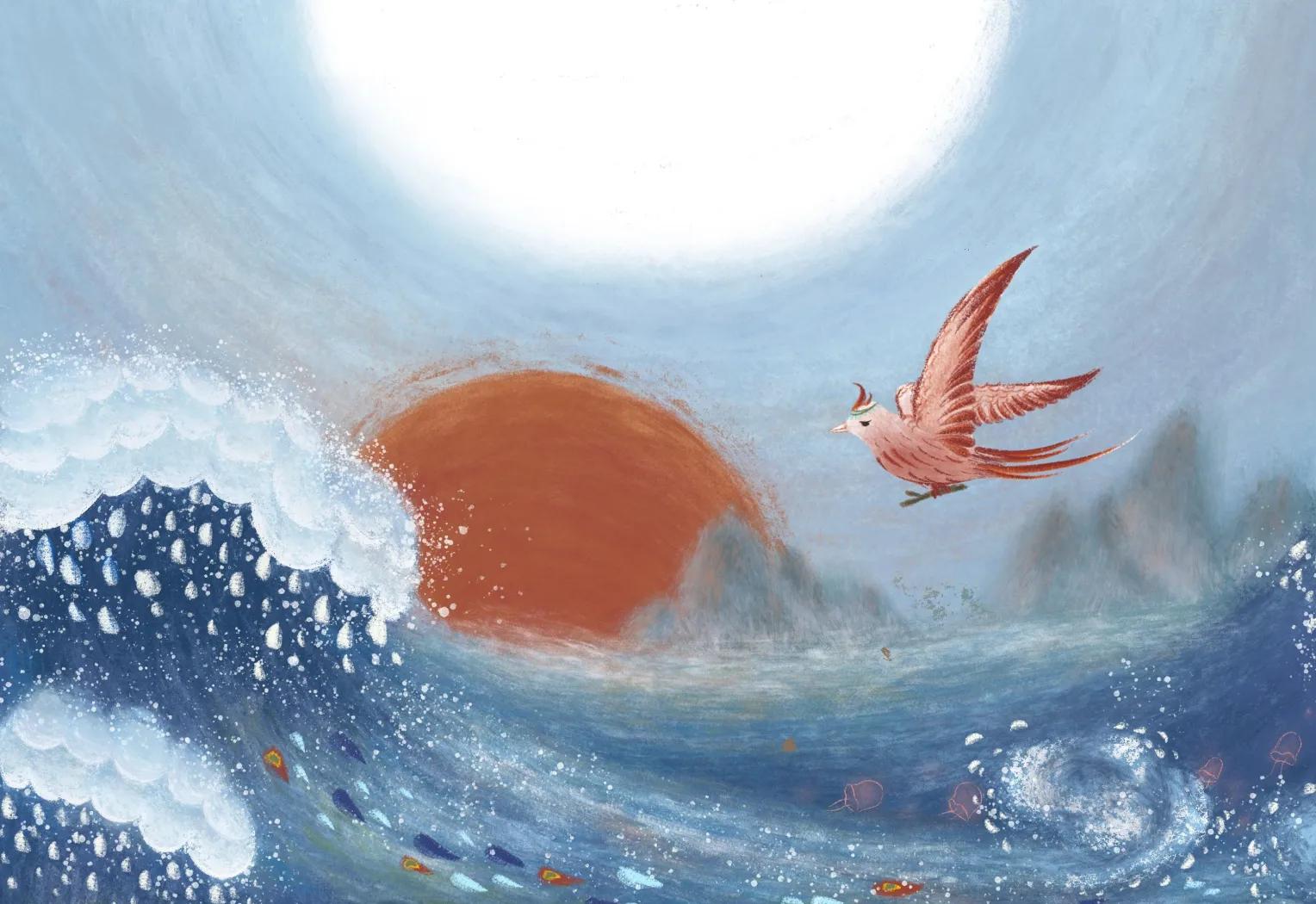
From the foam where she had drowned, a bird emerged. It was small — no larger than a crow — but its appearance was strange and arresting. Its head was patterned with intricate markings, dark and elaborate, like the painted face of an opera singer frozen mid-lament. Its beak was white as bone, as the bleached shells at the tide line, as the face of the drowned. Its feet were red — the deep arterial red of living blood, of rage, of a wound that will not close. 花脑袋、白喋、赤足 — a flowered head, a white beak, crimson feet. The ancient texts record these details with the precision of a naturalist's field guide, as though the bird's very body were a document of grief made visible.
The bird cried its own name. Jingwei. Jingwei. The sound was thin and sharp, like a needle piercing silk, like a child calling for its mother in an empty house. And so the bird came to be known as Jingwei — not a name given by others, but a name she spoke into existence herself, the last syllable of her former identity compressed into a single, endless utterance.
She made her nest on Fajiu Mountain, a peak that rose from the northern reaches like a clenched fist raised against the sky. From there, each morning, she could see the Eastern Sea glittering in the distance — vast, blue, victorious. And each morning, the sight of it filled her with a purpose so absolute, so beyond reason, that it transcended madness and arrived at something closer to holiness.
The Eternal Labor
Jingwei began to carry things to the sea. Pebbles. Twigs. Fragments of shell and dried grass and broken stone. She would fly from Fajiu Mountain to the Western Hills, select her cargo with terrible deliberation, and then make the long flight eastward, the tiny weight clamped in her white beak or gripped in her red feet. And then she would release it over the water and watch it sink — a single grain vanishing into an infinity of blue.
Then she would turn and fly back. And do it again. And again. And again.
The distances were immense. The payload was negligible. The ocean was, by any rational measure, unaffected. A pebble dropped into the Eastern Sea does not raise its level by any amount a human instrument could detect. A twig does not diminish its depth. In ten thousand years, in a million years, in the full lifespan of the sun, Jingwei's labor would not fill even a single tide pool. And yet she did not stop. She did not slow. She did not pause to consider the mathematics of futility. Each flight was an act of war, and she would fight this war forever.
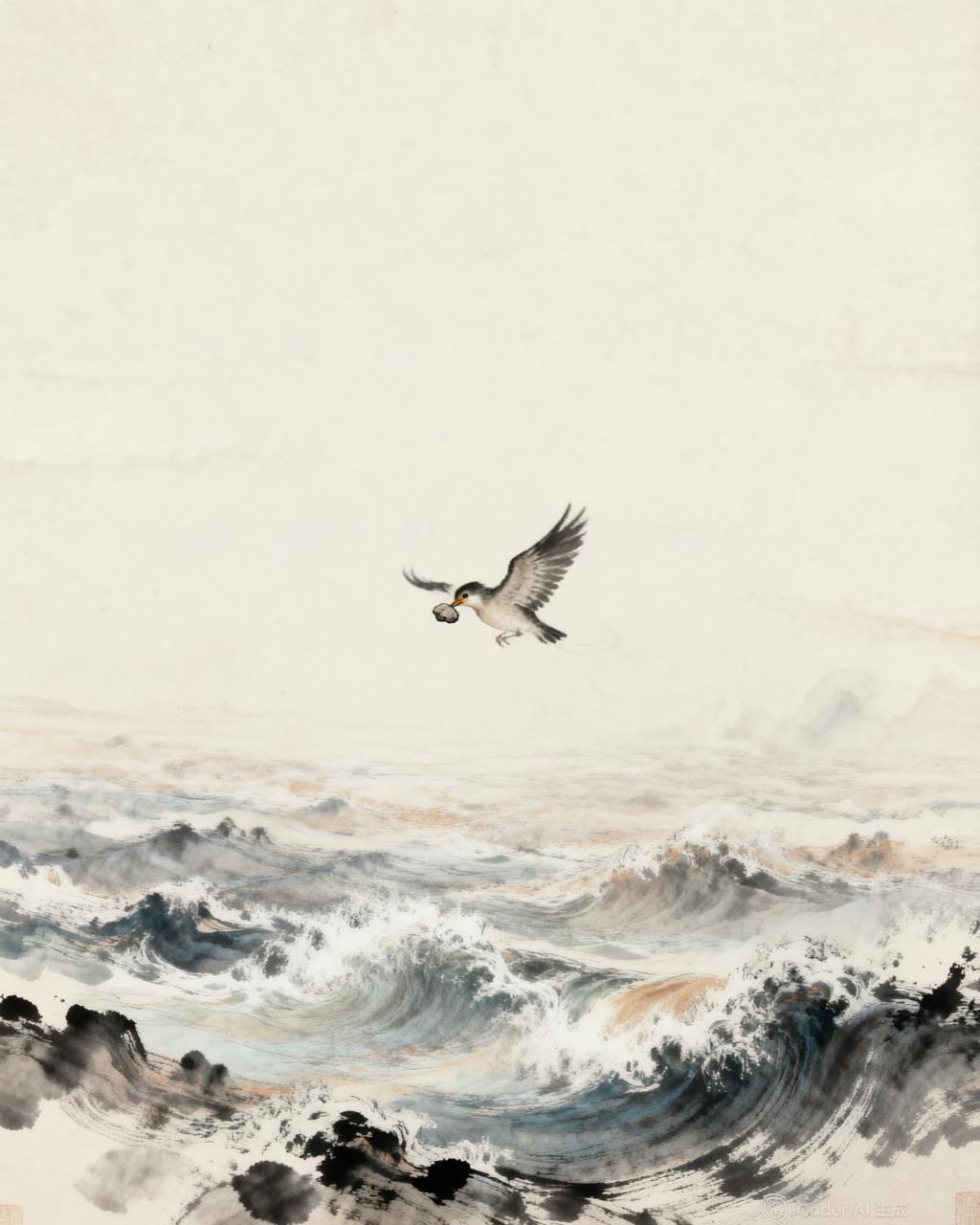
The seasons turned. Dynasties rose and fell in the world of men. Rivers changed their courses. Mountains wore themselves down by imperceptible degrees. And through it all, Jingwei flew. In rain, in snow, in the white silence of winter and the screaming winds of autumn, she flew. Her shadow passed over fishermen who pointed and told their children the story. Her cry echoed off cliff faces where poets sat and wept without knowing why. She became a fixture of the landscape as permanent as the stars — a small, dark shape against the sky, moving always eastward, always carrying, always returning.
The Sea Speaks: A Dialogue of Defiance
In some versions of the tale, the Eastern Sea itself grows weary of Jingwei's persistence and speaks. Its voice is the voice of all tides, all storms, all the accumulated weight of water that has existed since the world's first morning.
"Little bird," the sea thunders, and its laughter is the sound of waves breaking on rocks. "You are nothing. A speck. A mote of dust with wings. You carry pebbles to fill me? I who swallow rivers? I who drown continents? I who existed before your father's father's father drew his first breath? You will labor for a hundred million years and I will not have risen by the width of a single hair. Go back to your mountain. Forget your grief. You are dead, little princess. Accept it."
And Jingwei, hovering above the waves with a pebble no larger than a grain of rice in her beak, replies. Her voice is small. It is almost lost in the roar of the surf. But it does not waver.
"I will fill you," she says. "If not in a hundred million years, then in a billion. If not in a billion, then in ten billion. I will carry every pebble on every mountain. I will carry the mountains themselves, grain by grain. You took my life. You took my youth, my father's love, the world I was meant to inhabit. And I will take your depth. I will take your breadth. I will fill you until you are flat as a field and dry as dust, and I will do it if it takes until the last star goes dark. You killed me once. You will not kill my purpose."
The sea says nothing. What can it say? It has swallowed armies and empires, but it has never swallowed a will like this. And so the dialogue ends as it must — with Jingwei dropping her pebble, watching it sink, and turning westward for another.
The Idiom: 精卫填海 in Chinese Culture
The four characters 精卫填海 — Jingwei tian hai, "Jingwei fills the sea" — entered the Chinese language as a chengyu, a classical idiom that carries within its four syllables an entire philosophy of resistance. It is invoked whenever a person undertakes a task that appears, by all reasonable assessment, to be impossible. The student who studies for a decade to pass an examination that has defeated thousands before her. The engineer who spends a lifetime building a bridge across a gorge that has swallowed every previous attempt. The mother who walks a thousand miles to find her lost child. These are all Jingwei. They all carry their pebbles. They all fly eastward.
But the idiom carries a subtle emotional complexity that resists simple translation. It is not merely "perseverance" — that word is too cheerful, too confident of eventual success. Jingwei tian hai acknowledges, even celebrates, the possibility of failure. The bird may never fill the sea. The story does not promise that she will. The heroism lies not in the outcome but in the refusal to let the outcome determine the effort. It is perseverance stripped of optimism, will purified of expectation. In this sense, it is perhaps the most honest of all Chinese idioms — the one that looks directly at the void and says, I will act anyway.
In modern Chinese, the phrase appears in political speeches, in motivational literature, in the quiet conversations of people who have been told that their dreams are too large for their hands. It is the idiom of the underdog, of the grieving, of the stubborn. It belongs to anyone who has ever been laughed at by something vast and chose, in response, to pick up another stone.
Tao Yuanming and the Literary Legacy
No literary treatment of Jingwei surpasses the verses of Tao Yuanming (365–427 CE), the great recluse poet of the Eastern Jin dynasty, in his poem "Reading the Classic of Mountains and Seas" (讀山海经). In the tenth of his thirteen poems on the subject, Tao writes of Jingwei with a tenderness that transforms the myth from parable into prayer:
Jingwei carries twigs to fill the blue sea.
Xingtian dances with his axe, his old spirit unyielding.
Both lived in the time of the Yellow Emperor —
their ambitions stretch beyond a thousand autumns.
Tao pairs Jingwei with Xingtian, the headless giant who continues to fight with his nipples as eyes and his navel as mouth — another figure of defiance beyond death, beyond reason, beyond the body's capacity for surrender. Together, they form a diptych of refusal: the small bird and the mutilated warrior, both engaged in battles they cannot win, both choosing to fight regardless. Tao, who had himself abandoned a political career to farm in obscurity, understood something essential about Jingwei's choice. It was not madness. It was the only sane response to a world that demands surrender.
Later poets echoed the theme. Han Yu, the great Tang dynasty essayist, referenced Jingwei as a symbol of moral fortitude. In the Song dynasty, the image of the bird appeared in paintings, in porcelain decoration, in the embroidered borders of scholars' robes. By the Ming and Qing dynasties, Jingwei had become so thoroughly embedded in the cultural imagination that her story required no telling — a single brushstroke of a small bird over vast water was enough to summon the entire myth, the entire grief, the entire defiance.
Philosophical Readings: The Meaning of Impossible Labor
What does it mean to devote an eternity to a task that cannot be completed? Western philosophy might call it absurd — Camus's Sisyphus pushing his boulder up the hill, condemned to watch it roll back down for all eternity. But the Chinese reading of Jingwei differs from the Greek reading of Sisyphus in one crucial respect: Sisyphus is punished. His labor is a sentence imposed by the gods, a torture designed to break him. Jingwei's labor is chosen. No god commands her. No fate compels her. She picks up the pebble because she decides to, every single time, and that decision is an act of freedom so radical that it transforms futility into meaning.
There is also a feminist reading that modern scholars have explored with increasing vigor. Jingwei is a young woman killed by a force that represents patriarchal indifference — the sea does not hate her; it simply does not care that she exists. Her transformation into a bird is a refusal to remain a victim, a refusal to be mourned and forgotten. She will not be a cautionary tale told to other princesses. She will be a war. She will be the thing the sea cannot digest, the pebble that sits in its belly forever, the small voice that says no to every wave that breaks upon the shore.
And there is a Buddhist resonance, too — the idea that attachment to outcome is the root of suffering, and that true liberation lies in the act itself, performed without expectation of reward. Jingwei does not fill the sea. Jingwei carries pebbles. The filling is irrelevant. The carrying is the life.
The Bird Still Flies
Today, if you stand on the coast of Shandong or Zhejiang on a clear morning, you may see small birds flying eastward over the water, dark shapes against the pale sky. They are not Jingwei, of course. They are terns, or gulls, or swallows going about the ordinary business of survival. But the Chinese eye, trained on four thousand years of story, sees something else in their flight. It sees a princess who drowned and refused to stay drowned. It sees a daughter who lost her father and decided to punish the thing that took him. It sees the smallest possible creature waging war against the largest possible enemy, and finding in that war a meaning that the enemy, for all its vastness, can never possess.
The Eastern Sea is still there. It is still deep, still wide, still indifferent. And somewhere, in the space between the mountain and the water, in the pause between one flight and the next, Jingwei is still carrying her pebble. She will always be carrying it. That is the promise of the myth — not that the sea will be filled, but that the bird will not stop. And in a world that so often demands we accept our losses, bow to our limitations, and call our grief by the name of wisdom, that promise is enough. It has always been enough.
Pick up your pebble. Fly east. The sea is waiting.