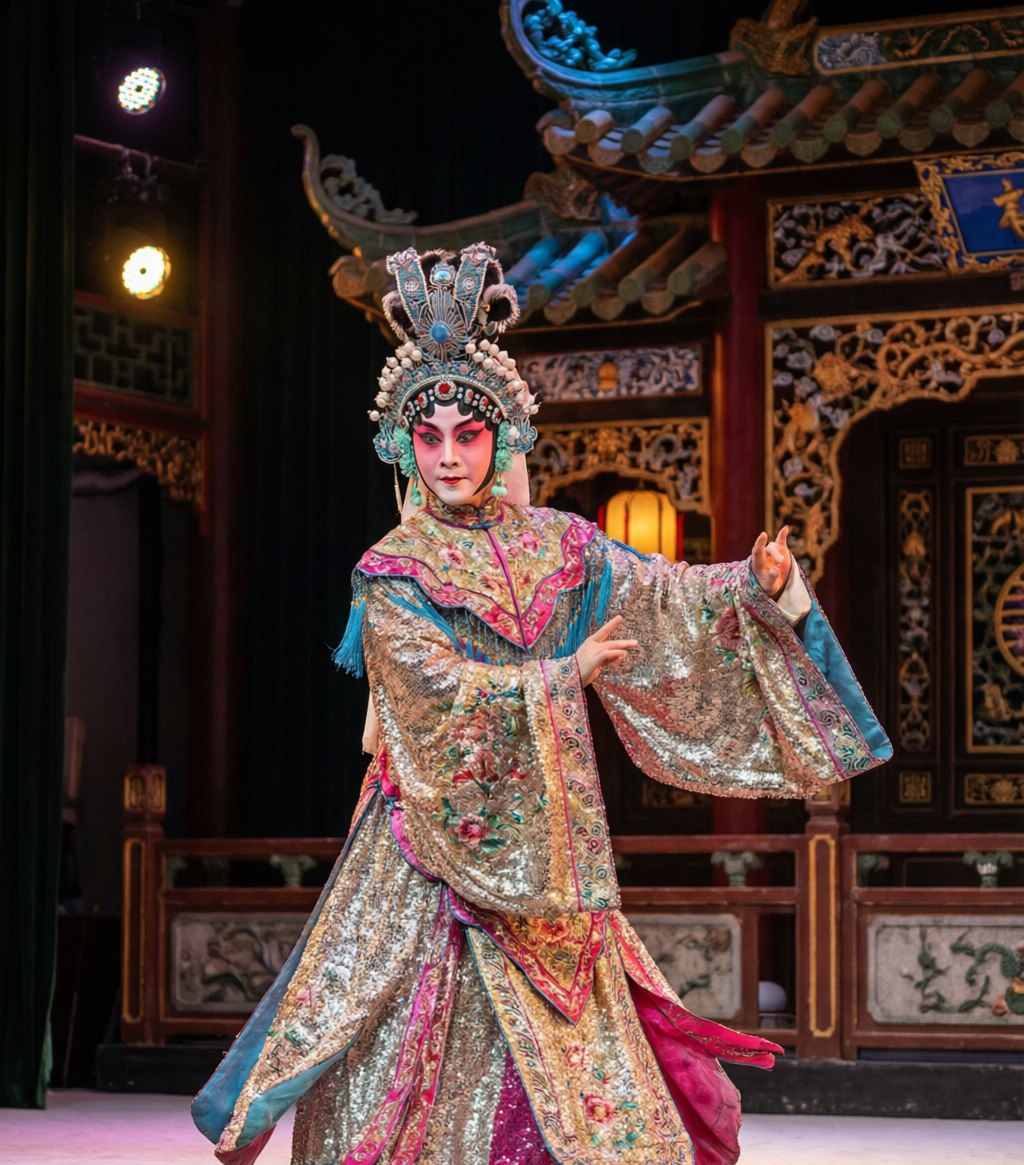
Glitter on the Pearl River
Of all China's regional operas, none is quite so dazzling to the eye as Cantonese Opera, known in Chinese as Yueju (粤剧). Its stage is a riot of color and light: costumes encrusted with sequins that scatter the footlights into a thousand sparks, headdresses crowned with trembling plumes and glittering ornaments, banners and weapons that flash with every turn of the performer's body. Where the operas of the northern plains favor a starker, more austere grandeur, Cantonese Opera luxuriates in surface, in spectacle, in sheer material splendor. It is an art of the prosperous south — of the Pearl River Delta, of the trading ports, of a region that has always looked outward toward the sea.
Yet to call Cantonese Opera merely spectacular would be to mistake it. Beneath the glitter lies a sophisticated musical and dramatic tradition, one that has absorbed more outside influence than perhaps any other Chinese opera and transformed everything it touched into something distinctly its own. Sung in the Cantonese language, shaped by the fiddle's cry, refined by generations of virtuoso performers, and carried across the oceans by one of history's great diasporas, Yueju is at once a local treasure and a global art — a thread of song connecting the villages of Guangdong to Chinese communities on every continent.
Roots in the South
Cantonese Opera's history stretches back several centuries, its origins woven from the many performance traditions that circulated through the prosperous south. From the Ming dynasty onward, traveling troupes brought the styles of the central and eastern regions into Guangdong, where they mingled with local folk songs, religious ritual performances, and the native musical traditions of the Cantonese-speaking population. Over time, these elements fused into a distinctive regional form, sung in the local dialect and flavored by the sounds of the south.
The form matured in the cities of the Pearl River Delta — Guangzhou (Canton), Foshan, and the surrounding towns — and it flourished in an environment very different from the rural heartland of the northern operas. This was a region of merchants and maritime trade, of wealth and cosmopolitan taste, and its opera reflected that character. Cantonese Opera became known for its willingness to innovate, to borrow, and to please. It was, from early on, a commercial art, performed in theaters and at festivals for audiences who expected to be entertained and who had the means to reward excellence.
The character of the region shaped the character of the art. The Pearl River Delta has long been among the most outward-looking corners of China — a land of fishermen, merchants, and seafarers, of bustling ports and constant contact with the wider world. Guangzhou was for centuries the great gateway of Chinese maritime trade, the city where foreign goods, foreign ideas, and foreign sounds arrived and were absorbed into local life. An opera born in such a place could hardly be insular. Cantonese Opera developed a taste for novelty, a comfort with borrowing, and a confidence in its own identity that allowed it to take in outside influences without losing itself. This mercantile, cosmopolitan temperament would define the form through every stage of its later history, from its embrace of Western instruments to its pioneering role in early Chinese cinema.
The nineteenth and early twentieth centuries were a period of extraordinary ferment. As Cantonese communities spread abroad, the opera traveled with them, and as new influences arrived from the West, the form absorbed them with characteristic openness. The result was an opera more adaptable, more eclectic, and more outward-looking than almost any other in the Chinese tradition.
The Sound of the Gaohu
The musical soul of Cantonese Opera is its singing, and the instrument that most defines its sound is the gaohu (高胡), the "high fiddle." Held between the knees and bowed with a long, singing stroke, the gaohu produces a bright, penetrating, intensely expressive tone that mirrors and supports the human voice. Its sound — sweet, keen, and a little melancholy — is instantly recognizable, and to Cantonese listeners it is inseparable from the emotion of the opera itself.
The gaohu is accompanied by an ensemble that reflects the form's eclectic history. Alongside traditional Chinese instruments — the erhu, the plucked pipa and yangqin, the flute, and a percussion section of gongs, cymbals, and drums — Cantonese Opera has, since the early twentieth century, incorporated Western instruments such as the violin, the saxophone, and the guitar. This blending of Chinese and Western timbres is one of the form's defining features and a mark of its southern, cosmopolitan origins. The singing itself is built on a rich system of melodic patterns and song types, some inherited from older operatic traditions and others drawn from Cantonese folk music and popular song, giving performers a wide and flexible musical vocabulary.
"When the gaohu begins, the whole theater leans in. It is the sound of longing itself, and every Cantonese heart knows it."
— On the central place of the high fiddle in Cantonese Opera
Crucially, the opera is sung in Cantonese, a language with nine distinct tones, and its melodies are shaped to follow those tones with great care. The relationship between word and music is intimate and precise; a skilled singer bends the melodic line to preserve the meaning and the natural music of the language. This is one reason Yueju resonates so deeply with Cantonese speakers: it is their language raised to the level of art, made beautiful and unforgettable.
The opera's singing also draws on a deep well of native Cantonese narrative-song traditions, above all naamyam (南音), the "southern sounds" — a refined, often melancholy style of storytelling song once performed by blind singers and in the pleasure quarters of the delta cities. The cadences of naamyam, with their lingering, ornamented phrases and their air of wistful longing, left a lasting mark on Cantonese Opera's vocal idiom, and the form also absorbed the simpler, percussive rhythms of the muyu (木鱼), the "wooden fish" narrative songs sung to a steady struck beat. These local roots give Yueju's singing a distinctive emotional color — a sweetness tinged with sadness, a lyricism that feels inseparable from the Cantonese landscape and the Cantonese ear — and they remind us that beneath the sequins and the footlights lies a tradition nourished by the humblest of folk voices.
Role Types and Radiant Costume
Cantonese Opera employs the familiar Chinese system of role types — the sheng (生) male roles, the dan (旦) female roles, the jing (净) painted-face roles, and the chou (丑) clowns — but it has refined them into a particularly elaborate set of specialized categories, each with its own conventions of movement, singing, and dress. The martial roles are spectacular, demanding acrobatic skill and command of stylized combat, while the civil roles prize elegance of bearing and subtlety of expression.
It is in costume and makeup, however, that Cantonese Opera most visibly distinguishes itself. The costumes are among the most lavish in any Chinese operatic tradition: robes and armor covered in dense, shimmering sequins and intricate embroidery, designed to catch and multiply the light. The effect, under modern stage lighting, is one of almost overwhelming brilliance. Headdresses are tall and ornate, adorned with jewels, beads, and quivering ornaments that move with the performer. Makeup, while following the symbolic color conventions of Chinese opera, tends toward a refined, polished beauty in the female roles, complementing the splendor of the wardrobe.
This visual magnificence is not mere decoration. In a tradition that has always competed for audiences in a crowded, commercial entertainment market, spectacle is part of the art. The glitter of a Cantonese Opera stage is a promise: that the audience will be transported, dazzled, and given their money's worth in wonder.
The Purple Hairpin and the Master of Dreams
The Cantonese Opera repertoire is vast and varied, ranging from martial epics to intimate love stories, but few works are as cherished as The Purple Hairpin (紫钗记, Zichai Ji). The play tells the story of a talented scholar and a beautiful courtesan whose love is tested by separation, misunderstanding, and the interference of the powerful, its central symbol a purple jade hairpin that binds the lovers' fate. It is a tale of devotion and fidelity, of love preserved against every obstacle, and its arias are among the most beloved in the form.
The Purple Hairpin is one of several celebrated adaptations drawn from the works of the great Ming dynasty dramatist Tang Xianzu (汤显祖), whose masterpiece The Peony Pavilion (牡丹亭) has inspired operatic versions across many traditions. Cantonese Opera's Tang Xianzu adaptations are prized for their lyrical beauty and their deep feeling, and they showcase the form at its most refined — the gaohu singing, the voices rising, the stage glowing with color as a story of love transcending even death unfolds. These literary works sit alongside a popular repertoire of folk tales, historical dramas, and comic plays, giving Yueju an unusual range from the high to the humble.
Film, Diaspora, and the Wider World
No Chinese opera has been so shaped by its encounter with the modern world, and with the wider world beyond China, as Cantonese Opera. In the twentieth century, the form developed a close and fruitful relationship with cinema. Cantonese opera films became a major genre, carrying the art to audiences far beyond the theater and preserving the performances of legendary stars. The interplay ran both ways: the conventions of film influenced the staging and pacing of live performance, and opera stars became some of the first great celebrities of Chinese-language cinema.
This era produced a galaxy of legendary performers whose names remain household words among Cantonese audiences. Masters such as Sit Kok-sin (薛觉先) and Ma Sze-tsang (马师曾) transformed the art in the early twentieth century, each founding a distinctive school of singing and performance and drawing devoted followings that crossed over between stage and screen. Their rivalry and their innovations pushed Cantonese Opera to new heights of sophistication and popularity, and the tradition of the named star — the performer whose personal style defines a role and draws the crowds by name alone — remains central to the form. In Cantonese Opera, the audience often comes as much for the artist as for the play, a testament to a culture that has always celebrated individual virtuosity.
Even more consequential was the diaspora. From the nineteenth century onward, millions of Cantonese speakers emigrated — to Southeast Asia, to North America, to Australia, to Europe — carrying their language, their customs, and their opera with them. In the Chinatowns of San Francisco, Vancouver, Singapore, and Sydney, Cantonese Opera became a vital thread of cultural continuity, a living link to the homeland performed at festivals and community gatherings. For overseas Chinese, Yueju was more than entertainment; it was memory, identity, and belonging made audible and visible.
"In every city where Cantonese voices gather, the gaohu follows. The opera is the homeland, carried in a music case across the sea."
— On the role of Cantonese Opera in the overseas Chinese diaspora
A Treasure Recognized by the World
In 2009, the significance of Cantonese Opera was formally recognized on the world stage when it was inscribed on UNESCO's Representative List of the Intangible Cultural Heritage of Humanity. The inscription acknowledged Yueju as a tradition of outstanding artistic and cultural value, one that embodies the history, language, and creativity of the Cantonese-speaking world and that has played a unique role in connecting Chinese communities across the globe.
The recognition was well earned. Few operas can claim so rich a synthesis of music, drama, costume, and movement, or so remarkable a geographic reach. From the temples and theaters of Guangdong to the community stages of distant Chinatowns, Cantonese Opera has sustained a continuous tradition while remaining open to change — a balance that few arts achieve.
Splendor That Travels On
Today, Cantonese Opera thrives most visibly in Hong Kong and Macau, where it retains a devoted audience, a professional infrastructure, and a prominent place in cultural life. In Guangdong, its birthplace, it continues to be performed and celebrated, supported by efforts to train new performers and to bring the art to younger audiences. Across the diaspora, community troupes keep the tradition alive, and the form's classic recordings and films circulate widely in the digital age.
The challenges are real — an aging core audience, the competition of countless modern entertainments, the difficulty of sustaining a demanding performing tradition in a fast-moving world. But Cantonese Opera has always been an art of adaptation. It absorbed Western instruments, embraced cinema, and crossed oceans; it has reinvented itself before, and there is every reason to believe it will do so again. What endures is the essence: the cry of the gaohu, the glitter of sequins under the lights, the beauty of the Cantonese language lifted into song. From the Pearl River to the far corners of the earth, that splendor still travels on, carrying with it the voice of the south and the hearts of all who call it home.