The Most Singable of Operas
Of all China's major operatic traditions, Huangmei Opera (Huangmei xi, 黄梅戏) is the one you are most likely to find yourself humming. Its melodies are bright, simple, and infectious; its stories are cheerful and warm; its language is close to everyday speech. Where Kunqu demands patience and Peking Opera demands awe, Huangmei Opera asks only that you enjoy yourself. It is, in the best sense, a people's art — born not in the courts of emperors or the gardens of scholars but in the tea fields and village festivals of rural Anhui, and shaped by the voices of ordinary working people. Its genius is accessibility: it takes the conventions of Chinese opera and makes them feel effortless, tuneful, and alive.
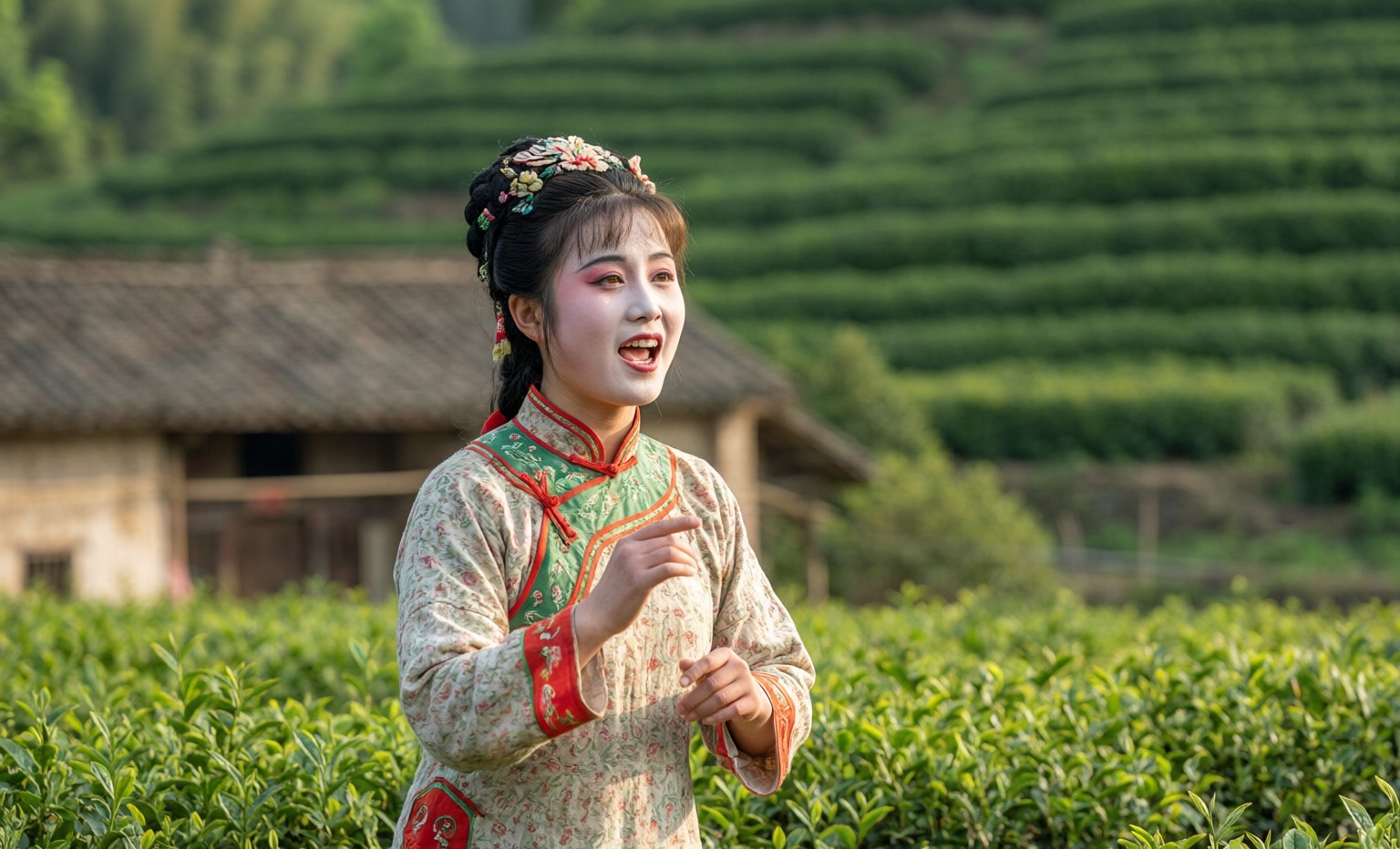
The form carries the sunshine of its origins. Huangmei Opera is associated above all with Anqing (安庆), a city on the Yangtze River in Anhui province, and with the green, rain-washed hills where tea is grown and picked. Its earliest songs were the work songs of the countryside — the melodies sung by women as they harvested tea leaves, and the lively duets performed at rural fairs and temple festivals. That pastoral, folk-song character has never left the art. Even at its most polished and theatrical, Huangmei Opera retains the freshness of a song sung outdoors, in good weather, by people who are glad to be singing.
It is this quality — cheerful, unpretentious, immediately appealing — that has made Huangmei Opera one of the most widely loved genres in China. Its signature tunes are known by heart across the country, its classic films have been watched by hundreds of millions, and its melodies have crossed over into popular music, television, and everyday life. To understand Huangmei Opera is to understand how a humble folk tradition can rise, without losing its soul, to become a national treasure.
From Tea-Picking Songs to the Stage
The roots of Huangmei Opera lie in the folk songs of the Huangmei region, which straddles the border of Anhui, Hubei, and Jiangxi provinces. The name itself is debated: it may derive from Huangmei County (黄梅县) in Hubei, or from the "yellow plum" season (黄梅时节, huangmei shijie) — the rainy early-summer period when the plums turn yellow and the tea is harvested, the very season when these songs were traditionally sung. Either way, the origin is agricultural and popular. The earliest forms were the tea-picking songs (caicha ge, 采茶歌) and the small, comic duets known as "two-person" and "three-person" plays (二人台, 三人台), performed by peasant singers at festivals with minimal staging and abundant charm.
Over the nineteenth and early twentieth centuries, these small forms gradually grew. They absorbed the structure and repertoire of larger operatic traditions, added more characters and more elaborate plots, and migrated from the countryside into the towns and cities of Anhui. The city of Anqing became the form's center and its crucible, the place where rural song was refined into urban theatre. By the middle of the twentieth century, Huangmei Opera had matured into a fully developed operatic genre — still recognizably the child of the folk song, but now capable of sustaining full-length dramas of considerable sophistication.
The transformation was completed, and broadcast to the nation, through cinema. In the 1950s, a series of Huangmei Opera films carried the form far beyond its regional base, turning local favorites into national sensations. The most important of these films would make Huangmei Opera a household name across China — and would make one performer a legend.
A Bright and Flowing Sound
The music of Huangmei Opera is its defining glory, and its secret is simplicity. The melodic system is built on a small number of bright, flexible tune patterns, the most important being the pingci (平词), the principal narrative melody, and a family of livelier, more colorful tunes used for duets, comic scenes, and emotional highlights. The melodies are predominantly in a major, cheerful mode, with a flowing, song-like quality that makes them easy to sing and easy to remember. Where the northern operas favor intensity and the refined southern traditions favor subtlety, Huangmei Opera favors warmth and directness. Its tunes sound, to many listeners, almost like folk songs that have learned to act.
The accompaniment reflects the form's folk origins. The leading instrument is the gaohu (高胡), a high-pitched fiddle, supported by the erhu, the pipa (琵琶) lute, the bamboo flute (dizi, 笛子), and the yangqin (扬琴) hammered dulcimer. The percussion is lighter and less dominant than in Peking Opera, serving the music rather than driving it. In the modern era, Huangmei Opera orchestras have often expanded to include richer harmonies and even Western instruments, giving the music a lush, melodic fullness that has helped it cross over into popular taste. The overall effect is one of sunshine and good humor — music that invites you in rather than overwhelming you.
Roles, Makeup, and a Lighter Touch
Huangmei Opera employs the standard four role types — the male sheng (生), the female dan (旦), the painted-face jing (净), and the clown chou (丑) — but it treats them with a lighter hand than the more formal traditions. The form's heart lies in the sheng and dan roles, the young men and young women whose romances drive the repertoire, and especially in the xiaodan (小旦), the lively young female role that has produced many of the form's greatest stars. Unlike the all-female tradition of Yue Opera, Huangmei Opera has typically featured both male and female performers, with the women often taking the lead in the beloved romantic parts.
The makeup and costume of Huangmei Opera are notably naturalistic. The painted faces of the jing role are far less elaborate than in Peking Opera; the costumes are bright and attractive but less ornate, favoring a fresh, folk-inflected elegance over imperial splendor. The movements, too, are less rigidly codified — closer to natural gesture, infused with the liveliness of folk dance. This relative informality is part of the form's appeal: it feels human, approachable, and warm. A Huangmei Opera performer seems less to be executing a sacred geometry than to be telling you a story with song and smile.
"Huangmei Opera does not perform at you. It sings with you, as if you had always known the tune."
— A traditional appreciation of the form's folk-song warmth and immediate appeal
The Heavenly Match: A Fairy Comes Down to Earth
The single work most identified with Huangmei Opera is The Heavenly Match (天仙配, Tian Xian Pei), also known in English as The Marriage of the Fairy Princess. It is a beloved folk legend, retold in countless forms across China, of the romance between a mortal man and a goddess. Dong Yong (董永), a poor but virtuous young farmer, sells himself into servitude to pay for his father's funeral — an act of filial piety so moving that it reaches heaven itself. The Seventh Fairy (七仙女), the youngest daughter of the Jade Emperor, looks down from the clouds, falls in love with his goodness, and descends to earth to become his wife. The two enjoy a brief, idyllic happiness — the famous scene of the couple weaving together to pay off Dong Yong's debt is a set piece of domestic tenderness — before the laws of heaven compel the fairy to return to the sky, separating the lovers forever.
The 1955 film of The Heavenly Match, starring Yan Fengying (严凤英) as the Seventh Fairy and Wang Shaofang (王少舫) as Dong Yong, was a phenomenon. It was one of the most popular Chinese films of its era, seen by vast audiences across the country and abroad, and it established Huangmei Opera as a national art. The film's melodies — above all the joyful duet "The Couple Return Home Together" (夫妻双双把家还, Fuqi shuangshuang ba jia huan) — became so widely known that they are still sung today, decades later, at weddings and celebrations. The song's vision of a simple, shared happiness — "you plow the field, I weave the cloth" — has become a kind of folk proverb, an image of the good life distilled into a few bright lines. Few operatic works in any tradition can claim to have entered so deeply into the everyday language of their culture.
The Female Son-in-Law: Wit and Disguise
The other pillar of the Huangmei Opera repertoire is The Female Son-in-Law (女驸马, Nü Fuma), a story of wit, disguise, and triumphant cleverness. Feng Suzhen (冯素珍), a brilliant young woman, disguises herself as a man to travel to the capital and take the imperial examinations — hoping to win the rank and influence needed to rescue her wrongfully imprisoned fiancé. She performs so brilliantly that she not only tops the examinations but is chosen by the emperor himself as the imperial son-in-law (fuma, 驸马), betrothed to the princess. The comedy and tension of a woman trapped in a male role, maneuvering to escape an unwanted royal marriage while saving the man she loves, makes for sparkling theatre. In the end, through a combination of courage and quick thinking, Feng Suzhen reveals the truth, wins the emperor's admiration, and is reunited with her true love.
The 1959 film of The Female Son-in-Law, again starring Yan Fengying, cemented the work's place in the canon. Its arias — particularly the exuberant "Who Says Women Are Inferior to Men" (谁料皇榜中状元, "Who would have thought the top name on the imperial list...") — have become anthems of feminine talent and daring. Together, The Heavenly Match and The Female Son-in-Law represent the two poles of the Huangmei Opera imagination: the tender pastoral romance and the spirited comedy of cleverness, both suffused with the form's characteristic warmth and melodic grace.
Yan Fengying: The Voice of a Tradition
No account of Huangmei Opera is complete without Yan Fengying (严凤英, 1930–1968), the performer whose voice became, for millions, the voice of the form itself. Born into poverty in Anhui, Yan showed an extraordinary musical gift from childhood and rose, through sheer talent and relentless work, to become the supreme star of Huangmei Opera. Her singing was celebrated for its naturalness, its sweetness, and its emotional sincerity — a quality that perfectly embodied the form's folk-song soul. Her performances in The Heavenly Match and The Female Son-in-Law made her a national icon, and her recordings remain the standard against which later performers measure themselves.
Yan Fengying's life, like that of many artists of her generation, ended in tragedy. During the Cultural Revolution (1966–1976), she was persecuted as a representative of the "old" culture she had done so much to elevate, and in 1968 she took her own life. Her death was a wound in the life of the art, and her subsequent rehabilitation and commemoration have made her a symbol of both the glory and the suffering of Chinese traditional theatre. To listen to Yan Fengying today is to hear Huangmei Opera at its most radiant — and to remember the cost at which such beauty was sometimes preserved.
A Folk Art That Conquered a Nation
The cultural significance of Huangmei Opera lies in its remarkable journey from the margins to the mainstream. It is a tradition that never pretended to be aristocratic or obscure, and its popularity is a testament to the enduring power of melody, warmth, and good storytelling. Its tunes have crossed over into every corner of Chinese popular culture — adapted into pop songs, used in television and advertising, sung in karaoke parlors and at family gatherings. The "Huangmei melody" (黄梅调, Huangmei diao) became, in the mid-twentieth century, a recognizable musical idiom across the entire Chinese-speaking world, influencing film music and popular song far beyond the opera stage.
This very accessibility has sometimes drawn the gentle condescension of connoisseurs, who regard Huangmei Opera as lighter and less sophisticated than Kunqu or Peking Opera. But such judgments miss the point. The form's simplicity is not a deficiency but an achievement — the hard-won clarity of an art that has distilled the essence of folk song into something that can move a stadium or a living room with equal ease. Its stories of filial piety, faithful love, and clever triumph speak to values that remain central to Chinese life, and its melodies carry those values into the heart with an ease that more demanding arts cannot match.
Singing On
Today Huangmei Opera thrives as one of China's most popular and accessible traditional arts. Professional troupes, centered in Anqing and Hefei in Anhui province, continue to perform the classics and to create new works, while dedicated academies train the next generation of performers. The form has embraced modern stagecraft and new media — its works are broadcast on television and streamed online, and its melodies reach audiences who may never set foot in a theatre. The great films of the 1950s remain beloved, regularly revived and introduced to new viewers, and the signature arias of The Heavenly Match and The Female Son-in-Law are as widely known as ever.
The challenges facing every traditional art in the digital age are real, and Huangmei Opera must continually renew its appeal for younger audiences. But it faces that future with a rare advantage: an art built, from its first tea-picking songs, on the conviction that beauty should be shared, that a good tune belongs to everyone, and that the deepest feelings are best expressed simply. Long after the imperial courts have fallen silent and the scholars' gardens grown quiet, the songs of the tea hills still rise — bright, cheerful, and impossible to forget. The Seventh Fairy still descends from the clouds, the clever daughter still wins the emperor's praise, and somewhere, in a voice as fresh as morning, a melody begins that you will be humming for the rest of the day.