A Stage With Nothing On It
The stage is bare. There is no scenery, no curtain, no painted backdrop of a palace or a battlefield. A table and two chairs, draped in embroidered silk, are the entire set — and yet, in the hands of a skilled troupe, that table becomes a city wall, a mountain, a bed, a throne. An actor mimes opening a door, and a door exists. She walks in a tight circle while the percussion clatters, and the audience understands that she has traveled a hundred li. A general raises a tasseled whip, and he is mounted on a horse. Four soldiers carrying flags painted with wheels become a chariot. This is the founding principle of Peking Opera (Jingju, 京剧): the stage is empty so that the performer's body can fill it, and the audience's imagination completes what the actor suggests.
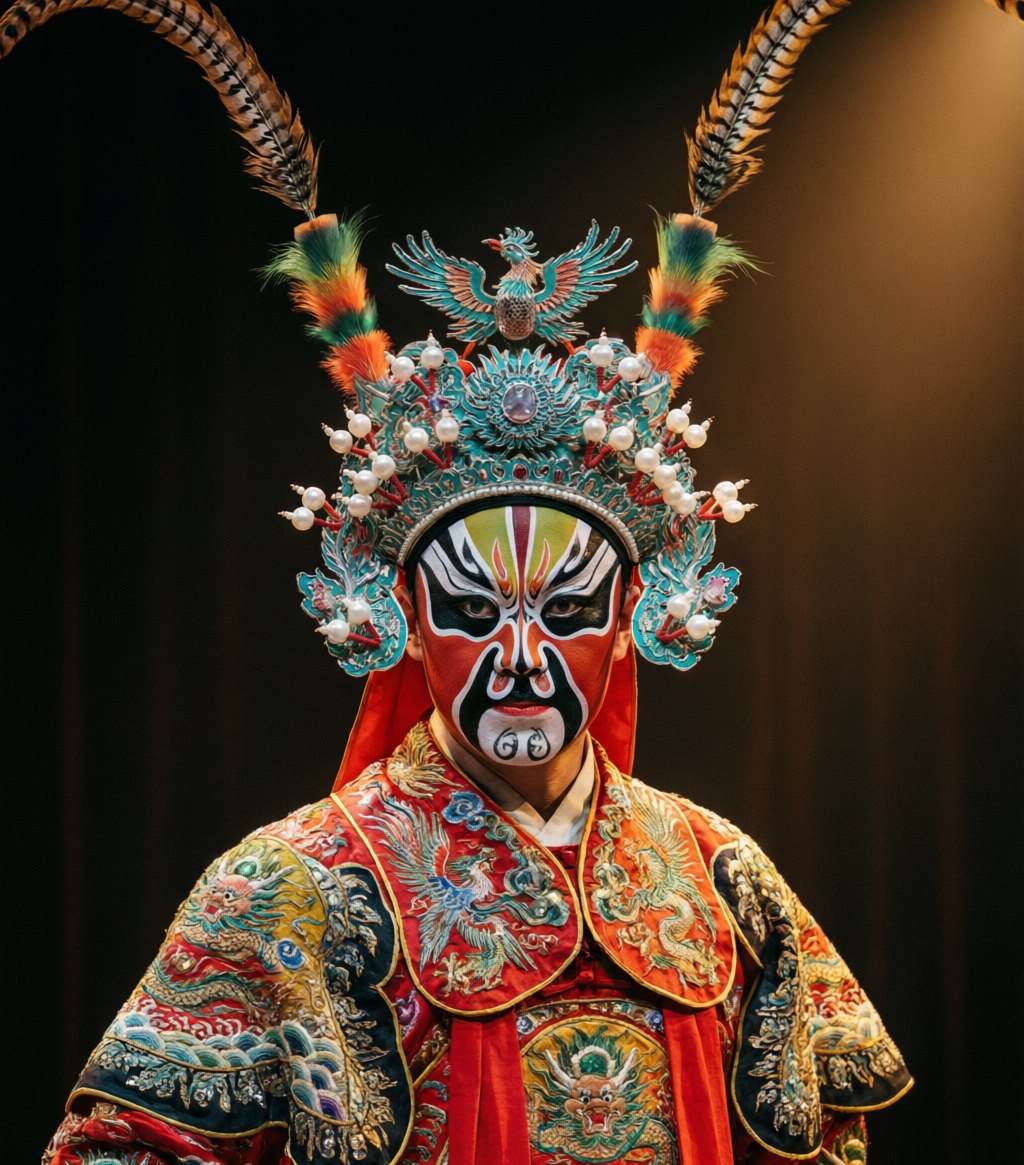
To a first-time viewer, the effect can be overwhelming. The singing is high and piercing, pitched to carry across an open-air teahouse without amplification. The makeup is not makeup at all but a painted mask of brilliant color. The costumes are heavy with silk and gold thread, the headdresses bristle with pheasant tails and trembling pearls. Every movement is codified — the way a sleeve is flung, the way a beard is stroked, the way a warrior's eyes widen before a fight. Nothing is accidental. Behind the apparent extravagance lies one of the most disciplined and rigorously formalized performance systems ever devised, refined over more than two centuries by generations of performers who treated their craft as a kind of sacred geometry.
Peking Opera is not the oldest of China's operas — that honor belongs to Kunqu, its refined ancestor. But it is the most famous, the most spectacular, and the one that the world has come to treat as synonymous with Chinese theatre itself. It is, in the phrase the Chinese use, the "national opera" (guo ju, 国剧) — the form that carries the country's stories to its widest audiences and represents its stagecraft to the world.
Four Troupes Arrive in Beijing
The conventional birthday of Peking Opera is 1790, the year the Qianlong Emperor (乾隆) celebrated his eightieth birthday. To mark the occasion, four celebrated opera troupes from Anhui province — the so-called "Four Great Anhui Troupes" (四大徽班, sida huiban) — traveled north to perform in the capital. They brought with them a lively, popular style known as huiban, sung to a pair of melodic systems called xipi (西皮) and erhuang (二黄), which would become the twin musical pillars of the new form.
The Anhui troupes did not create Peking Opera in a single season. What happened instead was a slow, fertile blending. Over the following decades, performers from Hubei province (Han troupes, 汉调) arrived and merged their own xipi and erhuang traditions with the Anhui style. The result absorbed the elegant literary inheritance of Kunqu, the acrobatic energy of the older bangzi clapper operas, and the dialect and stage conventions of Beijing itself. By the middle of the nineteenth century, during the reigns of the Daoguang and Xianfeng emperors, the hybrid had crystallized into something recognizably new — a form sung in a stylized version of the Beijing dialect, performed in the capital's teahouses and theaters, and patronized by the imperial court.
The patronage of the court mattered enormously. The Empress Dowager Cixi (慈禧太后), who ruled China in all but name for much of the late nineteenth century, was a passionate opera devotee. She summoned the finest performers into the Forbidden City, rewarded them lavishly, and effectively elevated the actors of Peking Opera from itinerant entertainers — a profession long ranked among the lowest in the Confucian social order — into celebrated artists. The imperial seal of approval helped transform a popular entertainment into a national institution.
The Sound: A Fiddle, A Drum, and the Voice
The music of Peking Opera divides into two streams, and the distinction shapes everything a performer does. The first is wenchang (文场), the "civil" or melodic section — the strings and winds that carry the singing. Its leading instrument is the jinghu (京胡), a small, high-pitched two-stringed fiddle with a piercing, almost vocal tone that follows and shadows the singer's line note for note. The jinghu is accompanied by the lower jing erhu (京二胡), the moon-shaped lute (yueqin, 月琴), and sometimes the sanxian (三弦). Together they weave a thin, bright texture over which the voice soars.
The second stream is wuchang (武场), the "martial" or percussion section — and in Peking Opera, percussion is not accompaniment but architecture. The conductor of the entire performance is the player of the ban (clapper) and danpi gu (single-headed drum), who leads the ensemble and cues every entrance, every gesture, every shift of mood. Around him crash the daluo (大锣, large gong), the xiaoluo (小锣, small gong), and the naobo (cymbals). The percussion does not merely keep time; it punctuates action, signals a character's emotional state, and provides the rhythmic skeleton for acrobatic combat. A general's entrance is announced by a specific pattern of gongs; a moment of shock by a sharp crack of the clapper. To understand Peking Opera is, in large part, to learn to hear what the percussion is saying.
The two melodic systems inherited from the Anhui and Hubei troupes carry the emotional weight. Xipi (西皮) is bright, lively, and energetic, suited to joy, excitement, and vigorous narrative. Erhuang (二黄) is lower, slower, and more contemplative, the mode of sorrow, reflection, and tragic grandeur. A skilled librettist and composer move between the two — and between their many rhythmic variants, from the free-metered daoban (导板) opening cry to the rapid-fire liushui (流水, "flowing water") — to shape the emotional arc of a scene.
Four Roles, A Whole Humanity
Every character in Peking Opera belongs to one of four great role types, a taxonomy so fundamental that performers train for years within a single category before they are permitted to master another. The system is the skeleton on which the entire art hangs.
The sheng (生) is the male role. It subdivides into the laosheng (老生), the dignified older man who sings in his natural voice and wears a long beard; the xiaosheng (小生), the young man who sings in a high, falsetto-tinged voice; and the wusheng (武生), the martial male, an acrobat and fighter who may perform breathtaking feats of combat. The dan (旦) is the female role, and its most celebrated subdivision is the qingyi (青衣), the virtuous, dignified woman who sings in a refined falsetto, and the huadan (花旦), the lively, flirtatious young woman. There is also the wudan (武旦) and daomadan (刀马旦), the female warrior, and the laodan (老旦), the old woman who sings in her natural voice.
The jing (净), the "painted-face" role, is the most visually arresting. These are forceful, larger-than-life characters — generals, judges, gods, and villains — whose entire face is covered in elaborate patterns of color. The chou (丑), the clown, is identified by a small patch of white paint around the nose and eyes. The clown is the only role permitted to improvise, to break the fourth wall, to speak in colloquial Beijing slang, and to mock the action. He is the pressure valve of the form, and audiences adore him.
The painted faces of the jing role — the lianpu (脸谱) — are a symbolic language in themselves. Color declares character before a single word is sung. Red signifies loyalty and courage, and belongs above all to Guan Yu (关羽), the god of war. Black denotes integrity and blunt honesty, the color of the incorruptible Judge Bao (包拯). White signals treachery and cunning, forever fixed to the face of the villain Cao Cao (曹操). Blue and green mark fierce, wild, or outlaw heroes; yellow marks ambition and ferocity; gold and silver are reserved for gods, demons, and spirits. A literate audience reads a painted face the way a herald reads a coat of arms — instantly, and with pleasure.
"One minute of performance on stage takes ten years of work beneath it."
— A traditional Peking Opera proverb (台上一分钟,台下十年功), describing the decade of training behind a single moment of apparent ease
Costume as Cosmology
If the painted face is a moral diagram, the costume (xingtou, 行头) is a social one. Peking Opera dress does not aim at historical accuracy; it aims at legibility. The garments are drawn largely from Ming dynasty court dress, regardless of the era in which a play is set, and they communicate rank, gender, age, and character at a glance. The most magnificent is the mang (蟒), the dragon robe worn by emperors and the highest officials, embroidered with coiling dragons and worn with a jade belt. Generals wear the kao (靠), a stiff, elaborate armor bristling with flags strapped to the back, which transforms the wearer into a walking, glittering monument. Scholars and officials wear the guan yi (官衣), and ordinary characters the plain zhezi (褶子).
The headdresses are no less eloquent — crowns, hats, and helmets adorned with pheasant-tail plumes (lingzi, 翎子) that a skilled warrior can manipulate to express rage, alarm, or triumph. The long "water sleeves" (shuixiu, 水袖), extensions of white silk attached to the cuffs, are perhaps the form's most expressive prop: a performer can flick, swirl, tremble, or fling them to externalize grief, fury, shyness, or joy. To watch a great dan performer work her water sleeves is to watch emotion made visible in fabric.
Mei Lanfang and the World Discovers Jingju
No single figure did more to elevate Peking Opera into a world art than Mei Lanfang (梅兰芳, 1894–1961). Born into a family of performers, Mei became the supreme master of the dan role — and, in an era when women were still largely barred from the professional stage, a man who embodied femininity with such refinement that he redefined the art of the female role for a generation. His performances were not mere impersonation; they were a distillation of grace, a stylized ideal of womanhood rendered in gesture, sleeve, and song.
Mei's significance extends far beyond virtuosity. In 1930 he toured the United States, performing in New York, Chicago, and San Francisco to audiences that included Broadway luminaries and university scholars. In 1935 he traveled to the Soviet Union, where his work was studied by Bertolt Brecht and Sergei Eisenstein. Brecht's famous theory of "epic theatre" and the "alienation effect" — the idea that an actor should present rather than fully become a character, keeping the audience critically aware — was directly stimulated by his encounter with Mei's stylized, non-naturalistic stagecraft. In a single generation, Mei Lanfang carried Peking Opera from the teahouses of Beijing into the center of twentieth-century world theatre.
The Plays That Carry a Civilization
The Peking Opera repertoire numbers in the hundreds, drawn from history, legend, and the great classical novels. A handful of works have become so central that they function as cultural shorthand.
Farewell My Concubine (霸王别姬, Bawang Bie Ji) is perhaps the most famous of all. It dramatizes the final night of Xiang Yu (项羽), the warlord-king who, defeated by the founder of the Han dynasty, camps beside a river with his beloved concubine Yu Ji (虞姬). Knowing that all is lost, Yu Ji performs a final sword dance for her lord and then takes her own life rather than be captured. The scene of the sword dance — set to a haunting melody, the concubine's twin swords flashing — is one of the supreme showpieces of the dan repertoire, a study in doomed loyalty and terrible beauty.
The Drunken Beauty (贵妃醉酒, Guifei Zui Jiu) is Mei Lanfang's signature piece. It depicts Yang Guifei (杨贵妃), the beloved imperial consort of the Tang dynasty, waiting in a garden for the emperor who never arrives. As she drinks alone, her composure slowly dissolves into intoxication, jealousy, and grief. The role demands extraordinary physical control: the performer must enact drunkenness — the swaying gait, the unsteady gaze, the "drunken" bends and turns — while executing movements of pinpoint precision. It is a virtuoso display disguised as a portrait of a woman coming apart.
Beyond these, the repertoire ranges across the entire Chinese imagination: the military stratagems of Romance of the Three Kingdoms, the outlaw heroics of Water Margin, the monkey-king fantasies of Journey to the West, and countless stories of loyal generals, wronged wives, clever magistrates, and filial children. For centuries, these plays were how ordinary people — many of them illiterate — absorbed their history, their ethics, and their sense of what it meant to be loyal, brave, just, or good.
A National Treasure in a Changing World
The twentieth century tested Peking Opera severely. During the Cultural Revolution (1966–1976), the traditional repertoire was largely banned; in its place, the authorities promoted eight "model works" (yangbanxi, 样板戏), revolutionary operas that retained the form's musical and acrobatic vocabulary while stripping it of its imperial and feudal subject matter. Many great performers, including veterans of the old school, were persecuted. Mei Lanfang himself had died in 1961, just before the storm broke. The art survived, but it was scarred.
The reform era that followed brought both revival and new anxiety. The traditional repertoire returned to the stage, the great academies resumed training, and Peking Opera was embraced as a symbol of national cultural pride. In 2010, UNESCO inscribed Peking Opera on its Representative List of the Intangible Cultural Heritage of Humanity, formalizing its status as a treasure not only of China but of the world. The form is taught in conservatories, performed in grand theaters, and broadcast on national television.
And yet the old question haunts it: how does an art built for the teahouse, the open-air fair, and an audience fluent in its every convention survive in the age of cinema, television, and the smartphone? The answer, as with so much of Chinese tradition, is neither simple nor settled. Peking Opera has adapted — with new lighting, new staging, new works, and ambitious crossover experiments — while its guardians insist that the core disciplines of singing, recitation, acting, and combat must remain intact. What has not changed is the essential miracle at its center: a bare stage, a single performer, and the conviction that with a sleeve, a glance, and a song, an entire world can be summoned into being. After more than two centuries, that conviction still holds. The gongs crash, the jinghu cries out, the painted face turns toward the light — and the empty stage is empty no longer.