There is a night in China when the entire country holds its breath. Trains empty their last passengers into frozen station platforms. Kitchens steam and sizzle from Heilongjiang to Yunnan. Grandmothers lay out extra chopsticks for those who cannot come. Children press their faces to frost-laced windows, waiting for the sky to catch fire. And somewhere in every city, a young professional closes a laptop, shoulders a bag, and joins the river of humanity flowing in one direction only: home. This is Chuxi — New Year's Eve — the single night in the Chinese calendar that carries more emotional gravity than all others combined. It is not a celebration so much as a communion, a annual sacrament of presence in which the living gather to honor what came before and to dare the darkness together until the light returns.
When Is Chuxi?
Chuxi falls on the last day of the twelfth month of the Chinese lunar calendar — either the twenty-ninth or the thirtieth, depending on whether the final month is short or long in that particular year. Because the lunar calendar drifts against the Gregorian, the date shifts annually, landing somewhere between late January and mid-February. In 2026, Chuxi arrives on February 16th. In 2027, it falls on February 5th. This variability is not an inconvenience but a feature of the system: the lunar calendar keeps faith with the moon's phases, and so Chuxi always arrives beneath a moonless sky, the darkest possible night, as though the year must end in absolute blackness before the new light can be born.
Origins and Legends
The most beloved origin story belongs to Nian. In the ancient telling, Nian was a horned beast of terrible appetite that dwelt beneath the sea, surfacing on the last night of winter to devour grain stores, livestock, and — when hunger drove it mad — villagers themselves. For generations, people fled into the mountains on this night, barring their doors and praying for dawn. Then a wandering elder, white-bearded and serene, refused to run. When Nian slithered ashore, the old man met it with three weapons: sheets of crimson paper pasted across every doorway, bundles of dry bamboo set ablaze to crack and thunder, and candles blazing in every window. The beast convulsed, shrieked, and fled back into the deep. It feared three things — the color red, loud noise, and bright flame — and from that night forward, no village ran. They armed themselves in scarlet and gunpowder and stayed awake to dare the monster's return. The Chinese character for "year," 年 (nián), is the beast's own name. To celebrate the new year is, etymologically, to survive Nian once more.
Beneath the legend lies deeper history. Oracle bone inscriptions from the Shang Dynasty, over three thousand years old, record year-end sacrificial rites to ancestors and nature gods — offerings of millet, wine, and slaughtered animals made at the boundary between one cycle and the next. The ritual purpose was clear: to feed the dead, to thank the spirits, and to negotiate safe passage into the unknown year ahead.
The name itself is a small poem. 除 (chú) means to remove, to eliminate, to sweep away. 夕 (xī) means evening, dusk, the fading light. Together, 除夕 is "the evening of removal" — the night on which the old is banished, the accumulated weight of twelve months shed like dead skin so that something new can breathe.
The Reunion Dinner (年夜饭)
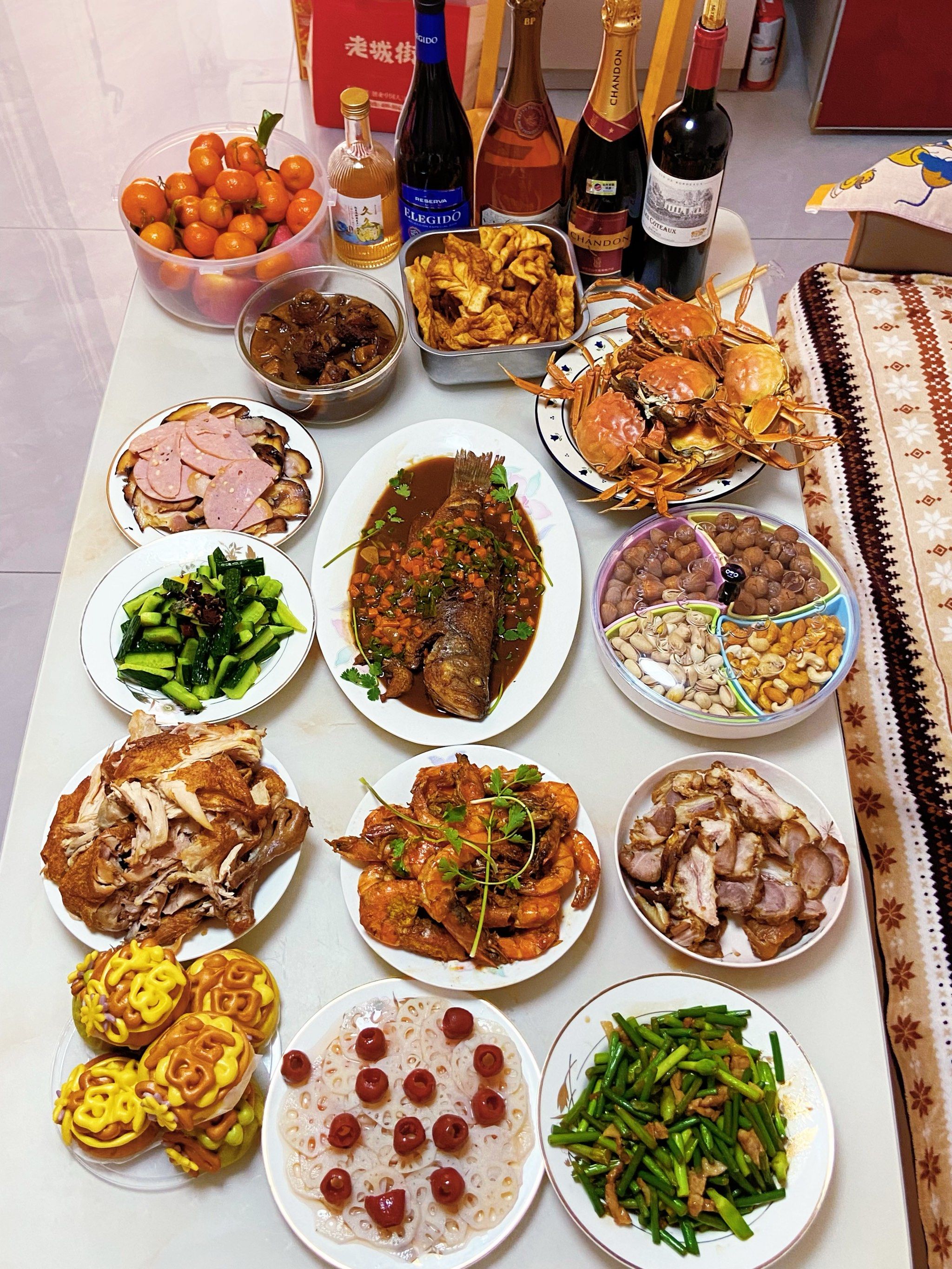
If Chuxi is the heart of the Chinese year, then the reunion dinner — niányèfàn, literally "year's eve meal" — is the heart of Chuxi. This is the meal that justifies the largest human migration on Earth. It is the one dinner no one misses, or rather, the one dinner whose absence leaves a wound that lasts the entire year. Families plan it for weeks. Grandmothers begin cooking at dawn. The table is set with a precision that belies its apparent abundance: every dish is a sentence in a language of blessing.
A whole fish must appear, steamed or braised, head and tail intact, because the word for fish (鱼, yú) is a homophone of surplus (余). To eat fish is to pray for more than enough in the year ahead — and tradition dictates that the fish must not be fully consumed, so that the surplus literally remains. Dumplings (饺子, jiǎozi), obligatory in the north, are shaped like ancient gold ingots and promise wealth to those who eat them. In the south, sticky rice cake (年糕, niángāo) puns on "year high," a wish for promotion, growth, and upward motion. A whole chicken, often poached and served with its head and feet, represents family togetherness and prosperity. Spring rolls, golden and cylindrical, mimic bars of gold. Longevity noodles stretch uncut across the table, and to sever them is to court misfortune.
The seating is not casual. The eldest grandparent takes the seat of honor — facing the door, the position of authority in Chinese spatial grammar. The youngest children sit nearest the kitchen door, ready to fetch and serve. Before a single chopstick lifts, the youngest generation stands and toasts the elders, glasses lowered below the elders' rims in a gesture of deference. Only then does the meal begin.
"一年不赶,赶三十晚。"
"You may be unhurried all year long — but on the thirtieth night, you must not be late."
— Chinese folk saying on the urgency of the reunion dinner
Shousui: Guarding the Year
The dinner ends, but the night is far from over. Shousui (守岁) — literally "guarding the year" — is the tradition of remaining awake through the entire night, keeping vigil as the old year passes into the new. The custom carries a tender superstition: it is said that the longer the children stay awake, the longer their parents will live. To sleep early on Chuxi is to wish shortness upon those who gave you life.
In the modern era, shousui has found its perfect companion: the CCTV Spring Festival Gala, a four-and-a-half-hour variety broadcast watched by over a billion people simultaneously. Families arrange themselves before the television — grandparents in padded chairs, children on the floor with tangerines and melon seeds — and the Gala provides a shared national rhythm to the private vigil. Between sketches and song numbers, the mahjong tiles clatter. Uncles argue over card games. Grandmothers tell stories they have told every year, and the children pretend not to have heard them. The hours stretch, warm and drowsy and sacred, until the clock approaches twelve.
Fireworks and the Midnight Thunder
At the stroke of midnight, China detonates. The sound is not a metaphor — it is a physical force, a wall of percussion that rolls across cities and villages in overlapping waves, rattling window glass and setting car alarms screaming. Billions of firecrackers ignite within minutes, filling the air with sulfurous smoke and a red confetti of spent paper casings. The sky above every neighborhood blooms with color: gold chrysanthemums, green willows, crackling silver palms. Children cover their ears and shriek with delight. Dogs howl. The elderly smile and nod, because they remember when the sound meant something more than spectacle.
The spiritual purpose is ancient and explicit: the thunder drives away evil. Just as the old man's crackling bamboo sent Nian fleeing back to the sea, the midnight barrage is an apotropaic act, a communal exorcism performed not by priests but by every household simultaneously. The noise announces to the spirit world that this family, this street, this city, is awake, armed, and unafraid. The new year enters through a corridor of fire.
In recent decades, many Chinese cities have imposed bans or restrictions on private fireworks, citing air quality and safety concerns. Beijing's ban, enacted in stages since the 1990s, has transformed the midnight sky in the capital from an inferno to a relative quiet. Yet the impulse persists. Electronic firecrackers crackle from apartment balconies. Municipal light shows substitute for private arsenals. And in the countryside, where enforcement is looser and the sky is wider, the old thunder still rolls across the fields as it has for a thousand years.
Red Couplets and Door Gods
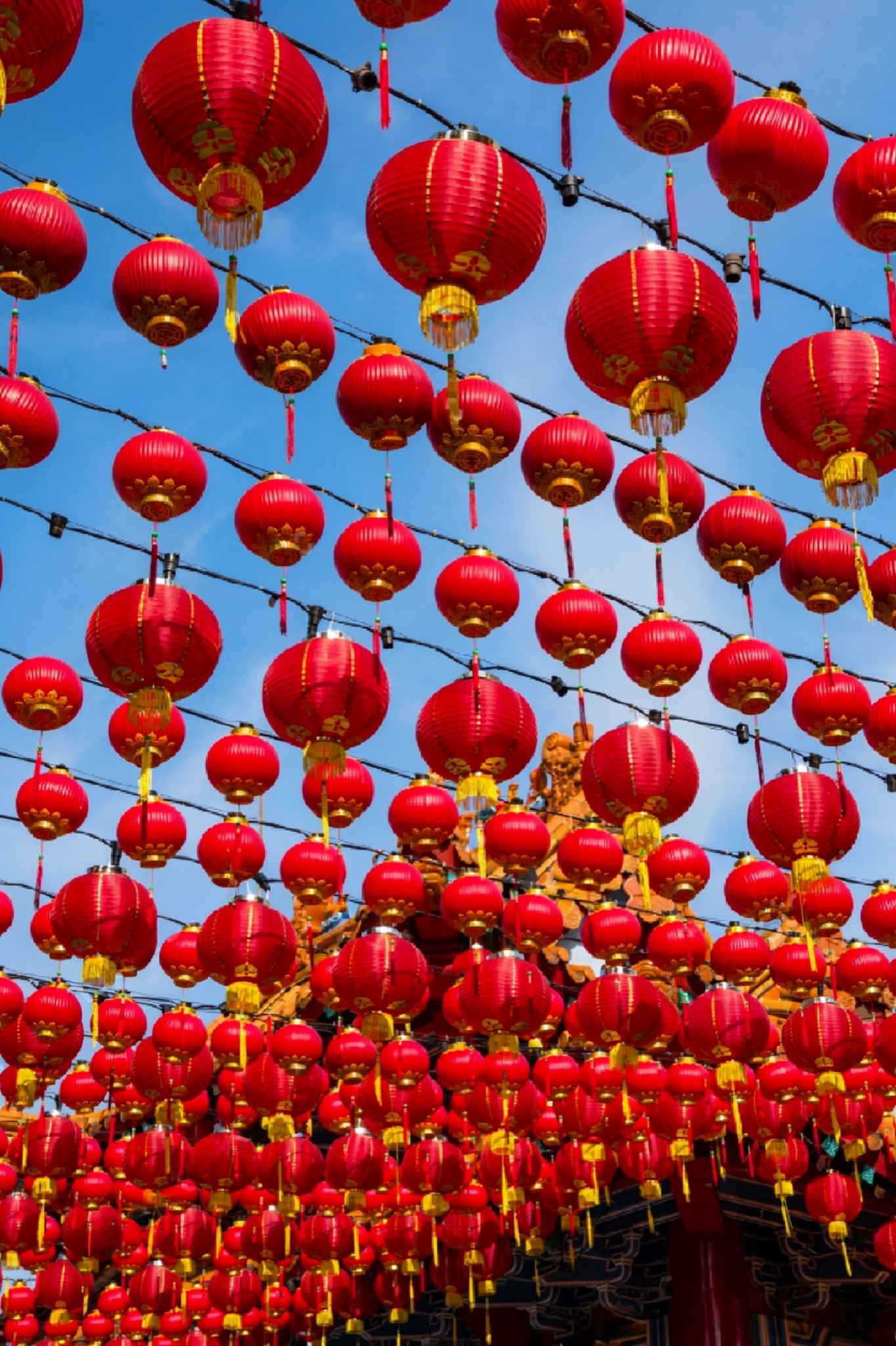
In the days before Chuxi, every doorway in China undergoes a transformation. Spring couplets (春联, chūnlián) appear — pairs of poetic lines written in black or gold ink on strips of red paper, pasted vertically on either side of the door frame. A horizontal banner crowns the lintel. The verses are miniature poems of aspiration: wishes for prosperity, health, scholarly success, and family harmony, compressed into seven or five characters per line. The tradition dates to the Five Dynasties period, when the ruler Meng Chang is credited with composing the first known couplet in 964 CE.
The character 福 (fú, fortune or blessing) is pasted on doors and walls — and very often upside-down. The inversion is deliberate: the word for "upside-down" (倒, dào) is a homophone of "arrive" (到), so an inverted 福 declares, in visual pun, that fortune has arrived. Children point at it and laugh, and the adults nod, satisfied that the wordplay has done its work.
On the doors themselves stand the Door Gods (门神, ménshén): fierce, armored figures printed in vivid woodblock colors, pasted one on each panel so they face outward, guarding the threshold. The most common pair is Qin Shubao and Yuchi Gong, two Tang Dynasty generals whose loyalty to Emperor Taizong was so absolute that their images alone were said to keep demons from his bedchamber. They stand with maces and swords, wild-eyed and magnificent, and no self-respecting household enters the new year without them at the gate.
Windows receive their own adornment: paper cuttings (剪纸, jiǎnzhǐ), intricate silhouettes cut with scissors or craft knives from single sheets of red paper. Flowers, zodiac animals, the double-happiness character, scenes of harvest and plenty — each is a small miracle of negative space, letting the winter light through in patterns of blessing.
Chuxi in the Modern Era
The twenty-first century has not diminished Chuxi. It has multiplied its channels. The chunyun (春运) travel rush — the forty-day period surrounding the festival — generates approximately three billion passenger journeys, a logistical undertaking without parallel in human history. High-speed trains that did not exist a generation ago now carry millions home at three hundred kilometers per hour, yet the emotional destination is unchanged: the table, the elders, the meal.
Technology has woven itself into the ritual without displacing it. WeChat red envelopes (微信红包) allow grandparents in Chengdu to send blessings to grandchildren in Toronto at the tap of a screen. Video calls prop phones against rice cookers so that the family member working overseas can see the table, raise a glass, and be toasted in return. The Spring Festival Gala is now livestreamed, commented on in real time by hundreds of millions on social media, its sketches memed within minutes of broadcast. The forms are digital; the grammar is ancient.
What endures beneath every adaptation is the irreducible core: the insistence that on this one night, presence matters more than productivity. That the living should gather, eat together, stay awake together, and face the darkness together until the light returns. That the old should be honored and the young should be blessed. That a family, however scattered by ambition and geography, owes itself one night of wholeness per year. Chuxi is not nostalgia. It is not performance. It is the annual proof that the bonds which made us are stronger than the distances that divide us — and that every year, without fail, we can still come home.