Of all the words a visitor learns first in Chinese, few open as many doors as lǐmào (礼貌) — courtesy, manners, the outward bloom of an inward respect. China is sometimes called the "State of Rites" (礼仪之邦), and the title is no empty boast. For more than two thousand years, the proper way to greet, to seat, to pour, to give, and to refuse has been treated not as fussy decoration but as the very grammar of human relationship. To move gracefully through a Chinese home, table, or shop is to read a language older than the empire itself.
The good news for the traveler is that Chinese etiquette, for all its depth, rests on a handful of principles that are easy to grasp: deference to elders and guests, the giving and saving of "face" (面子, miànzi), a preference for modesty over self-assertion, and a deep belief that small gestures — a cup offered with two hands, a bill quietly paid — carry the weight of words. Master these, and a hundred specific rules begin to make sense on their own.
The Roots of Li: Why Manners Matter
The Chinese word for ritual, propriety, and courtesy alike is lǐ (礼). Confucius placed it at the center of the good life. For him, li was not mere ceremony but the discipline by which raw human feeling is shaped into something beautiful and social — grief given the form of mourning, affection given the form of respect. "Without propriety," the Analects warn, "respectfulness becomes laborious bustle; carefulness becomes timidity; boldness becomes insubordination; straightforwardness becomes rudeness." Even virtues, untempered by manner, curdle into vices.
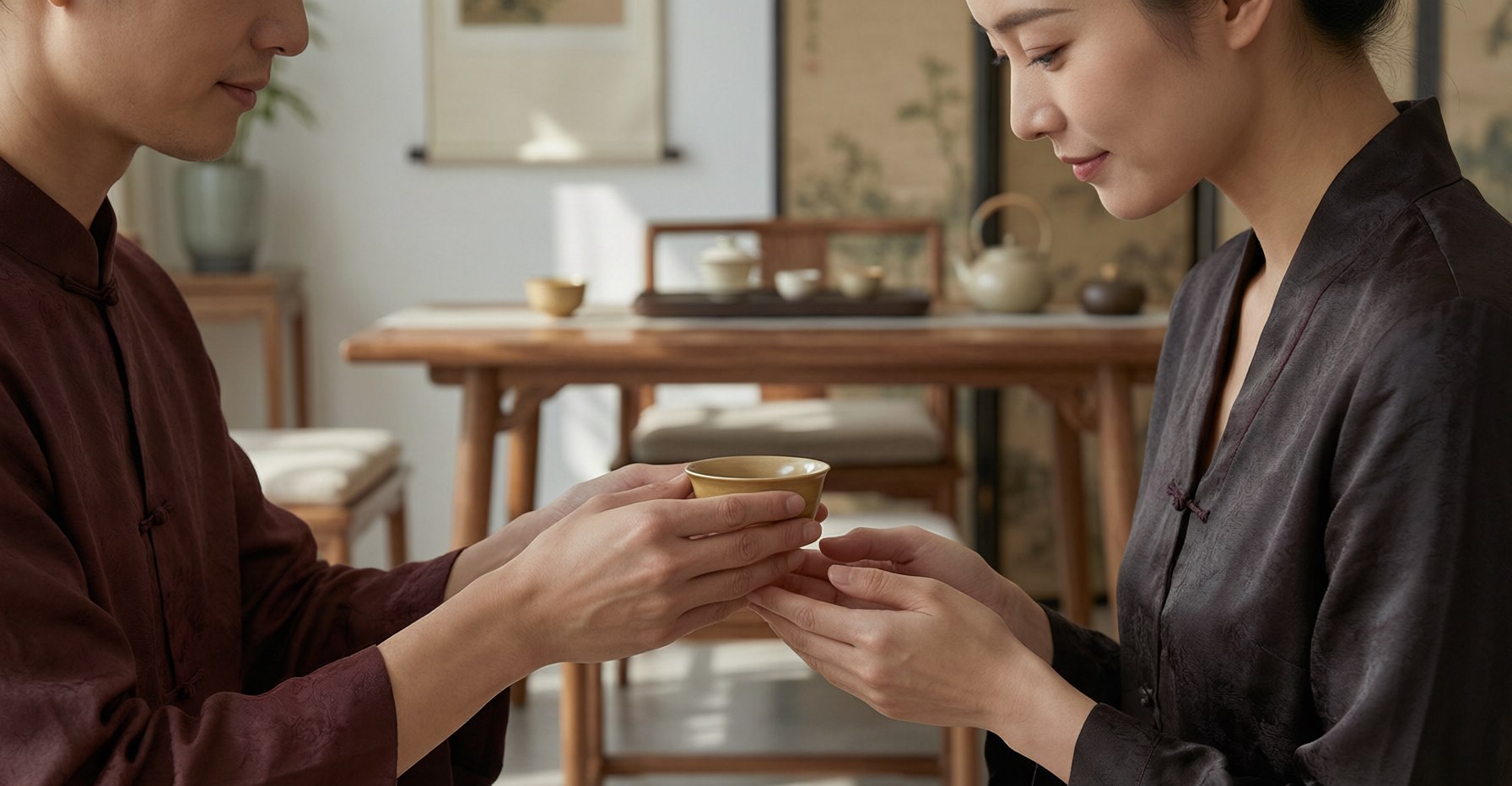
This is why etiquette in China is rarely experienced as arbitrary. Ask why a teacup is offered with two hands and the answer is never "because it is the rule." It is because the second hand is a visible sign that the giver has held nothing back — that the gesture is whole. The form follows the feeling. Understanding this spares the visitor a great deal of anxiety: when in doubt, choose the more generous, more deferential, more modest option, and you will seldom be wrong.
"Is it not a pleasure to have friends come from afar?"
— Confucius, Analects 1.1 — the first line of the Chinese moral tradition, and its first word on hospitality
Greetings and the Language of Address
The classic Chinese greeting is the handshake, usually lighter and often longer than its Western counterpart, sometimes accompanied by a slight nod or, among the older generation, the faintest bow. The most common spoken greeting, nǐ hǎo (你好, "you good"), is perfectly correct but can sound textbook-stiff; in daily life people more often say nín hǎo (您好) to show respect — the honorific nín being the polite form of "you" — or simply ask, "Have you eaten?" (chī le ma? 吃了吗), a warm idiom that means nothing more than "how are you?" and deserves no literal answer.
Address is where courtesy becomes an art. Chinese rarely uses bare given names with anyone but close friends and family. Instead, people are addressed by title and surname — Wáng lǎoshī (Teacher Wang), Lǐ jīnglǐ (Manager Li) — or, as a mark of warmth and respect, by a kinship term. An older man becomes shūshu (uncle), an older woman āyí (auntie); a peer is gēge (elder brother) or jiějie (elder sister). To call someone lǎo (老, "old") before their surname — Lǎo Wáng — is, far from an insult, a token of affectionate respect for seniority. When uncertain, err toward the more formal title; it is always safer to over-honor than to under-honor.
Names themselves are handled with care. The family name comes first — Máo Zédōng is Mr. Máo, never Mr. Zédōng — and to write or speak a person's name in red ink, or to address them by their full name in flat tones, can feel abrupt. Modesty governs the self: one refers to one's own work as "clumsy" and one's own opinion as "a few unworthy words," while lifting up the other person's. This ritual humility is not false; it is the lubricant that keeps the machinery of face turning smoothly.
The Courtesy of Tea and the Guest
No account of Chinese manners can begin anywhere but tea, for tea is the first and last word of hospitality. The moment a guest crosses the threshold, a cup appears. To serve nothing is a coldness almost beyond imagining. The host pours for the guest before pouring for themselves, refills the cup the instant it runs low, and considers it a small point of honor that the guest never find their cup empty.
The guest, in turn, has a graceful reply. When tea is poured, it is customary to tap the table lightly with two bent fingers — a silent "thank you" said to trace to the Qianlong emperor, who once poured tea for his traveling companions in disguise; they, unable to kowtow without revealing him, bent their fingers to mimic kneeling foreheads. Today the little tap is simply a warm acknowledgment. Receive the cup with both hands if you wish to show particular respect, and sip rather than drain it; a cup emptied too fast can read as thirst rather than appreciation.
At the Table: Dining and Banquet Manners
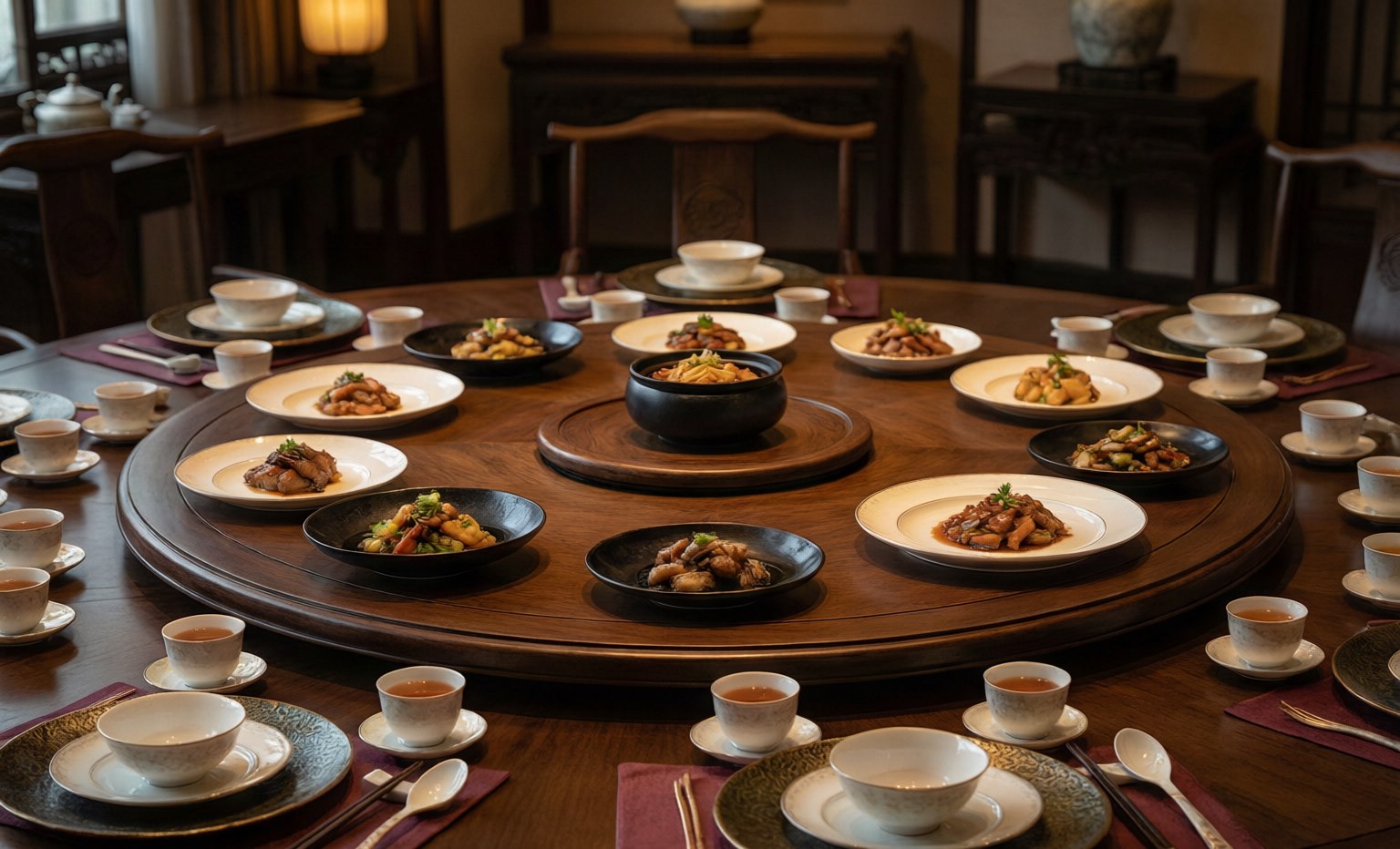
The Chinese table is a theater of courtesy, and its rules reward the attentive guest. Meals are communal: dishes are set in the center, often on a revolving lazy susan, and shared. The guest of honor is seated facing the entrance — the seat of greatest respect — with the host opposite, nearest the door and the servers, so that they may order, pour, and settle the bill without fuss. Elders are served first, and it is polite to wait until the eldest or the host lifts their chopsticks before you begin.
Chopsticks carry their own quiet code. Never stand them upright in a bowl of rice, for this resembles the incense sticks burned for the dead and is among the most unsettling sights at a Chinese table. Do not spear food with them, drum with them, or point with them; when resting them, lay them flat across your bowl or on the chopstick rest. When serving others — a gesture of warmth — use the communal serving chopsticks or the reversed, clean ends of your own.
Several customs surprise the uninitiated. The host will often pile choice morsels onto a guest's bowl or plate as a sign of care; accept with thanks and eat what you can. A burp, far from rude, may be taken as a compliment to the cook, though it is not required of you. And the bill — the bill is a contest. To fight to pay (抢着买单, qiǎng zhe mǎidān) is a sincere performance of generosity, and among friends it can grow spirited indeed. As a guest, you should make a genuine effort to pay; as a host, you should quietly ensure you win. To split a bill evenly (AA制) is increasingly common among the young but can still feel cold to older sensibilities, who prefer the round of "this one is on me, next time is on you" that keeps friendship in motion.
"When eating, do not gobble; when drinking, do not gulp. Do not make a show of your teeth, do not slurp your broth."
— Book of Rites (礼记), the ancient handbook of table conduct, still recognizable at any Chinese dinner
The Art of Giving and Refusing
Few rituals reveal the Chinese heart more clearly than the exchange of gifts. A gift is offered and received with both hands — the two hands saying, again, "I give you my whole attention." And it is rarely opened in front of the giver; to tear into a present at once can suggest greed, so the recipient sets it aside with thanks to be enjoyed later, in private. If you present a gift, do not be surprised or offended when it is declined once or twice before acceptance. This ritual refusal (推辞, tuīcí) is a dance of modesty on both sides: the giver insists, the receiver demurs, and only after a courteous round or two is the gift finally taken. To accept on the first offer can seem too eager; to refuse too long, ungracious.

The choice of gift matters as much as the manner. Fruit, fine tea, good alcohol, and pastries are safe and welcome; gifts are often given in pairs, for good things, it is said, come in twos. Wrapping in red or gold signals celebration and fortune. But certain gifts are quietly forbidden by custom: a clock, because "to give a clock" (送钟, sòng zhōng) sounds exactly like "to attend a funeral"; an umbrella (伞, sǎn), which sounds like "to part"; a pair of pears shared between lovers, for "to share a pear" (分梨, fēn lí) echoes "to separate." Green hats are best avoided for men, since "to wear a green hat" means to be betrayed in love. These are not superstitions to be mocked but a poetic people's sense that words and objects carry omens — and a thoughtful guest honors that sense.
Numbers, Colors, and the Things Left Unsaid
Chinese courtesy extends even to the choice of a number or a color. The number eight (八, bā) is beloved because it sounds like "to prosper" (发, fā); nine (九, jiǔ) is auspicious because it sounds like "long-lasting," and six (六, liù) suggests smooth success. The number four (四, sì), by contrast, sounds like "death" (死, sǐ) and is widely avoided — you will find buildings with no fourth floor and gifts never given in fours. Red is the color of joy, luck, and celebration, worn at weddings and pasted on doors at New Year; white, traditionally the color of mourning, is best reserved. Gold speaks of wealth and honor.
Equally important is what is not said. Direct refusal is softened; a Chinese "maybe" or "we'll see" (再说吧, zài shuō ba) often means a gentle "no," offered to spare the other person's face. Public criticism, blunt contradiction, or forcing someone into a corner causes a loss of face (丢面子, diū miànzi) that can wound far deeper than the words suggest. The courteous guest praises in public and reserves disagreement for private, gives others an easy way to say yes, and never mistakes frankness for kindness when the two diverge.
For the Visitor: Grace in Practice
How does all this translate for the traveler who has come not to study rites but simply to be welcomed? A few instincts go a very long way. Greet elders first and with the honorific nín. Accept tea, food, and gifts with both hands and a sincere xièxie (谢谢). At table, let the eldest begin first, keep your chopsticks civil, and make a genuine show of fighting for the bill. Bring a small gift — good tea or fruit, wrapped warmly — when invited to a home, and do not be hurt if it is set aside unopened or politely refused before it is accepted. Avoid the number four, the color white for celebration, and the gifts that sound like parting or death.
Above all, do not fear mistakes. Chinese hosts are famously generous and forgiving toward guests who are visibly trying. The effort itself — the two hands, the slight nod, the attempt at nín hǎo — is read as respect, and respect is the one currency that never fails. Etiquette, in the end, is not a minefield of forbidden gestures but a shared agreement to treat one another with care. The Chinese perfected that agreement long ago and, in their teahouses and dining rooms and doorways, they practice it still. Arrive with good intentions, watch how your hosts behave, and follow their lead — and you will find that the State of Rites has a place set for you too.