On the fifteenth night of the eighth lunar month, when the harvest is gathered and the autumn air turns crisp, the moon rises fuller and brighter than at any other time of year. Across China — and across the entire Chinese diaspora — families step outside, tilt their faces upward, and share in a single act of looking. They eat round cakes. They light lanterns. They recite poems composed a thousand years ago. And in that shared gaze at the same silver disc, separated by distance but united by sight, they enact one of the oldest and most tender rituals in Chinese civilization: the Mid-Autumn Festival (中秋节, Zhōngqiū Jié).
Chang'e and Hou Yi: A Love Story Written in Moonlight
The festival's most beloved legend is a story of love, sacrifice, and eternal separation. In the ancient telling, ten suns once blazed in the sky simultaneously, scorching the earth and threatening all life. The archer Hou Yi (后羿), possessed of superhuman skill, shot down nine of the suns, leaving one to give the world light. As reward, the Queen Mother of the West (西王母) gave him an elixir of immortality — enough for one person to ascend to heaven.
Hou Yi, unwilling to leave his beloved wife Chang'e (嫦娥), hid the elixir. But when his treacherous apprentice Feng Meng attempted to steal it by force, Chang'e faced an impossible choice. Rather than let the elixir fall into wicked hands, she drank it herself. Her body became weightless. She rose through the air, through the clouds, past the stars — until she alighted upon the moon, the closest celestial body to the earth she had left behind. There she remains, in the cold palace of Guanghan (广寒宫), accompanied only by the Jade Rabbit who pounds the elixir of life in an eternal mortar.
Hou Yi, heartbroken, set out offerings of Chang'e's favorite foods in the courtyard each year on the night of the fullest moon. Neighbors joined him. The practice spread. And so the Mid-Autumn Festival was born — not from triumph but from longing, not from reunion but from the ache of separation made bearable by ritual.
"May we all be blessed with longevity. Though a thousand miles apart, we share the beauty of the same moon."
— Su Shi (苏轼), "Prelude to Water Melody" (水调歌头), 1076 CE
Ancient Roots: Moon Worship and Harvest Gratitude
Beneath the romance of Chang'e lies a far older stratum of meaning. Moon worship in China predates recorded history. Oracle bone inscriptions from the Shang Dynasty (c. 1600–1046 BCE) reference sacrifices to the moon, and the Zhou Li (Rites of Zhou) describes an autumnal ceremony in which the emperor offered thanks to the moon for the harvest. The logic was cosmological: the sun represented yang, masculinity, and the active principle; the moon represented yin, femininity, and receptivity. Autumn, the season of gathering-in and completion, belonged to the moon.
By the Tang Dynasty (618–907), the festival had shed its purely ritual character and become an occasion for aesthetic pleasure. Emperors hosted moon-viewing banquets in palace gardens. Poets composed verses by moonlight. The common people adopted the custom of family gatherings under the open sky, eating seasonal fruits and gazing upward. The Song Dynasty formalized the fifteenth of the eighth month as an official holiday, and it has remained one ever since — second only to Spring Festival in emotional significance for most Chinese families.
Mooncakes: A Pastry Geography of China
No Mid-Autumn Festival exists without mooncakes (月饼, yuèbǐng). These dense, round pastries — their shape echoing the full moon and their sharing symbolizing family unity — come in such regional variety that they constitute a edible map of Chinese culinary identity.
Cantonese-style (广式) mooncakes are the most widely recognized: thin, golden-brown wrappers encasing rich fillings of lotus seed paste, red bean paste, or five-nut mixture, often with one or two salted duck egg yolks nested at the center like a miniature moon within the moon. Their surface is pressed with intricate molds — characters for longevity, images of rabbits or flowers — and brushed with egg wash for a lacquered sheen.
Suzhou-style (苏式) mooncakes shatter at the touch, their flaky, layered pastry made from lard-worked dough that bakes into dozens of gossamer strata. Fillings tend toward the savory: minced pork, scallion, and a whisper of sugar. Beijing-style (京式) mooncakes are plainer, with a thicker, crumbly crust and fillings of hawthorn or sweet bean paste, reflecting the northern palate's preference for restraint.
In Yunnan, mooncakes are filled with ham and roses. In Chaoshan, they are layered with mung bean paste and pork fat. In recent decades, "snow-skin" (冰皮) mooncakes — refrigerated, with a mochi-like shell and fruit or custard fillings — have captured younger consumers, while luxury brands compete with truffle, abalone, and bird's nest variations. Yet the essential act remains unchanged: cutting the cake into wedges, passing pieces to each person at the table, and eating together under the moon.
Lanterns, Riddles, and the Children's Night
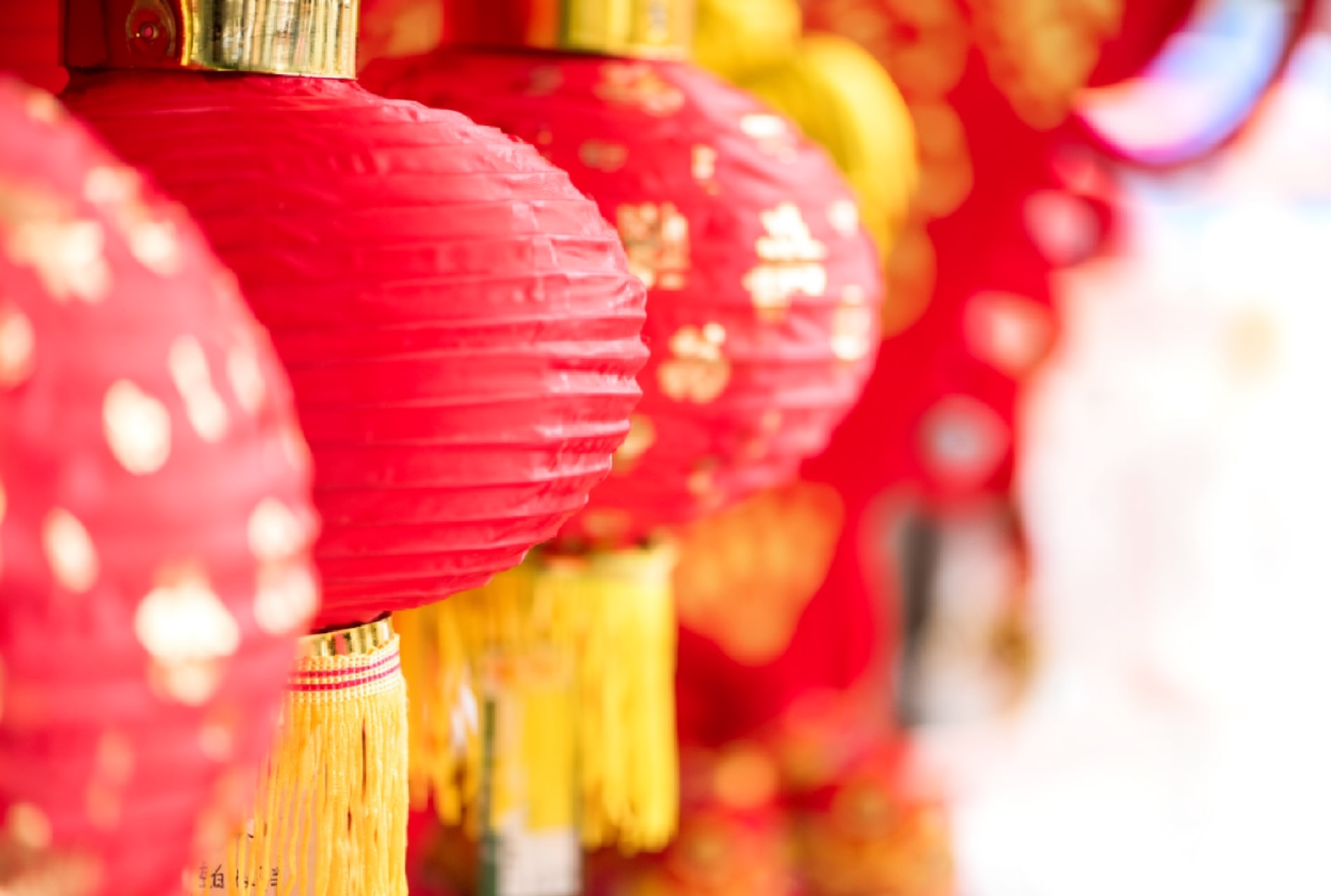
If mooncakes belong to the adults, lanterns belong to the children. On Mid-Autumn night, across southern China and throughout Southeast Asian Chinese communities, children carry lanterns through the streets — paper and cellophane constructions shaped like rabbits, fish, lotus flowers, and cartoon characters, glowing from within with candles or LED lights. In parks and temples, elaborate lantern displays transform the landscape into luminous wonderlands.
Lantern riddles (灯谜) add an intellectual game to the visual spectacle. Riddles are written on slips of paper and attached to hanging lanterns; passersby attempt to solve them, with small prizes for correct answers. The tradition dates to the Song Dynasty and transforms the night into a communal puzzle — strangers leaning close to the same lantern, murmuring possibilities, laughing at wrong guesses.
In some regions, the night also carries a quiet romantic charge. Young women once prayed to Chang'e for beautiful husbands or happy marriages. In Fujian and Taiwan, a folk game called "listening for the moon" (听香) involved women walking in silence until they overheard a stranger's words, which they interpreted as an oracle for their romantic future. The moon, feminine and luminous, has always been a confidante for longing hearts.
The Poetry of the Moon: Li Bai, Su Shi, and a Thousand Years of Longing
No object in Chinese literature has inspired more verse than the moon. It appears in the earliest Shijing (Book of Songs) as a symbol of beauty and constancy, and it has never left the poetic imagination since. Li Bai's "Quiet Night Thoughts" (静夜思) — "Before my bed, the moonlight gleams like frost. I raise my head to gaze at the bright moon; I lower it, and think of home" — is memorized by every Chinese child and remains, after thirteen centuries, the most universally recognized poem in the language.
But it is Su Shi's 1076 ci poem, written drunk on Mid-Autumn night while separated from his brother Su Zhe, that has become the festival's definitive literary expression. "When did the bright moon first appear?" he asks, raising his cup to the sky. "I do not know what year it is tonight in the palaces above." The poem moves from philosophical questioning through personal grief to a resolution of extraordinary generosity: since separation cannot be avoided, let the shared moon become a bridge. "但愿人长久,千里共婵娟" — may we live long, and though a thousand li apart, share this beautiful moon together.
The moon in Chinese poetry is never merely astronomical. It is a mirror for the self, a messenger between separated lovers, a symbol of enlightenment in Buddhist verse, a reminder of impermanence (for it wanes) and return (for it waxes again). To look at the moon in the Chinese tradition is to enter a conversation that spans millennia.
The Jade Rabbit and Modern Celebrations
Look closely at the full moon, Chinese children are told, and you will see the Jade Rabbit (玉兔, Yù Tù) — the white hare who accompanies Chang'e in her lunar palace, eternally pounding herbs in a mortar to prepare the elixir of immortality. The image likely originated in the visual pareidolia of the moon's maria, but it has become one of Chinese culture's most enduring and endearing symbols. China's lunar exploration program named its rover "Yutu," sending a mechanical jade rabbit to walk where the mythical one was imagined to hop.
Modern Mid-Autumn celebrations blend the ancient and the contemporary. Families still gather for dinner, still share mooncakes, still step outside to look up. But the evening now also includes video calls to distant relatives, social media posts of moon photographs, and television specials. In cities, parks host moon-viewing events with traditional music, poetry recitation, and hanfu-clad performers. Commercial mooncake sales reach billions of yuan annually, and the festival has become a significant gift-giving occasion — boxes of mooncakes exchanged between colleagues, clients, and friends as tokens of regard.
Yet strip away the commerce and the technology, and the festival's heart remains what it was when Hou Yi set out offerings in his courtyard: an act of love directed across an uncrossable distance. The moon is the one thing that cannot be owned, cannot be hoarded, cannot be different for one person than another. It belongs equally to everyone who looks up. And in that shared looking — parent and child, lover and beloved, the living and the remembered — the circle is made whole. The cake is round. The moon is round. The family, however scattered, is round. This is the Mid-Autumn promise, renewed each year when the eighth month's light reaches its fullness: that separation is real, but so is connection, and the moon sees both.