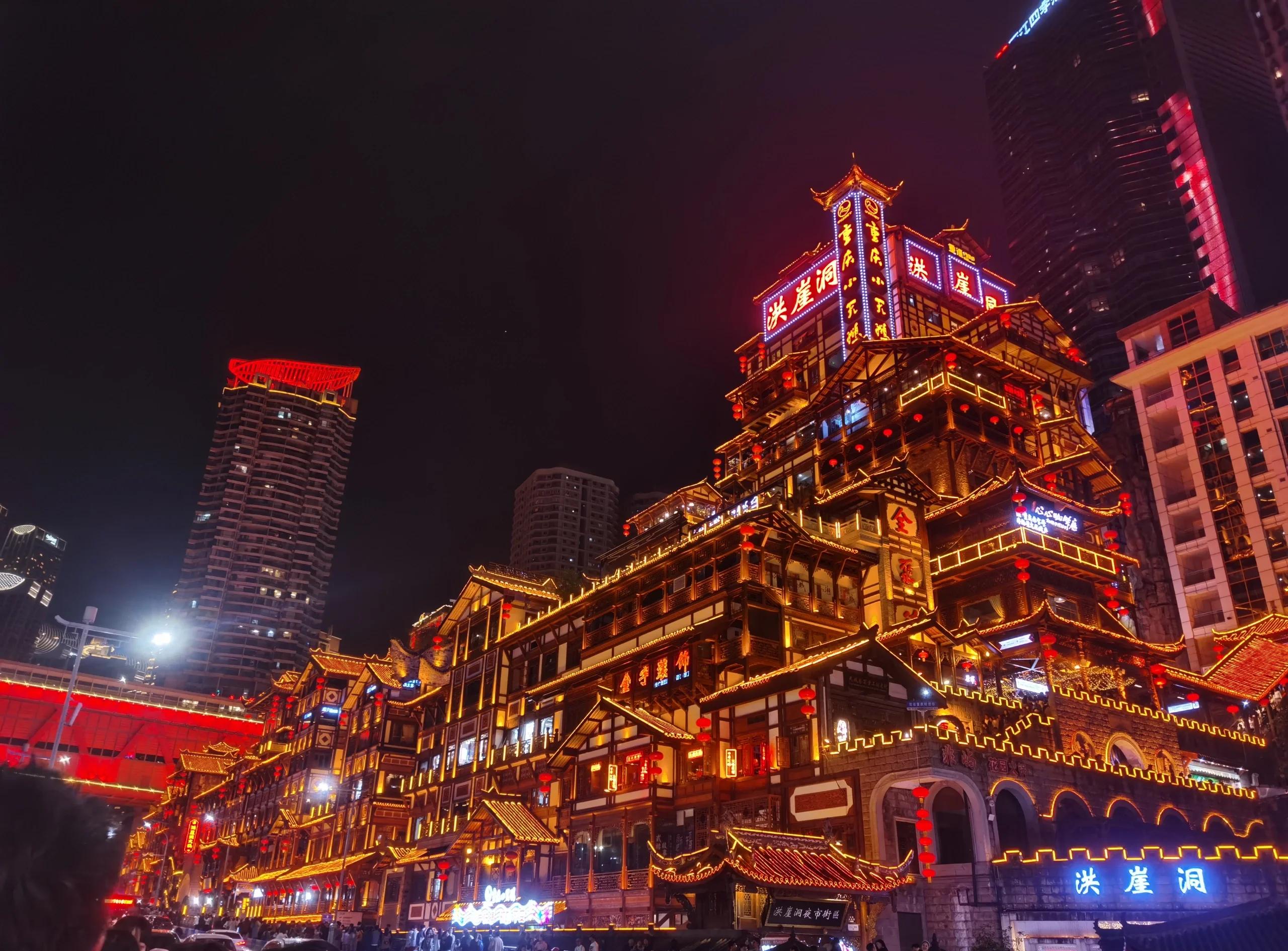
There is a moment, crossing the Qiansimen Bridge as dusk surrenders to night, when the city of Chongqing performs its most astonishing trick. The lights flicker on — first one, then dozens, then thousands — and suddenly the cliff face across the Jialing River erupts in gold. Eleven stories of tiered wooden pavilions, their upturned eaves catching the warm glow of lanterns, materialize from the darkness like a palace that has been waiting, patient and hidden, for the sun to leave. The reflection shimmers in the black water below. The crowd on the bridge falls silent, then erupts. Phones rise like a field of luminous flowers. And for a breathless, disorienting instant, you are no longer in a modern Chinese metropolis of thirty million people. You are standing at the gates of the spirit world, watching Miyazaki's bathhouse come alive.
This is Hongyadong. And no photograph, no viral video, no amount of breathless social media captioning can prepare you for the sheer vertical impossibility of it — a building that should not exist, clinging to a cliff like a barnacle made of dreams, glowing as though lit from within by the memories of a thousand years.
What Is Hongyadong?
Hongyadong (洪崖洞), which translates literally as "Hongya Cave," is an eleven-story commercial and cultural complex built directly into the steep cliff face where Chongqing's old city meets the Jialing River. Rising seventy-five meters from the riverbank to the road above, it is a modern recreation of the traditional Bayu (巴渝) architectural style — the indigenous building tradition of the ancient Ba people who inhabited this region for over two thousand years. The complex opened in 2006 after years of planning and construction, sprawling across forty-six thousand square meters of terraced space that houses restaurants, teahouses, handicraft shops, performance venues, and observation platforms.
The name itself reaches back centuries. Local legend holds that a general named Hong Ya once garrisoned his troops in a natural cave at this very spot during the Song Dynasty, and the cliff face became known as his cave. Over the following centuries, the area accumulated layers of history — Ming Dynasty city walls, Qing Dynasty merchant houses, Republican-era dockside warehouses — all stacked upon one another in the chaotic, gravity-defying manner that has always characterized Chongqing. When the old structures were finally demolished in the early 2000s, the city chose not to build a glass tower or a shopping mall. Instead, they reached backward, resurrecting the architectural language of the ancient Ba people and wrapping it around the cliff like a golden scroll unrolling into the night.
The Architecture of Impossible Angles
The genius of Hongyadong lies in its adherence to the diaojiaolou (吊脚楼) tradition — the stilted house technique perfected by riverside communities across southwestern China over millennia. In a diaojiaolou, the building does not fight the terrain. It negotiates with it. Wooden stilts drive into the hillside at varying depths, creating a level platform atop an uneven slope. The structure appears to float, half-rooted in earth, half-suspended in air, as though the mountain grew it like a strange and beautiful fungus.
At Hongyadong, this principle is scaled to an almost hallucinatory degree. The eleven floors are not eleven floors in any conventional sense. Enter from Cangbai Road at the top, and you step onto what feels like a ground-floor plaza. Descend through the complex — past food stalls and craft shops and the smell of chilies frying in beef tallow — and eleven stories later, you emerge onto Binjiang Road at the bottom, another "ground floor," another street-level entrance, as though you have passed through a fold in space. Both entrances face busy roads. Both are at street level. The building between them is a vertical city unto itself.
The wooden facades are layered in the traditional Bayu style: dark timber frames, grey tile roofs with upturned corners, red lanterns swaying from the eaves. But the engineering beneath is thoroughly modern — steel reinforcement hidden within the timber skeleton, allowing the structure to bear loads that would have crushed the ancient builders' dreams. The effect is of something ancient and fragile holding itself together by willpower alone, which is precisely the feeling Chongqing cultivates in everything it builds.
Chongqing: The City That Defies Flatness
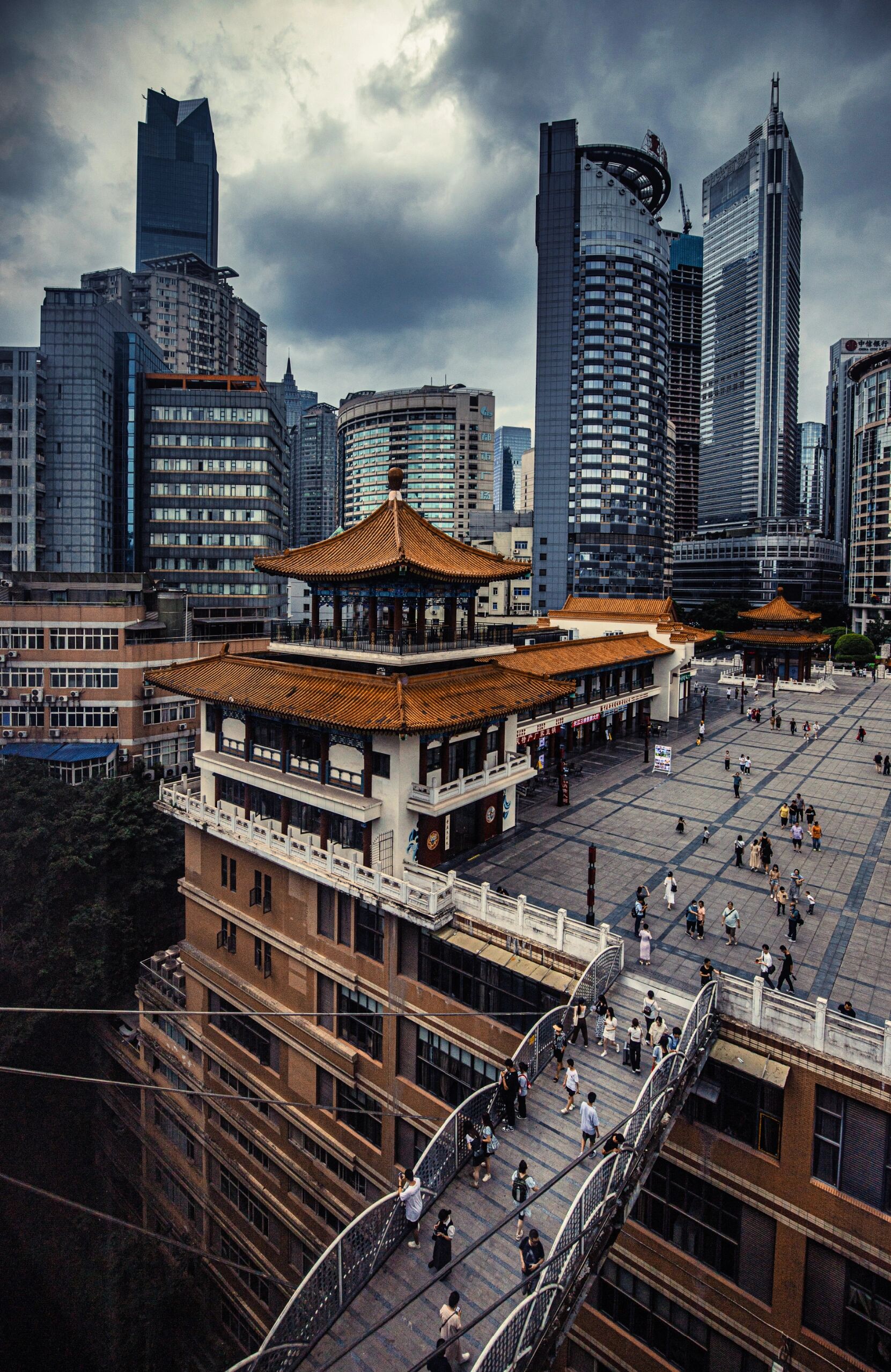
To understand Hongyadong, you must first understand the city that made it inevitable. Chongqing — the Mountain City (山城) — sits at the confluence of the Yangtze and Jialing rivers, where the land refuses, with almost personal spite, to be flat. The city is built on a series of ridges and valleys so steep that urban planners long ago abandoned the pretense of a grid. Roads loop over roads. Bridges span gorges between buildings. A light rail line passes directly through the middle of a residential apartment block, the train emerging from someone's living room wall like a mechanical whale breaching a concrete sea.
Chongqing is also the Fog Capital, shrouded in mist for over a hundred days a year, and the Hotpot Capital, where the air itself carries the numbing perfume of Sichuan peppercorns and rendered beef fat. It is a city of thirty-three million people in its municipality, a place where GPS surrenders in confusion because the road you are "on" is actually the roof of the road below, and the building you are inside is also a hillside, and the hillside is also a bridge.
"Chongqing is not built on the mountain. The mountain is built into Chongqing." — Local saying (重庆不是建在山上,山是建在重庆里的)
In a city where the very concept of "ground floor" is a philosophical question rather than a fact, Hongyadong is not an anomaly. It is a thesis statement.
Inside Hongyadong: Food, Craft, and Culture
The interior of Hongyadong is organized vertically, each cluster of floors devoted to a different facet of Chongqing life. The lower levels — roughly B1 through B4, though "basement" is a generous term for spaces that open directly onto the riverside road — are devoted to food. And not the polite, curated food of a museum gift shop. This is Chongqing eating at full volume: hotpot restaurants where the broth boils in nine-grid iron pots and the air turns red with chili vapor; xiaomian (小面) noodle stalls where breakfast means a bowl of wheat noodles drowning in sesame paste, chili oil, and preserved vegetables; sour and spicy rice noodles (酸辣粉) served in paper bowls to crowds who slurp them standing, shoulder to shoulder, gazing out at the river.
The middle floors house traditional handicraft workshops — woodcarving, Shu embroidery, paper-cutting, sugar painting — where artisans demonstrate techniques passed down through generations of Bayu craftspeople. A small folk culture museum occupies one level, displaying artifacts from the old dockside communities that once populated this stretch of river: bamboo carrying poles, wooden washboards, the tools of boat trackers who once hauled cargo vessels upstream with ropes and raw human strength.
On select evenings, the complex hosts Sichuan opera performances — the famous face-changing (变脸) art where performers swap painted masks in the blink of an eye, each new face a different emotion, a different spirit. Watching it in the amber glow of Hongyadong's lantern-lit courtyard, with the river murmuring below and the city's neon skyline blazing beyond, the ancient art feels less like a performance and more like a memory surfacing.
The upper floors open onto observation decks that face the Jialing River and the Qiansimen Bridge. At night, these platforms fill with photographers and dreamers, all of them trying to capture the same impossible image: a golden palace floating above a black river, too beautiful to be real, too solid to be a dream.
The Viral Phenomenon
Hongyadong existed for over a decade as a well-regarded local attraction before the internet discovered it. Then, around 2018, the comparison crystallized: the tiered wooden structure, glowing warm gold against the night, its reflections rippling in the dark water below — it looked, unmistakably, like the bathhouse from Hayao Miyazaki's Spirited Away. The parallel spread across Douyin, Weibo, and eventually TikTok and Instagram like wildfire. Videos of the illumination sequence — the moment the lights cascade on, floor by floor, transforming a dark cliff into a palace of fire — accumulated hundreds of millions of views.
The numbers that followed were staggering. During national holidays, Hongyadong began drawing over one hundred thousand visitors per night. The Qiansimen Bridge became a pedestrian photography platform. The surrounding streets gridlocked with tour buses. Chongqing, long overshadowed by Beijing, Shanghai, and Xi'an in the international tourism imagination, was suddenly the most viral city in China — and Hongyadong was its avatar.
The transformation was not without friction. Local residents navigated around seas of selfie sticks. The complex implemented crowd-control measures, timed entry, and capacity limits. Yet something essential survived the virality: the genuine, gut-level astonishment of seeing it for the first time. No algorithm can flatten that. No amount of prior viewing prepares the human eye for the scale, the warmth, the sheer defiant beauty of a building that looks like it was dreamed into existence by a civilization that found gravity merely suggestive.
Visiting Hongyadong
The single most important tip: come after dark. Hongyadong by daylight is pleasant — a well-maintained cultural complex with good food and river views. Hongyadong after six in the evening, when the golden illumination ignites and the night sky turns the timber facades into something from a Tang Dynasty painting, is transcendent. The lights typically switch on around 6:00 PM in winter and 7:30 PM in summer, remaining lit until 11:00 PM.
Getting there is straightforward. Take Metro Line 1 or Line 6 to Xiaoshizi (小什字) station, exit at Exit 6, and walk five minutes downhill toward the river. Alternatively, numerous bus routes stop along Cangbai Road at the top entrance. Taxis can drop you at either the upper or lower entrance, though traffic around the complex can be punishing on weekend evenings.
For photography, the best vantage points are the Qiansimen Bridge itself (pedestrian walkway on the south side), the opposite bank of the Jialing River near the Grand Theatre, and the upper observation decks within the complex looking outward. For the classic "Spirited Away" composition — the full facade reflected in water — position yourself on the bridge about two-thirds of the way across, facing upstream.
To avoid the worst crowds, visit on a weekday evening outside of national holidays. The complex is free to enter, though individual restaurants and performances charge separately. Combine your visit with the nearby Jiefangbei pedestrian district (a ten-minute walk uphill) for shopping and street food, and the Chaotianmen dock area (fifteen minutes along the river) for views of the Yangtze-Jialing confluence and the spectacular Raffles City development.
And when you finally stand on that bridge, phone raised, golden light washing over your face, and the crowd around you murmurs in a dozen languages the same wordless wonder — remember that you are looking at something genuinely singular. Not a theme park. Not a reconstruction of a reconstruction. A living argument, rendered in timber and light, that a city can be built not despite its landscape but because of it. That the mountain need not be flattened. That the cliff can hold a palace, if you build it with enough stubbornness, enough poetry, and enough love for the impossible.