In the lexicon of Chinese landscape appreciation, there exists a saying so definitive, so final in its judgment, that it has functioned for four centuries as the last word on mountain beauty: Wuyue guilai bu kan shan, Huangshan guilai bu kan Yue — "Having returned from the Five Sacred Mountains, one does not look at mountains; having returned from Huangshan, one does not look at the Five Sacred Mountains." This is not hyperbole. It is a verdict, rendered by the Ming Dynasty travel writer Xu Xiake after a lifetime of climbing every significant peak in China, and it has never been successfully challenged.
Huangshan — the Yellow Mountain — rises in southern Anhui Province, a granite massif of seventy-two named peaks, the highest (Lotus Peak, Lianhua Feng) reaching 1,864 meters. But statistics fail the mountain entirely. What matters is not height but quality of form — the way Huangshan combines, in a single landscape, every element that Chinese aesthetics have spent two millennia learning to value. Strange pines. Absurd stones. A sea of clouds. Hot springs. The Chinese call these the mountain's "four wonders" (si jue), and together they compose a scene so concentrated in beauty that it seems less a natural formation than a deliberate work of art.
The Four Wonders: A Catalogue of the Impossible
The pines of Huangshan are not trees in any ordinary sense. They are Huangshan song — Huangshan pines (Pinus hwangshanensis), a species found nowhere else on Earth, and they grow where no tree should grow: from bare granite, their roots penetrating hairline fractures in the rock, their trunks twisted by centuries of wind into shapes that suggest calligraphy more than botany. Some lean horizontally from cliff faces. Some spiral. Some split into multiple trunks that reach in different directions, as though the tree could not decide which way to grow and chose all directions simultaneously.
The most famous of these is the Welcoming Pine (Yingke Song), which extends one long branch horizontally from its trunk near Jade Screen Peak, as though offering a hand to approaching visitors. It has become one of China's most recognized natural symbols, appearing on postage stamps, in government reception halls, and in the collective imagination as an emblem of hospitality. The tree is estimated to be over eight hundred years old. It has survived dynasties, wars, and revolutions. It continues to extend its branch.
The stones of Huangshan are equally improbable. Granite, weathered over millions of years by frost, wind, and chemical erosion, has been sculpted into forms that the Chinese have named with characteristic poetic precision: "Monkey Gazing at the Sea," "Squirrel Jumping to Heavenly Capital," "Immortal Playing Chess," "Dream Brush Producing Flowers." Over one hundred twenty such named rock formations exist, and the names are not arbitrary. They capture the moment of recognition — the instant when abstract geology resolves into narrative, when stone becomes story.
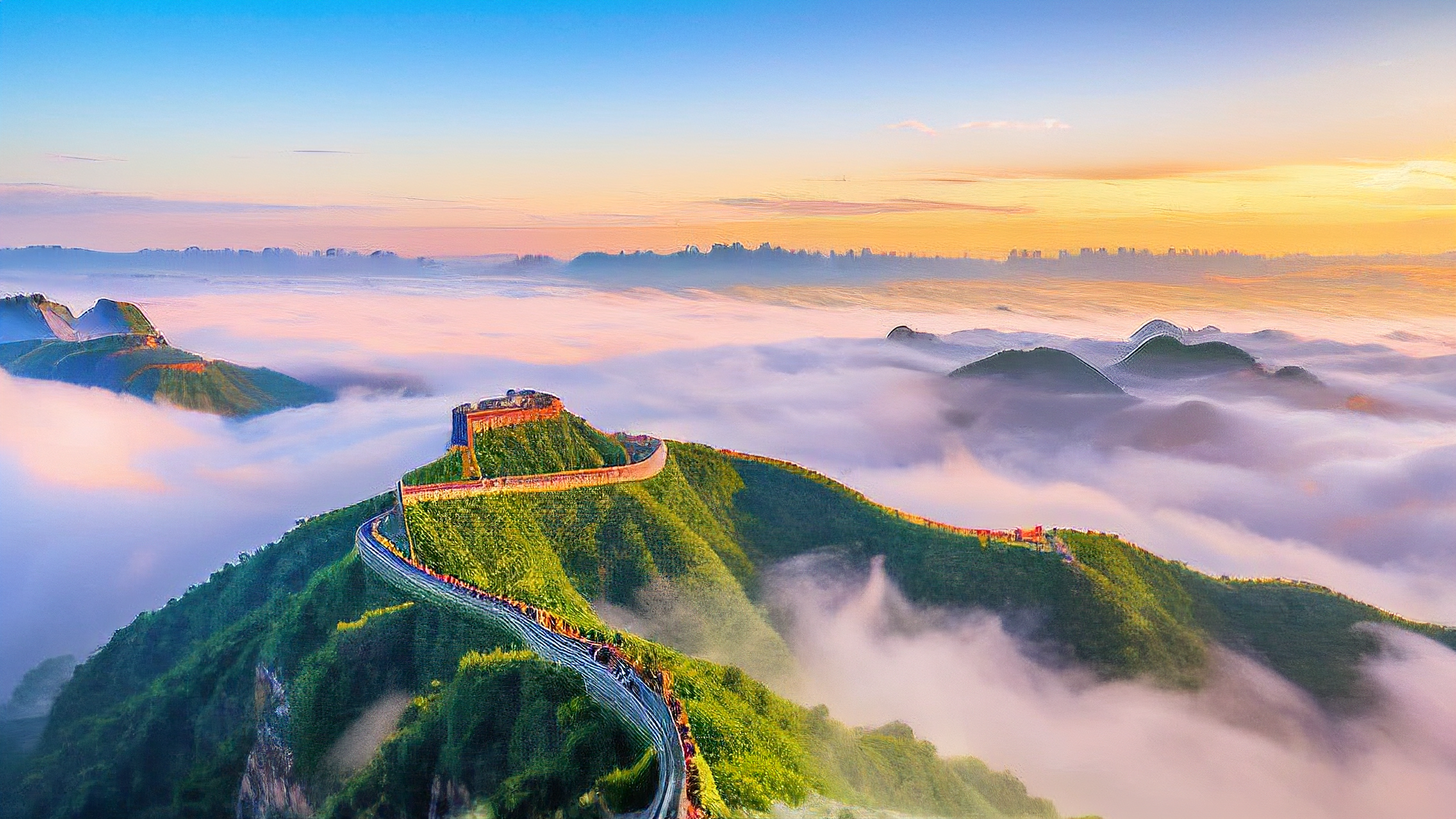
The sea of clouds (yunhai) transforms the mountain from a terrestrial landscape into a celestial one. When weather conditions align — typically after rain, when warm moist air rises and meets the cooler upper elevations — the valleys fill with cloud until only the highest peaks remain visible, floating like islands in a white ocean. The effect is so complete, so convincing, that standing on a Huangshan summit during a cloud sea feels genuinely like standing above the world. The Chinese have long associated this experience with the Taoist conception of immortality — the realm above the clouds where the xian, the transcendent beings, dwell.
The hot springs, the fourth wonder, emerge at the mountain's base at a constant temperature of approximately 42 degrees Celsius. They have been used for bathing since the Tang Dynasty, and their mineral content — rich in carbonates — was traditionally believed to cure skin ailments and restore vitality. The springs represent the mountain's hidden interior life, the geothermal energy that reminds us Huangshan is not merely a surface phenomenon but a deep-earth process made visible.
The Huangshan School: When Painting Met Its Subject
"I collected all the strange peaks of Huangshan and made them my friends. The mountains and I meet spiritually, and we do not tire of each other."
— Shitao (石涛), Qing Dynasty painter, who lived on Huangshan for years
No mountain in China has exerted a greater influence on painting than Huangshan. The "Huangshan School" (Huangshan hua pai), which emerged in the late Ming and early Qing dynasties, produced some of the most radical and influential landscape painting in Chinese history. Its practitioners — Hongren, Mei Qing, Zha Shibiao, and above all Shitao — did not merely depict the mountain. They developed entirely new visual languages to capture its qualities: the verticality of its cliffs, the emptiness of its cloud seas, the angular drama of its pines.
Hongren, a monk-painter who lived on Huangshan for extended periods, reduced the mountain to its geometric essence — sharp angular peaks rendered in spare, almost architectural lines, with vast areas of empty paper representing cloud and sky. His paintings look startlingly modern, anticipating minimalism by three centuries. Mei Qing took the opposite approach, his Huangshan paintings swirling with energy, the peaks writhing like living things. Shitao synthesized both tendencies, producing works of extraordinary spontaneity that seemed to capture not the mountain's appearance but its qi — its vital energy, its breath.
The relationship was reciprocal. Huangshan shaped these painters, but their paintings also shaped how subsequent generations perceived the mountain. To climb Huangshan today is to see it simultaneously with one's own eyes and through the accumulated vision of four centuries of painting. Every viewpoint is already a composition. Every pine is already a brushstroke. The mountain exists in a perpetual dialogue between nature and art, and the boundary between the two has long since dissolved.
Sunrise and the Spiritual Summit
The tradition of climbing Huangshan to watch the sunrise is not merely scenic. It is, in the Chinese understanding, a spiritual practice — an act of alignment between the individual and the cosmos. The most popular vantage points are Refreshing Terrace (Qingliang Tai) and Lion Peak (Shizi Feng), where hundreds of visitors gather in the pre-dawn darkness, wrapped in rented military coats against the mountain cold, waiting for the moment when the eastern sky ignites.
The sunrise at Huangshan is not the simple emergence of a disk above a horizon. Because of the cloud sea, it is a theatrical event of extraordinary complexity. The sun may appear to rise from within the clouds themselves, casting the white ocean in shades of gold and rose. Peaks emerge from shadow one by one, as though being painted into existence. The pines catch the first light and glow. For a few minutes, the entire landscape exists in a state of becoming — neither night nor day, neither hidden nor revealed, but suspended in the luminous interval between.
The Chinese have a term for this quality of mountain experience: ling — spiritual efficacy, numinous presence. A mountain with ling is not merely beautiful; it is alive, responsive, capable of transforming those who approach it with proper attention. Huangshan has been considered a mountain of exceptional ling since at least the Tang Dynasty, when the poet Li Bai wrote of its peaks as "lotus flowers blooming from the earth." The name itself — Yellow Mountain — is traditionally attributed to the legendary Yellow Emperor (Huang Di), who was said to have refined elixirs of immortality here before ascending to heaven.
A Mountain Preserved: UNESCO and the Question of Access
Huangshan was inscribed as a UNESCO World Heritage Site in 1990, recognized for both its natural and cultural significance — a dual designation that reflects the mountain's unique status as simultaneously a geological phenomenon and a cultural artifact. The UNESCO citation notes its "spectacular natural scenery" and its role as "the cradle of Chinese landscape painting and literature."
The mountain receives approximately three million visitors annually, a number that presents ongoing challenges of preservation and access. Stone steps — over sixty thousand of them, carved into the granite over centuries — provide access to the major peaks, but the physical demands of the climb remain significant. The traditional approach, ascending on foot over two or three days, sleeping in mountain guesthouses, preserves something essential about the experience: the gradual revelation of the landscape, the physical engagement with the terrain, the sense of earning each viewpoint through effort.
Cable cars now provide faster access, and there is no shame in using them. Yet the old paths retain their power. To climb Huangshan on foot, particularly in the quiet hours before dawn or after the day-trippers have descended, is to participate in a tradition stretching back over a millennium. Monks, poets, painters, emperors, and ordinary pilgrims have walked these same steps, paused at these same viewpoints, felt this same combination of exhaustion and exhilaration as the clouds parted and the peaks revealed themselves.
"Huangshan is the mountain of mountains. To have seen it is to have seen them all, and to see them all is to understand that seeing is not the point."
— Xu Xiake (徐霞客), Ming Dynasty geographer, paraphrased from his travel diaries
The mountain does not require your understanding. It has been growing its pines from bare rock, filling its valleys with cloud, and catching the sunrise for longer than human memory. But it permits your presence, and in that permission lies something rare: the opportunity to stand within a landscape that has shaped an entire civilization's conception of beauty, and to feel, however briefly, that you too are part of the composition. You are the small figure in the painting, gazing upward. The mountain does not notice. That is precisely the point.