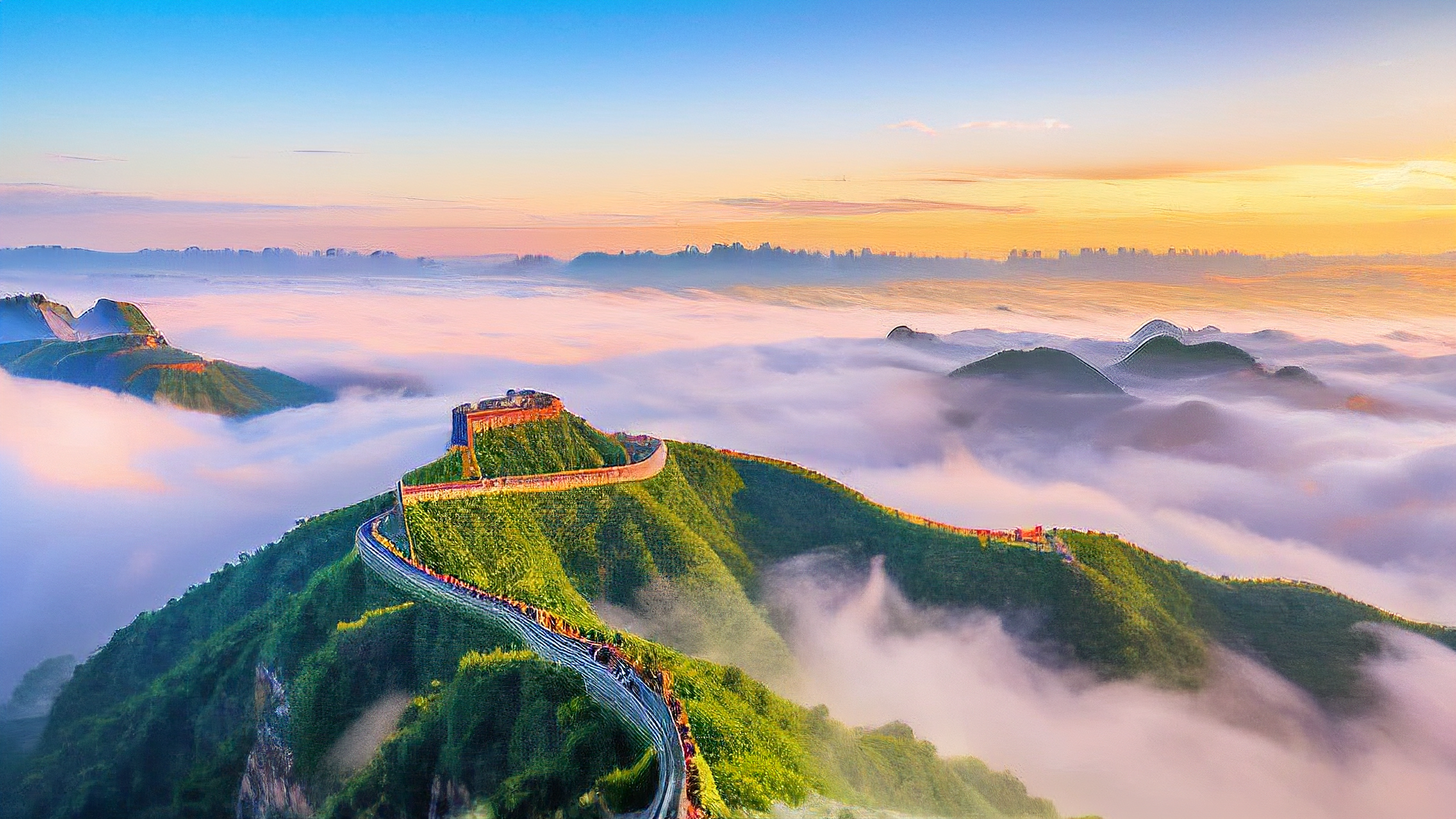
Long before China was a nation, before it was even a concept, it was a cosmological diagram. The land was understood not as territory to be administered but as a living body to be read — a body with a center, four directions, five elements, and a set of correspondences so intricate that every natural feature participated in a universal system of meaning. At the heart of this system stood five mountains, one for each direction, one for each element, one for each season of the soul. The Chinese call them the Wuyue — the Five Sacred Mountains — and for over three thousand years, they have functioned as the spiritual pillars holding up the Chinese cosmos.
These are not the highest mountains in China. They are not the most dramatic, the most remote, or the most technically challenging. Their sanctity does not derive from altitude. It derives from position — from their placement at the cardinal points of a sacred geography that maps not the physical world but the moral and spiritual one. To climb the Five Sacred Mountains is not to conquer nature. It is to take one's place within it.
The Cosmological Architecture: Five Peaks, Five Elements
The Five Sacred Mountains correspond, with the precision of a mathematical proof, to the five phases (wuxing) of Chinese cosmology: wood, fire, earth, metal, and water. Each mountain occupies a cardinal direction, governs a season, presides over a color, and embodies a specific spiritual quality. Together, they form a complete system — a pentagonal mandala written in stone across the Chinese landscape.
Tai Shan (Mount Tai), in Shandong Province, stands in the East. It corresponds to wood, to spring, to the color blue-green, and to birth. As the easternmost of the five, it is the mountain of sunrise — the first point where light touches the Chinese world. It is considered the foremost of the Five Sacred Mountains, the one to which emperors traveled to perform the feng and shan sacrifices: the feng on the summit, communicating with Heaven; the shan on a lower hill, communicating with Earth. No fewer than seventy-two legendary rulers are said to have performed these rites on Tai Shan, beginning with the mythical sage-kings of antiquity.
Hua Shan (Mount Hua), in Shaanxi Province, stands in the West. It corresponds to metal, to autumn, to the color white, and to death — or rather, to the necessary severance that autumn represents, the cutting away of what is no longer needed. Hua Shan is the most physically dramatic of the five: a single granite massif with five peaks, its cliff faces so sheer that the traditional climbing route includes the infamous "Plank Walk in the Sky" — a path consisting of wooden planks bolted to a vertical cliff face, with nothing below but a thousand meters of empty air.
Heng Shan (Mount Heng, Shanxi), in the north, corresponds to water, to winter, to the color black, and to the hidden depths of wisdom. This is the quieter, more contemplative of the sacred mountains, home to the extraordinary Hanging Temple (Xuankong Si) — a Buddhist, Taoist, and Confucian temple complex built into a cliff face, its wooden structures supported by beams inserted into holes carved in the rock, appearing to float above the valley floor. It has hung there for over fifteen hundred years.
Heng Shan (Mount Heng, Hunan) — the southern sacred mountain, distinguished from its northern namesake by a different Chinese character — corresponds to fire, to summer, to the color red, and to growth and flourishing. Its seventy-two peaks stretch across a vast area of Hunan Province, and its祝融峰 (Zhurong Peak) is named for the mythological fire god. The mountain is dense with temples, and its forests — unlike the bare granite of Hua Shan — are lush, subtropical, alive with birdsong and the sound of water.
Song Shan (Mount Song), in Henan Province, occupies the center. It corresponds to earth, to the transitional moment between seasons, to the color yellow, and to balance itself. As the central mountain, Song Shan represents the axis around which the other four revolve. It is home to the Shaolin Temple, birthplace of Chan (Zen) Buddhism and the martial arts tradition that bears its name, and to the Songyang Academy, one of the great centers of Neo-Confucian learning.
Imperial Pilgrimage: The Emperor Ascends
"The wise man finds pleasure in water; the virtuous man finds pleasure in mountains. The wise are active; the virtuous are tranquil. The wise are joyful; the virtuous are long-lived."
— Confucius, Analerta (论语), 6.23
The relationship between Chinese emperors and the sacred mountains was not one of casual appreciation. It was a political and spiritual obligation of the highest order. The feng and shan sacrifices on Tai Shan were, in theory, the prerogative of a ruler who had brought peace and prosperity to the realm — a cosmic report card, submitted to Heaven and Earth. To perform the rites without having earned them was an act of hubris that invited divine punishment. To neglect them was to sever the connection between the human and celestial orders.
Qin Shi Huang, the First Emperor who unified China in 221 BCE, ascended Tai Shan to perform the feng shan rites — and was caught in a violent storm on the summit, which his critics interpreted as Heaven's displeasure. Emperor Wu of the Han Dynasty made the journey multiple times, establishing the pattern of imperial pilgrimage that would continue for two millennia. The Tang Dynasty emperors expanded the temple complexes. The Qing Dynasty Kangxi and Qianlong emperors climbed Tai Shan repeatedly, leaving calligraphic inscriptions that remain visible today.
These imperial visits transformed the mountains physically. Roads were built, temples expanded, stone inscriptions carved. Tai Shan alone preserves over two thousand five hundred historical inscriptions and steles, ranging from the Han Dynasty to the present. The mountain is, in effect, an open-air archive of Chinese civilization — a library written in stone, organized not by subject but by altitude.
Taoist Peaks, Buddhist Valleys
The Five Sacred Mountains are sacred to both Taoism and Buddhism, though in different registers. For Taoists, the mountains are sites of spiritual cultivation — places where the qi of earth and heaven meet, where the practitioner can absorb celestial energy and advance toward immortality. Every sacred mountain has its Taoist temples, its meditation caves, its legends of masters who achieved transcendence on a particular peak and were never seen again.
Hua Shan, in particular, is a Taoist mountain. Its temples — the Jade Spring Temple at the base, the various shrines along the climbing route — are dedicated to Taoist deities and immortals. The mountain's extreme physicality, its sheer cliffs and terrifying paths, was understood not as an obstacle but as a test: only those with genuine spiritual commitment would attempt the ascent. The mountain filtered the casual from the sincere.
Buddhism arrived later but established itself deeply. Song Shan's Shaolin Temple, founded in 495 CE, became the most famous Buddhist monastery in China — not merely for its martial arts tradition but for its role as the transmission point of Chan Buddhism from the Indian monk Bodhidharma to the Chinese world. The Hanging Temple on northern Heng Shan houses Buddhist, Taoist, and Confucian shrines side by side, a physical embodiment of the Chinese tendency toward religious synthesis that has always puzzled Western observers expecting mutually exclusive faiths.
The Pilgrim's Path: Climbing as Practice
The traditional ascent of a sacred mountain is not a hike. It is a liturgy. The path is structured as a sequence of spiritual stations — gates, temples, pavilions, inscriptions — each marking a stage of inner transformation. On Tai Shan, the traditional route begins at the Dai Temple in Tai'an city, passes through the First Gate of Heaven, ascends the十八盘 (Eighteen Bends) — a punishing staircase of over sixteen hundred steps — and culminates at the Jade Emperor Peak, where the climber stands, metaphorically and almost literally, at the boundary between earth and sky.
The physical difficulty is intentional. The Chinese have always understood that spiritual insight requires physical engagement — that the body must participate in the soul's journey. The burning thighs, the labored breath, the temptation to stop and turn back: these are not incidental to the pilgrimage. They are the pilgrimage. The mountain asks something of you, and in the asking, transforms you. You arrive at the summit not merely at a higher altitude but at a different state of being.
"Climb the mountain and the world is small. Climb the sacred mountain and the self is small."
— Traditional saying, origin uncertain, attributed to multiple sources including Mencius
Modern infrastructure — cable cars, paved paths, souvenir shops — has made the sacred mountains accessible to millions who would never have attempted the traditional ascent. This is, on balance, a good thing. The mountains were never meant for an elite. The old woman climbing Tai Shan with incense sticks tied to her back, the student ascending Hua Shan on a dare, the family visiting Song Shan to show their children where Bodhidharma meditated: all are participating in a tradition that predates recorded history.
Inscriptions in Stone: The Mountain as Text
Perhaps the most remarkable feature of the Five Sacred Mountains is the sheer density of human inscription. Tai Shan's stone carvings span over two thousand years. Hua Shan's cliff faces bear the calligraphy of Tang, Song, Ming, and Qing masters. These inscriptions are not graffiti — they are offerings, prayers, poems, and philosophical statements carved into the mountain's body as acts of devotion and communication.
The most famous inscription on Tai Shan is the massive carved text of the Diamond Sutra in Sutra Stone Valley — Buddhist scripture rendered in characters over half a meter high, carved into a natural rock slope in the sixth century. The calligraphy is attributed to an unknown monk, and its style — bold, rounded, utterly confident — represents one of the high points of Chinese epigraphic art. It has weathered fourteen centuries of rain, wind, and political upheaval. It remains legible. The mountain holds the words as carefully as it holds the trees.
To walk the paths of the Five Sacred Mountains is to walk through a conversation between humanity and the earth that has been ongoing for longer than any other continuous cultural tradition on the planet. Every step crosses the footprints of emperors, monks, poets, and pilgrims. Every viewpoint has been seen, described, painted, and prayed over by generations beyond counting. The mountains do not require our worship. They have simply been waiting, with infinite patience, for us to arrive and add our small voice to the chorus. The path is open. The steps are carved. The only question is whether we will climb.