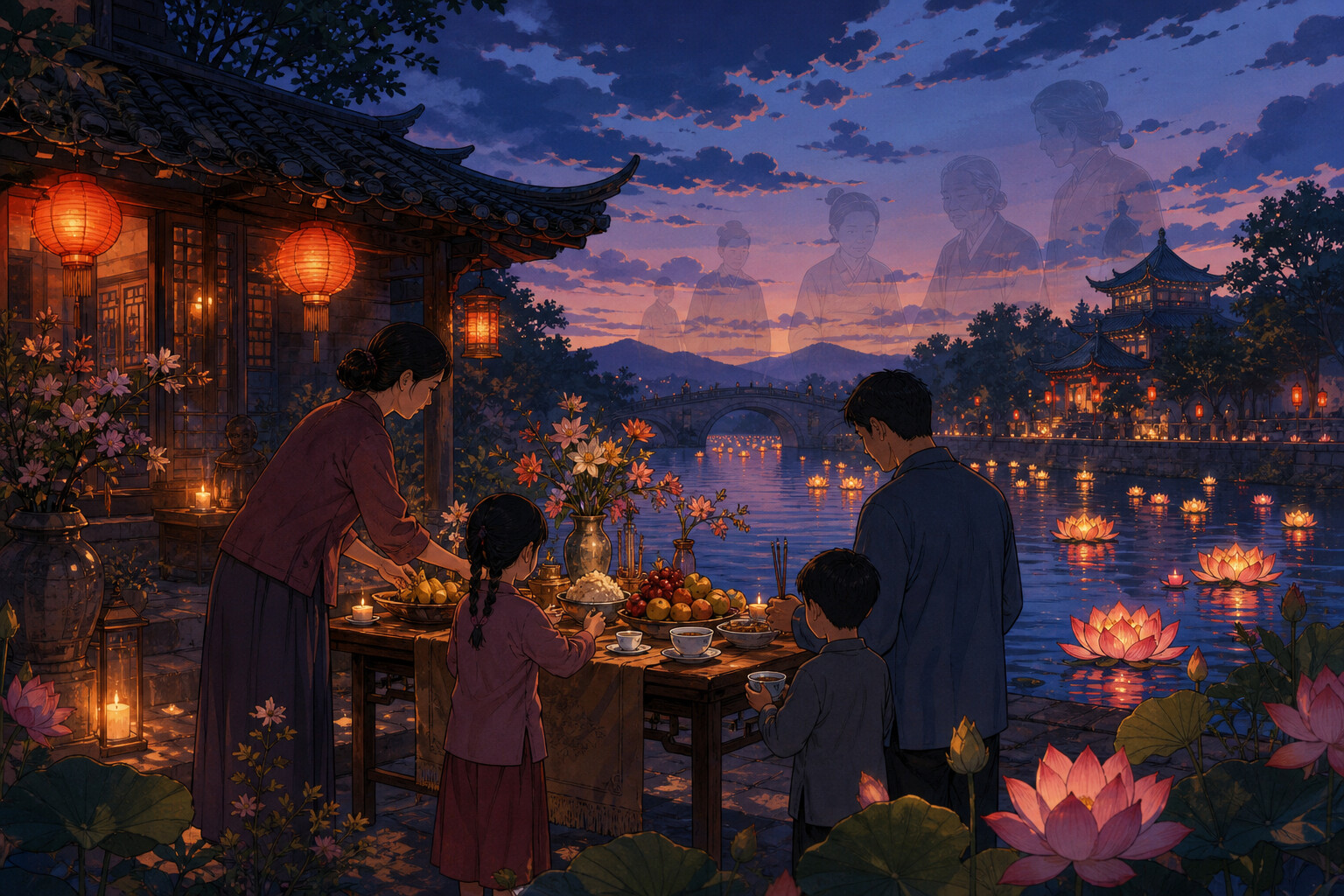
Today, Thursday, August 27, 2026, is the fifteenth day of the seventh month in the traditional Chinese calendar. It is Zhongyuan Festival—also called the Hungry Ghost Festival or, in Buddhist contexts, the Yulanpen Festival. On this night, many communities remember their ancestors and extend food, light and ritual care to wandering spirits who have no household waiting for them.
One Festival, Three Interwoven Traditions
Zhongyuan is not the product of a single founding story. Its present form grew from centuries of exchange among Daoist ritual, Chinese Buddhism, ancestor reverence and local folk practice. That is why several names can describe the same season while emphasizing different meanings.
Zhongyuan Jie
Zhongyuan is the “Middle Origin,” one of three calendrical yuan observances associated with the Three Officials of Heaven, Earth and Water. The seventh-month date is linked with the Earth Official and rites of pardon, release and care for the dead.
Yulanpen Festival
Buddhist tradition remembers Mulian—Maudgalyayana—seeking relief for his suffering mother. The story joins filial devotion to the making and sharing of religious merit, often through offerings and services for the deceased.
Hungry Ghost Festival
Folk practice imagines the seventh month as a time when spirits move more freely among the living. Families care for their own ancestors while also feeding “hungry ghosts”: unsettled beings with no descendants or regular offerings.
These layers do not cancel one another. A household might understand its actions mainly as family remembrance, attend a Buddhist service, recognize a Daoist ritual and follow local customs without drawing hard boundaries between them. Chinese festival life is often cumulative: stories and practices gather rather than replace one another.
Zhongyuan and Halloween: Similar Doorway, Different Room
For an international reader, Halloween offers a useful bridge. Both festivals developed around the idea that the border between worlds becomes unusually permeable. Both inherited customs involving food, fire, protection and the returning dead. Yet their emotional centers now point in different directions.
| Question | Zhongyuan Festival | Halloween |
|---|---|---|
| Calendar | Fifteenth day of the seventh lunar month; the wider seventh month may be treated as Ghost Month. | October 31, the eve of All Saints’ Day, with customs shaped by Allhallowtide, Samhain traditions and later popular culture. |
| Who returns? | Ancestors and wandering or “hungry” spirits. | Ghosts and supernatural beings in older belief; today, often fictional monsters and characters. |
| Main action | Offer, remember, transfer merit, appease and care. | Dress up, trick-or-treat, decorate, tell frightening stories and celebrate. |
| Food | Meals, fruit, tea and other offerings are presented to the dead before the living share or clear them. | Candy and party food are primarily for the living, especially children. |
| Public mood | Respectful, cautious and communal; festivities may accompany solemn rites. | Playful, theatrical and deliberately spooky in its modern secular form. |
| Central relationship | The living accept obligations toward family ancestors and spirits outside the family. | The supernatural becomes a space for play, fear, disguise and imagination. |
The comparison becomes misleading when Zhongyuan is reduced to horror. Its ghosts are not simply monsters. Some are remembered relatives; others represent the socially forgotten dead. The living respond not by becoming frightening themselves, but by setting another place at the moral table.
The Chinese Ghost Festival Explained
A concise religious-studies introduction to ancestors, hungry ghosts, paper offerings and performances.
Watch the original video on YouTube · English narration by ReligionForBreakfast · 15 min 35 sec
The video treats the festival as a living religious and social tradition rather than a list of spooky taboos. Notice its most important distinction: offerings go both to known ancestors and to spirits without descendants. That outward extension of care is what the Halloween shorthand usually misses.
What People Do During the Seventh Month
There is no single China-wide script. Practices change by region, religious community and family. In some places the festival is highly visible; elsewhere it is a quiet household observance or is barely marked at all. The following customs are best understood as a repertoire, not a checklist.
Prepare offerings
Families may arrange cooked dishes, rice, fruit, tea, wine, flowers and incense. Offerings for ancestors can be placed at a household altar; separate offerings may be left for wandering spirits.
Send paper goods
Joss paper and paper representations of useful objects may be burned as symbolic provisions for the other world. Fire rules and local restrictions should always take priority.
Hold religious rites
Buddhist chanting, merit-making and Yulanpen services coexist with Daoist rites intended to pardon, pacify or release suffering spirits.
Stage performances
Regional opera, puppet theatre and—in parts of Southeast Asia—getai concerts may entertain deities, spirits and living neighbors. Front seats are sometimes left symbolically empty for unseen guests.
Float lanterns
Water lanterns can guide spirits, carry prayers and mark a gentle return. The image turns darkness into a navigable path rather than a source of terror.
Share with the community
Public Yu Lan observances may include rice distribution, processions and opera, strengthening neighborhood ties as well as relations with the dead.
If You Encounter Zhongyuan Observances
A visitor does not need to adopt every belief, but should treat the ritual space as meaningful to the people maintaining it. Do not step over offerings, move incense, take food from an altar or occupy seats deliberately left empty. Ask before photographing worshippers or close-up ritual actions.
Popular lists of Ghost Month taboos—do not swim, whistle at night, turn when someone calls your name, or hang clothes after dark—vary widely and are often amplified for entertainment. They reveal how a community imagines vulnerability, but they should not be presented as rules followed by every Chinese person.
The Festival’s Deeper Question: Who Cares for the Forgotten?
Ancestor festivals can look inward, toward lineage and family continuity. Zhongyuan also looks beyond the family. The hungry ghost has no descendants, no stable place and no one obligated to remember. By offering food to such spirits, a community imagines care extending past kinship.
That is why fear and compassion remain intertwined. People make offerings partly because neglected spirits may be dangerous, but the ritual answer to danger is hospitality. The unknown dead are fed. Performances give them pleasure. Lanterns show them a way home. Disorder is met with generosity and boundaries rather than conquest.
Halloween allows people to play at becoming the monster. Zhongyuan asks what duty the living owe to a being who has become monstrous through hunger, loneliness or neglect. One festival thrives on disguise; the other insists on recognition.
Tonight, Let the Lanterns Mean More Than Ghosts
On August 27, 2026, the seventh lunar month reaches its fifteenth day. In homes and community spaces where Zhongyuan is observed, tables will be laid for guests who cannot be seen. Incense smoke will rise. Opera may face rows shared by the living and the absent. Lights may drift over water.
The festival does not ask everyone to agree on the geography of the afterlife. It asks the living to remember that a society is measured partly by whom it refuses to forget.
Zhongyuan Festival: quick answers
- When is Zhongyuan Festival in 2026?
- Thursday, August 27, 2026—the fifteenth day of the seventh traditional Chinese lunar month.
- Is Zhongyuan Festival Chinese Halloween?
- The analogy helps explain the nearness of spirits, but the festivals are not equivalents. Zhongyuan emphasizes offerings, ancestors, wandering spirits and moral obligation rather than costumes and entertainment.
- What do people do during Zhongyuan Festival?
- Depending on the community, people may offer food and incense, burn paper goods where permitted, attend Buddhist or Daoist rites, stage performances, distribute rice or float lanterns.
- Why is it called the Hungry Ghost Festival?
- “Hungry ghosts” are unsettled or neglected spirits who lack descendants or regular offerings. The festival extends ritual hospitality to them as well as to family ancestors.
Sources and further viewing
- Hong Kong Observatory: 2026 Gregorian–Lunar Calendar Conversion Table
- Government Records Service of Hong Kong: Yu Lan Ghost Festival practices
- ReligionForBreakfast: “The Chinese Ghost Festival Explained”
- HISTORY: Halloween’s development from Samhain and Allhallowtide to modern customs
Customs described here vary by region and community. The embedded video belongs to its original creator; ChinaMaxxing did not commission it and is not affiliated with its sponsorships.