The Boy Who Wrote It in Tears
Cao Xueqin (曹雪芹, c. 1715–1763) was born into a world of almost obscene privilege, and he lost it all before he was thirteen. His grandfather, Cao Yin (曹寅), had been one of the Kangxi Emperor's most trusted servants — a textile commissioner in Nanjing who hosted the emperor on his southern inspection tours, who collected rare books, who moved in the highest circles of Qing court society. The Cao family's wealth was legendary. Their gardens were said to rival the imperial parks. For three generations, they lived at the center of power.
And then the Yongzheng Emperor ascended the throne in 1722, and the political winds shifted. The Cao family was accused of financial irregularities — the specific charges remain debated by historians — and in 1728, their properties were confiscated. The family was stripped of rank, wealth, and position. Cao Xueqin, then a boy of perhaps twelve or thirteen, watched his universe collapse. He spent the rest of his life in poverty on the western outskirts of Beijing, supported by friends, drinking heavily, painting and writing. Tradition holds that he spent a decade on Dream of the Red Chamber (Honglou Meng, 红楼梦), revising it obsessively, "weeping blood" over the manuscript. His friend Dun Cheng (敦诚) wrote of finding him in a state of cheerful destitution, still working, still drinking, still utterly committed to the book. He died before completing it — or rather, before the completed version could be safely circulated. The first eighty chapters passed from hand to hand in manuscript copies, each one precious, each one annotated by eager readers. He left behind the first eighty chapters of what is, by any serious reckoning, the greatest novel ever written in Chinese.
A World Behind the Walls
The novel's setting is the vast compound of the Jia family (贾府) in an unnamed northern city — a sprawling aristocratic estate with two main mansions, the Rongguo Mansion (荣国府) and the Ningguo Mansion (宁国府), connected by gardens, corridors, and generations of accumulated obligation. Into this world we are introduced through the eyes of Lin Daiyu (林黛玉), a motherless girl sent to live with her grandmother, the formidable Grandmother Jia (贾母), and through her we meet the novel's central figure: Jia Baoyu (贾宝玉), the young heir who was born with a piece of magical jade in his mouth and who has, from earliest childhood, shown a distressing (to his father) preference for the company of girls over the study of Confucian classics.
Baoyu is not a hero in any conventional sense. He is petulant, emotional, sometimes cruel in the careless way of the very privileged. But he is also genuinely tender, genuinely perceptive, and genuinely incapable of performing the masculinity his father, Jia Zheng (贾政), demands of him. He calls men who pursue official careers "career worms" (禄蠹, ludu). He would rather compose poetry with his cousins in the garden than prepare for the examinations. His father beats him savagely for this. The reader, by and large, sides with Baoyu.
The love triangle at the novel's heart is between Baoyu, the brilliant and sickly Daiyu, and the capable, socially adept Xue Baochai (薛宝钗). Daiyu is all feeling — she writes the finest poetry in the novel, weeps at fallen petals, and loves Baoyu with a ferocity that consumes her. Baochai is all propriety — intelligent, warm, practical, everything a Confucian wife should be. The novel does not simplify this into a contest between good and bad. Baochai is genuinely admirable. But the system — the family, the marriage brokers, the logic of dynastic continuity — chooses Baochai for Baoyu, and Daiyu dies, tradition holds, on the night of their wedding. It is one of the most devastating sequences in world literature.
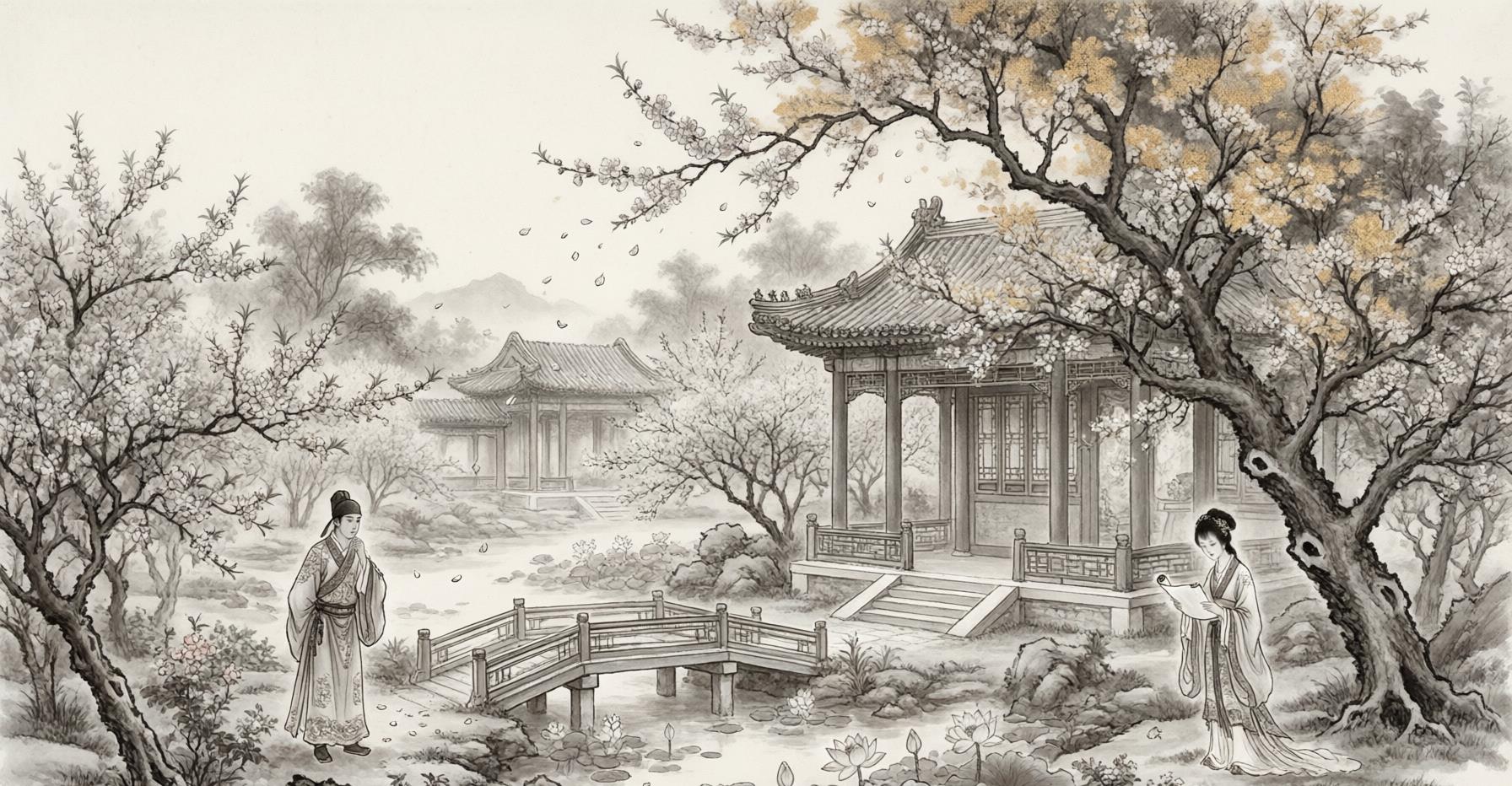
The novel's middle chapters — the ones readers remember most vividly — are set largely in the Grand View Garden (Daguanyuan, 大观园), a lavish pleasure ground built within the family compound to receive Baoyu's elder sister, now an imperial consort (贵妃, guifei), on a state visit. After the visit, the garden becomes the domain of the young people: Baoyu, his sisters, his cousins, and their attendants. Here they form poetry clubs (the famous Haitang She, 海棠社, or Begonia Society), stage crab-blossom viewing parties, compose verses on assigned themes, and enact a kind of pastoral idyll within the walls of a great house. The garden is a world apart — a space where talent and sensitivity matter more than rank, where a servant girl's wit is as valued as a young lady's. It is also, the reader understands from the start, temporary. Gardens, in Chinese literature, do not last. They bloom, and then they are swept away.
Four Hundred Lives and a Universe of Detail
The scope of Honglou Meng is staggering. The novel contains over four hundred named characters, from the highest matriarch to the lowest kitchen maid, and each is rendered with individual specificity. But it is the novel's encyclopedic attention to material life that distinguishes it from virtually everything else in the Chinese fictional tradition. Cao Xueqin describes, with the precision of a specialist, the preparation of specific dishes (the famous eggplant dish that requires ten chickens to prepare), the composition of medicinal prescriptions, the layout of garden architecture, the rules of poetic composition, the hierarchy of servant ranks, the rituals of Buddhist and Daoist worship, the management of household accounts, the etiquette of gift-giving, the construction of a kite.
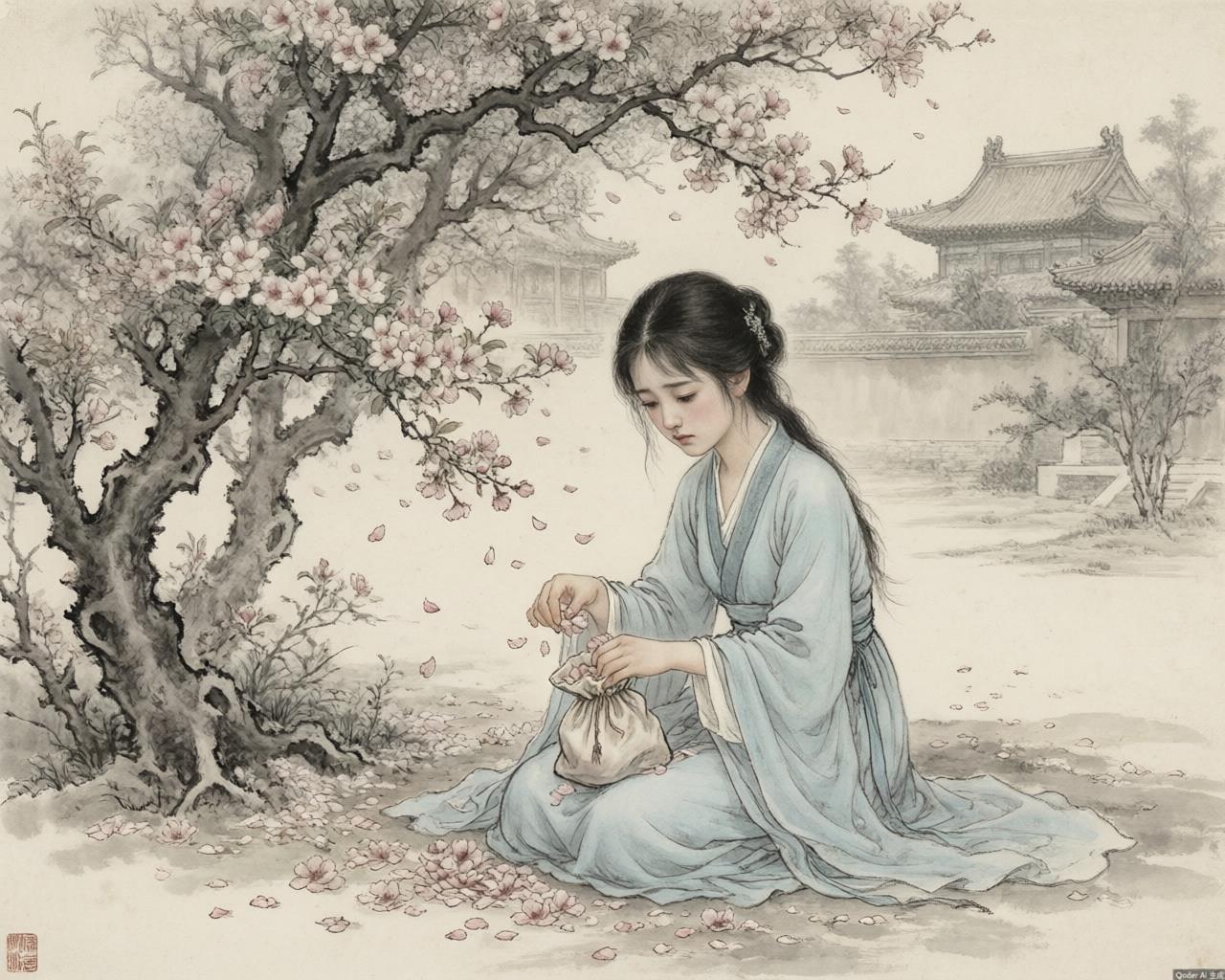
This is not padding. This is argument. The novel's insistence on the texture of daily life — what people eat, wear, read, play, argue about, how they arrange flowers, how they address their elders, how they conceal their feelings behind formal courtesies — is the mechanism by which Cao Xueqin makes you love this world before he destroys it. You cannot grieve for an abstraction. You grieve for the specific way Daiyu buries fallen blossoms in silk bags. You grieve for the specific recipe Grandmother Jia prefers for her evening congee. The detail is the point. When the family falls — and it falls, catastrophically, in the novel's final movement — you feel the loss not as a historical event but as the annihilation of a particular way of arranging chopsticks on a lacquer tray.
The Stone, the Flower, and the Question of Illusion
Honglou Meng opens not in the Jia compound but in a mythological frame. A sentient Stone (顽石, wanshi), left unused by the goddess Nüwa when she repaired the heavens, begs to be taken down to the mortal world to experience life. A Buddhist monk and a Daoist priest grant the wish. The Stone is reborn as Jia Baoyu, the jade in his mouth. Meanwhile, in the celestial realm, the Stone had once watered a Crimson Pearl Flower (绛珠仙草, jiangzhu xiancao), which now vows to repay the debt by following him to earth and repaying him with a lifetime of tears. The flower becomes Lin Daiyu.
This frame story is not mere decoration. It establishes the novel's governing philosophical tension: the relationship between illusion (幻, huan) and reality (真, zhen). The very names of the novel's two families encode this — Jia (贾) is a homophone for "false" (假), and the甄 family that appears briefly is a homophone for "true" (真). The novel's full title in some editions is The Story of the Stone (Shitou Ji, 石头记), and its opening poem warns the reader directly: "Truth becomes fiction when the fiction is true; non-being becomes being when the being is non-being" (假作真时真亦假,无为有处有还无). This couplet, inscribed on a牌坊 in the Land of Illusion (太虚幻境, Tai Xu Huanjing), is the novel's thesis statement. Everything you are about to read is real. Everything you are about to read is a dream. Both are true simultaneously.
"Truth becomes fiction when the fiction is true; non-being becomes being when the being is non-being."
— Cao Xueqin, Dream of the Red Chamber, Chapter 1
The Mystery of the Last Forty Chapters
Here is the wound at the center of Redology (Hongxue, 红学): Cao Xueqin died leaving the novel unfinished, or rather, leaving its ending in a state that has generated two and a half centuries of scholarly warfare. The first eighty chapters circulated in manuscript copies during Cao's lifetime, often with commentary by a figure known only as Zhiyan Zhai (脂砚斋, "Red Inkstone Studio"), whose marginal notes hint at plot developments in later chapters that do not appear in any surviving text. The novel was first printed in a complete 120-chapter edition in 1791, edited by Cheng Weiyuan (程伟元) and Gao E (高鹗). The last forty chapters are generally attributed to Gao E, though scholars debate the extent to which he was working from Cao's drafts, notes, or oral traditions.
The controversy is not merely academic. Readers have argued, passionately and sometimes bitterly, about whether Gao E's ending honors Cao's vision. In the printed version, the Jia family is partially restored after its fall, Baoyu passes the examinations (a bitter irony, given his lifelong contempt for them), and then he vanishes into the world as a Buddhist monk. Many readers find this resolution too neat, too consoling. The clues in Zhiyan Zhai's commentary suggest a darker ending: total ruin, Daiyu's death by drowning or grief, Baoyu reduced to genuine destitution. We will never know for certain. The lost ending is Chinese literature's great what-if, and it has generated an industry of speculation, reconstruction, and creative reimagining that shows no signs of exhausting itself.
Redology: The Academic Empire
No other Chinese novel has generated anything remotely approaching the scholarly infrastructure that surrounds Honglou Meng. Redology (Hongxue, 红学) is not a casual field of study. It is a recognized academic discipline with dedicated journals, international conferences, and competing schools of interpretation. There are scholars who have spent entire careers on the question of whether a single line in Chapter 67 is Cao's or Gao E's. There are scholars who have reconstructed the floor plans of the Rongguo Mansion from textual evidence. There are scholars who argue, with considerable passion, about whether Lin Daiyu's death constitutes a Buddhist or a Daoist transcendence.
The field's major figures read like a who's who of modern Chinese intellectual history. Hu Shi (胡适) established the autobiographical reading in the 1920s, arguing that the novel was Cao Xueqin's fictionalized memoir. Yu Pingbo (俞平伯) extended this approach. During the Cultural Revolution, Redology was attacked as bourgeois decadence, and scholars were persecuted for their work. The field survived, as fields do, and has since expanded to encompass feminist readings, narratological analyses, comparative literature approaches, and digital humanities projects that map the novel's social networks computationally. The novel supports all of this. It is deep enough, rich enough, contradictory enough, to sustain infinite interpretation. This is, perhaps, the truest test of a masterpiece.
From Opera to Theme Parks
Honglou Meng's influence on Chinese culture extends far beyond the academy. The novel has been adapted into Peking opera, Kunqu opera, Yue opera (越剧), television series (the 1987 CCTV adaptation is considered a national treasure), films, ballets, and countless stage productions. The Grand View Garden has been physically reconstructed as a tourist attraction in Beijing. Characters from the novel appear in advertising, in internet slang, in the names of restaurants and tea brands. Lin Daiyu has become a cultural archetype — the brilliant, melancholy, impossibly sensitive woman destroyed by a world too coarse for her. To call someone "a Daiyu" in Chinese is to invoke an entire philosophy of feeling.
The 1987 television adaptation, directed by Wang Fulin (王扶林), deserves special mention. Filmed over three years with a cast trained in traditional arts, it became one of the most-watched programs in Chinese television history. Its theme song, "Wang Ningmei" (枉凝眉, "Vainly Knitting the Brow"), is known to virtually every Chinese person born after 1970. The adaptation made choices — particularly regarding the ending, which drew on Redological scholarship rather than Gao E's continuation — that remain controversial, but its cultural impact is beyond dispute. For millions of viewers, it was their first encounter with the novel, and it shaped their understanding of the characters as definitively as any stage production shapes understanding of Shakespeare.
"All is vanity. The golden age is past. The great tree falls and the monkeys scatter. In the end, it is all a dream."
— Attributed to the novel's thematic arc, echoed in countless adaptations and commentaries
Why It Endures
Dream of the Red Chamber endures because it is, simultaneously, a love story, a family saga, a social novel, a philosophical meditation, and an encyclopedia of a civilization at its most refined and most fragile. It asks the largest questions — what is real, what is illusion, can beauty survive in a world governed by power and money, is love possible within a system designed to commodify it — and it asks them through the smallest details: the way a girl folds a handkerchief, the way a grandmother arranges a screen in her sitting room, the way a young man flinches when his father enters the room.
For readers approaching the novel from outside the Chinese tradition, the experience can be initially daunting — the cast list alone requires a bookmark — and then, somewhere around the twentieth chapter, suddenly addictive. The novel's domesticity is its gateway. You do not need to understand Qing dynasty sumptuary law to recognize a grandmother manipulating her children through strategic generosity, or two teenagers conducting a love affair entirely through the medium of borrowed books and meaningful silences. Cao Xueqin's genius is that the specifically Chinese details — the incense, the medicine, the poetry games — are not barriers to emotional comprehension but vehicles for it. The more specific the detail, the more universal the feeling. This is why the novel translates, imperfectly but powerfully, into English, French, German, Japanese, and dozens of other languages. The particular is the road to the general. Cao Xueqin understood this two centuries before it became a creative-writing workshop maxim.
Cao Xueqin wrote from the other side of loss. He had possessed the world he describes, and he had watched it taken from him. The novel is an act of reconstruction and an act of mourning performed simultaneously. Every beautiful scene is shadowed by the knowledge that it will not last. Every poem the characters compose is, for the reader, an elegy for the poets themselves. This double vision — the joy of the moment and the grief of its passing, held together without resolution — is what gives Honglou Meng its extraordinary emotional power. It does not console. It does not moralize. It simply shows you a world in its fullness and lets you feel the full weight of its passing. Two and a half centuries later, readers still weep. That is not sentimentality. That is art.