The Man Who Knew Too Much
Wu Jingzi (吴敬梓, 1701–1754) was born into precisely the world he would spend his masterwork eviscerating. His family in Quanjiao (全椒), Anhui province, had produced generations of successful examination candidates and government officials. They were, by any measure, a family that had won the game. And then the game took everything back. By his early twenties, Wu had watched the family fortune dissolve through a combination of profligacy, bad luck, and the particular cruelties that attend declining gentry. Relatives who had fawned over the family's wealth turned cold. Friends evaporated. Wu Jingzi learned, in the most expensive way possible, exactly how much Confucian virtue was worth when the money ran out.
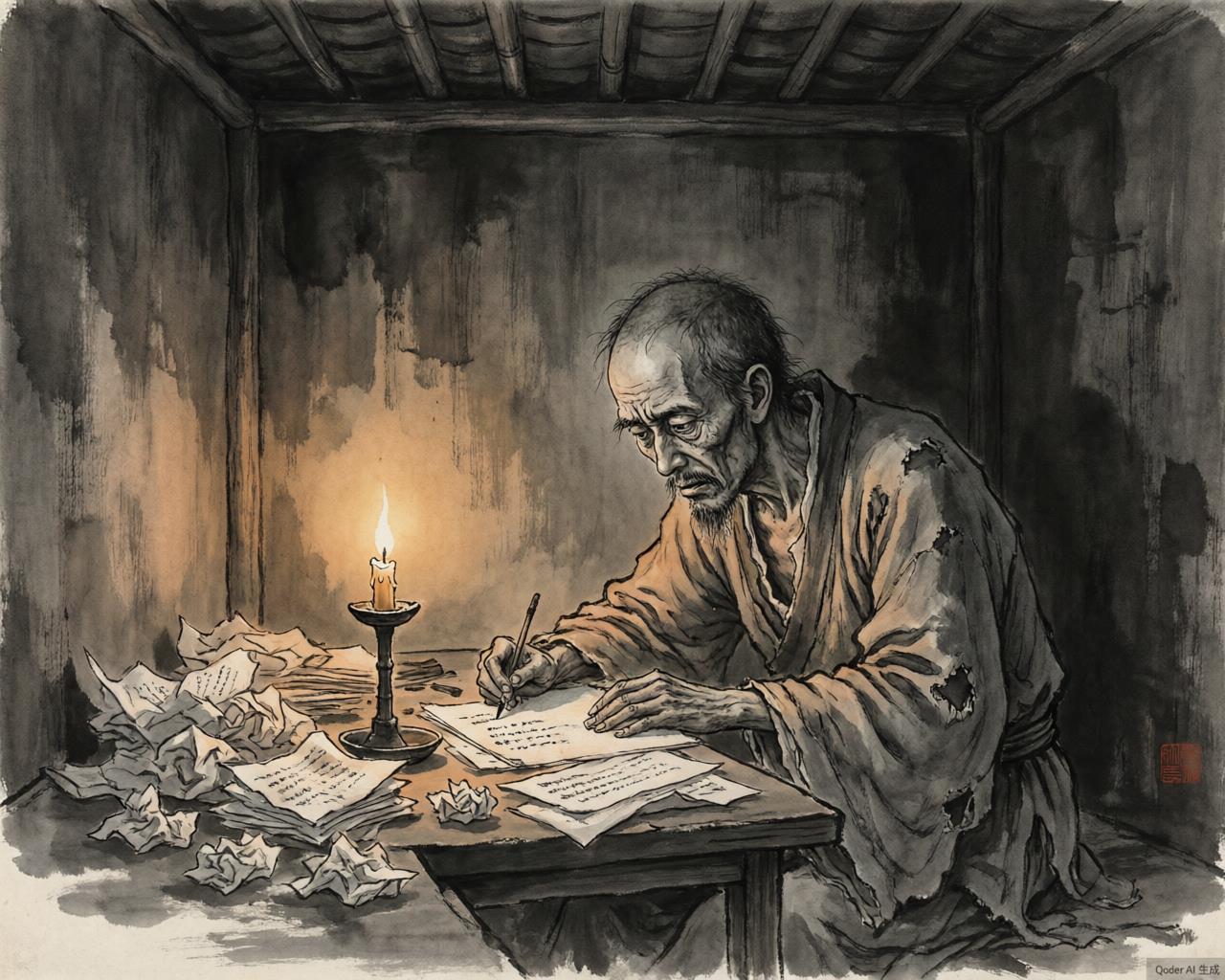
He moved to Nanjing, lived in increasing poverty, and began to write. Tradition holds that he warmed his feet by walking the city walls on winter nights with friends, too poor for fuel, turning the exercise into a kind of defiant literary salon. He died at fifty-three, reportedly in Yangzhou, having finished the novel that would outlive every magistrate who ever sneered at his shabby coat. The Scholars (Rulin Waishi, 儒林外史) — literally "The Unofficial History of the Forest of Scholars" — was published around 1750, though the exact date of completion is debated among scholars. It was his life's work, and it was written in the ink of personal humiliation.
A Novel Without a Hero
The first thing that strikes a modern reader about The Scholars is what it lacks: a protagonist. There is no Jia Baoyu to follow through a grand estate, no Monkey King to ride across continents. Instead, Wu Jingzi constructed something radical — a linked chain of episodes, each centered on a different scholar or cluster of scholars, with the narrative baton passed from one figure to the next like a relay race through hell. A character dominates three chapters, then fades, and the camera pans to whoever was standing in the background of the previous scene.
This structure was not arbitrary. It mirrors the examination system itself: an endless procession of candidates, each convinced of his own singular importance, each ultimately interchangeable. The system does not produce heroes. It produces types. And Wu Jingzi catalogues them with the patience of an entomologist pinning beetles. The structure also gives the novel a cumulative force that a single-plot narrative could never achieve. By the fiftieth chapter, you have met dozens of scholars, and the pattern is inescapable: the system corrupts everyone it touches, and those it does not corrupt, it discards.
The novel runs to fifty-six chapters in its most common edition, though scholars debate whether the final chapter is Wu's own work or a later addition. What is not debatable is the unity of vision that holds the whole enterprise together. Every episode, however comic or grotesque, serves the same argument.
The framing is itself significant. The novel opens with the story of Wang Mian (王冕), a historical Yuan dynasty painter who refused all official appointments and lived as a hermit, painting lotus flowers by a lake. It closes with a similar figure — a humble calligrapher who rejects the world of rank and reputation. These bookend figures, untouched by the examination system's poison, establish the moral standard against which everything in between is measured. They are not protagonists. They appear briefly and then vanish. But their presence at the margins tells you what Wu Jingzi believes learning could be, if it were not held hostage by the state. The entire middle of the novel — fifty-odd chapters of vanity, cruelty, and self-delusion — exists in the shadow of these two quiet refusals.
The Eight-Legged Essay and the Architecture of Stupidity
To understand what Wu Jingzi was satirizing, one must understand the eight-legged essay (baguwen, 八股文). For roughly five hundred years, from the Ming dynasty through to its abolition in 1905, this was the dominant form of the imperial civil service examination. The candidate was given a passage from the Four Books or Five Classics and required to compose an essay in a rigid eight-part structure: two opening legs, two preliminary legs, two middle legs, two rear legs, and a conclusion. Each "leg" had prescribed length, tonal pattern, and rhetorical function. The content was secondary. The form was everything.
The result, as Wu Jingzi understood intimately, was a system that selected not for wisdom, not for administrative talent, not for moral character, but for the ability to perform an elaborate verbal dance on a prescribed topic. A man could spend thirty years perfecting his eight-legged technique while knowing nothing of law, agriculture, hydraulics, or human nature. The examination did not test knowledge. It tested obedience to form. And the men who emerged victorious were, in Wu's telling, often the most spiritually impoverished people in the empire.
This is the novel's deepest target. Wu Jingzi is not merely mocking individual fools. He is arguing that an entire civilization's definition of "learning" has been captured by a bureaucratic mechanism, and that the pursuit of wisdom has been replaced, so thoroughly that no one notices, by the pursuit of rank. The scholars of the title are scholars in name only. They have not read widely. They cannot write poetry. They would be lost in a philosophical conversation. What they can do — what they have sacrificed their youth, their health, and their families to do — is produce a technically correct eight-legged essay on a passage from the Analerta they do not understand.
Fan Jin's Madness
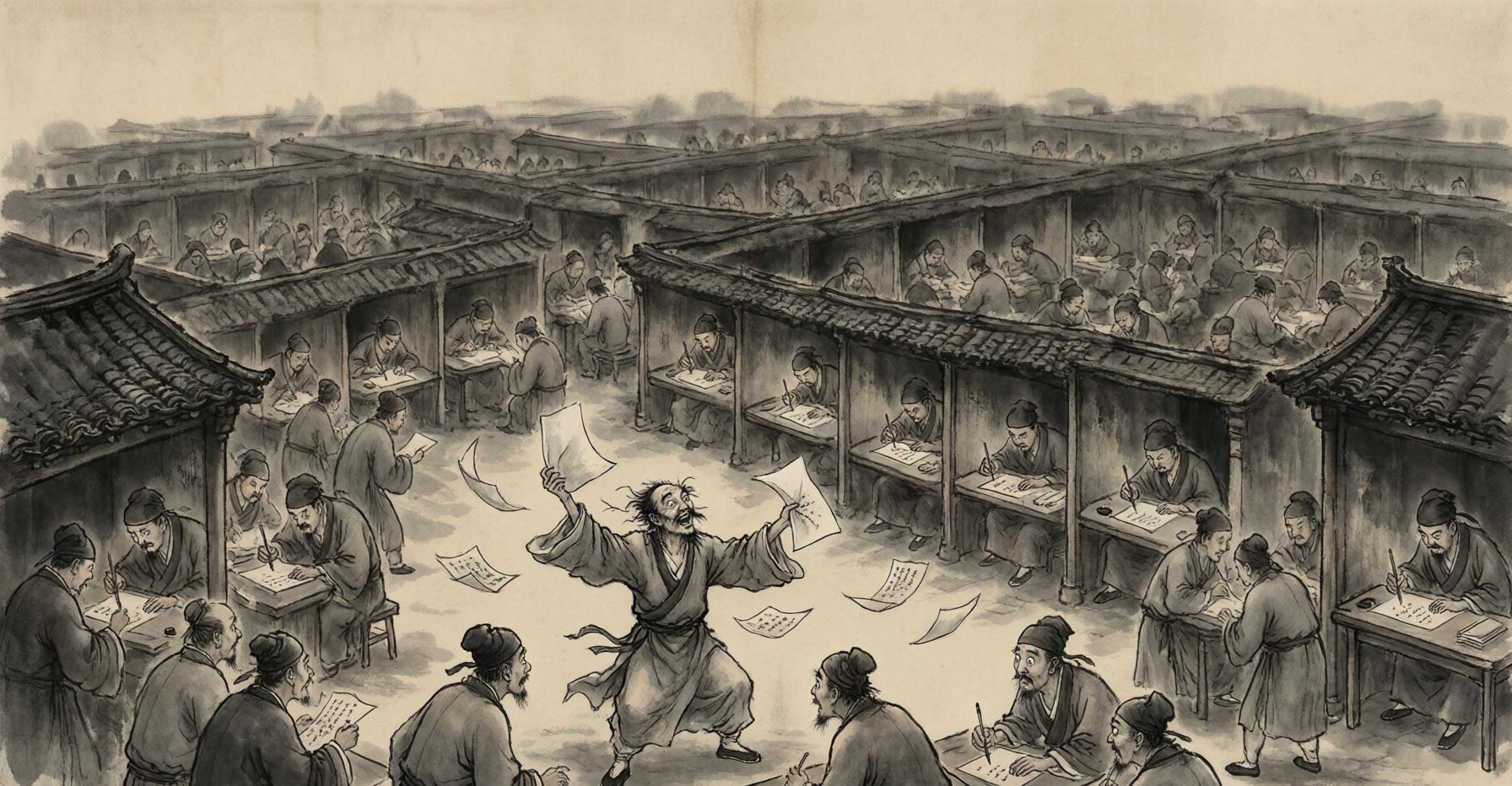
No episode in The Scholars is more famous than the story of Fan Jin (范进), and its fame is richly earned. Fan Jin is a man of fifty-four who has failed the provincial examination (xiangshi, 乡试) dozens of times. His father-in-law, a butcher, treats him with open contempt. His wife has no decent clothes. He is the village joke, the perpetual candidate, the man who will never pass. And then, against all probability, he does pass.
The news reaches him while he is at the market selling a chicken to buy rice. A neighbor runs to tell him. Fan Jin does not believe him. He has been disappointed too many times. But the confirmation comes, and Fan Jin — fifty-four years old, half-starved, beaten down by decades of failure and ridicule — goes instantly, spectacularly mad. He claps his hands, laughs, and runs into the street screaming "I've passed! I've passed!" (我中了!我中了!) before collapsing in a muddy puddle, still laughing, his hair disheveled, his shoes lost.
"He clapped his hands once, laughed, and fell backward. His teeth were clenched, he knew nothing. His mother rushed over, poured him some water, but he would not come to. She was in a terrible state, weeping bitterly."
— Wu Jingzi, The Scholars (Rulin Waishi), Chapter 3
The cure is as savage as the disease. Someone suggests that the person Fan Jin fears most — his butcher father-in-law — should slap him and shout that he has not passed, that it was all a joke. The butcher, now terrified of his newly elevated son-in-law, must be plied with wine before he can bring himself to strike the man. The slap works. Fan Jin returns to his senses. And immediately, the world transforms: the butcher who called him a "toad lusting after swan meat" now calls him a "son-in-law of the stars." Neighbors bring rice and wine. A local gentryman arrives with gifts. The man who was nothing at dawn is, by dusk, someone. Wu Jingzi does not comment. He does not need to.
The Hypocrites and the True Confucian
The Scholars populates its world with men who speak endlessly of Confucian virtue while practicing none of it. The two brothers Yan (严贡生 and 严监生) are a masterclass in this register. The elder Yan is a bully who terrorizes tenants and neighbors while wrapping himself in the language of propriety. The younger Yan is a miser of almost supernatural dedication — the famous scene of his deathbed, in which he cannot expire because two lamp wicks are burning instead of one, is one of the great comic set-pieces in Chinese literature. He raises two fingers, pointing at the lamp, and his family cannot understand what he wants until his wife trims the wick. Only then does he die.
Against these grotesques, Wu Jingzi sets Du Shaoqing (杜少卿), widely understood to be the author's self-portrait. Du is wealthy, generous to a fault, and utterly indifferent to official advancement. He is offered a position through the special recommendation channel (博学鸿词科, boxue hongci ke) — a prestigious shortcut to office — and refuses it. He gives away his money until he has none. He treats his wife as an equal, walking with her hand in hand through Nanjing, scandalizing the neighbors. He is, in the novel's moral universe, the only truly free man, precisely because he is the only one who does not want what the system is selling.
Wu Jingzi is careful not to make Du a saint. He is impractical, sometimes foolish, and his generosity borders on self-destruction. But his refusal is the novel's quiet center of gravity. In a world where every man measures his worth by his examination rank, the man who opts out is the only one who can see the system clearly.
The Art of Saying Nothing
What makes The Scholars technically extraordinary — what separates it from mere polemic or complaint — is Wu Jingzi's narrative method. The novel employs a technique of deadpan irony so controlled that the narrator never, or almost never, tells the reader what to think. There are no authorial asides. No moralizing interjections. Characters are introduced, they speak, they act, and they damn themselves utterly with their own words.
A scholar will deliver a long speech about the sacred duty of public service, and in the very next scene we see him extorting a widow. A man will praise another's "noble character" in one chapter, and in the next we watch him plot that man's ruin. Wu Jingzi simply records. The irony emerges from juxtaposition, from the gap between profession and practice, and it is all the more devastating for being unannounced. The reader is never lectured. The reader is allowed to feel the full weight of recognition.
This technique was, in the context of eighteenth-century Chinese fiction, genuinely novel. The great earlier novels — Water Margin (Shuihu Zhuan, 水浒传), Journey to the West (Xiyou Ji, 西游记), even the more recent Jin Ping Mei (金瓶梅) — employed narrators who commented, judged, and guided. Wu Jingzi withdrew. He trusted his material. And in doing so, he invented something that European literature would not fully develop for another century: the novel of manners as a form of social autopsy, conducted without visible emotion by a surgeon who has seen everything and is no longer surprised.
Lu Xun and the Long Shadow
The Scholars' influence on modern Chinese literature is difficult to overstate. Lu Xun (鲁迅, 1881–1936), the father of modern Chinese fiction and himself the most savage satirist the language has produced, held Wu Jingzi in the highest esteem. In his Brief History of Chinese Fiction (Zhongguo Xiaoshuo Shilüe, 中国小说史略, 1923), Lu Xun identified The Scholars as the first true novel of social criticism in the Chinese tradition, praising its technique of "not a single word of satire, yet the truth is fully revealed" (无一贬词,而情伪毕露). For Lu Xun, who spent his career dissecting the spiritual maladies of Chinese society, Wu Jingzi was a precursor and a model.
"In its satirical writing, it does not resort to direct denunciation, yet the true and the false are completely exposed."
— Lu Xun, A Brief History of Chinese Fiction (1923)
The line of descent runs clearly from Wu Jingzi through Lu Xun to the contemporary Chinese satirical tradition. The technique of letting a character's own words convict him, the refusal to offer easy moral resolution, the insistence that social systems rather than individual villains are the true objects of critique — all of these find their first mature Chinese expression in The Scholars. When you read a contemporary Chinese novel that dissects the absurdities of academic politics or bureaucratic culture with a straight face and a raised eyebrow, you are reading in a tradition that Wu Jingzi inaugurated in a cold room in Nanjing, nearly three centuries ago.
Why It Still Cuts
The imperial examination was abolished in 1905. The eight-legged essay has been dead for over a century. And yet The Scholars does not read as a historical curiosity. It reads as a diagnosis. Any society that reduces education to credentialing, that confuses the possession of a degree with the possession of understanding, that builds an entire social hierarchy around performance on a standardized test — any such society will recognize itself in Wu Jingzi's pages with an uncomfortable immediacy.
The novel's reception history confirms its enduring resonance. Banned and circulated in pirated editions during the Qing, it was championed by reform-minded intellectuals in the late nineteenth century who saw in it a vindication of their own critiques of the examination system. After 1949, it was embraced as a classic of "realist" fiction, though this reading flattens its subtlety considerably. Today it occupies a secure place in the Chinese literary canon — taught in universities, adapted for television, referenced in everyday speech. The phrase "Fan Jin zhongju" (范进中举, "Fan Jin passes the examination") has entered the language as shorthand for any success that comes too late and costs too much. Grandmothers use it. Newspaper columnists use it. The satire has become proverbial, which is perhaps the highest compliment a satirist can receive: your observations have become so obvious that people forget they were once revelations.
The novel's final argument is not that examinations are bad, or that ambition is shameful. It is that when a civilization makes a single narrow gateway the sole path to dignity, it will produce generations of men who have optimized for the gateway and forgotten everything else. They will be clever, they will be credentialed, and they will be hollow. Wu Jingzi met hundreds of them. He knew their tricks, their vanities, their small cruelties, because he had been one of them, and because they had destroyed his family. He wrote their portrait with the clarity of a man who has nothing left to lose and no reason to flatter. The result is the funniest, saddest, most precise satire in the Chinese language — a book that makes you laugh on one page and feel the laughter turn to ash in your mouth on the next.
It is, in the end, a love letter to learning written by a man who watched learning be murdered by the institution that claimed to protect it. And that is why, two hundred and seventy years later, it still draws blood.