A Novel That Shouldn't Exist
Every literary tradition has its embarrassing genius — the book that critics whisper about in footnotes, that students discover in locked cabinets, that everyone has heard of and no one quite knows how to discuss at dinner. For Chinese literature, that book is Jin Ping Mei (金瓶梅), known in English as The Plum in the Golden Vase or, more literally, The Plum, the Vase, and the Crabapple. Written around 1610, during the late Ming Dynasty, it is simultaneously one of the most important novels in the Chinese language and one of the most persistently misunderstood.
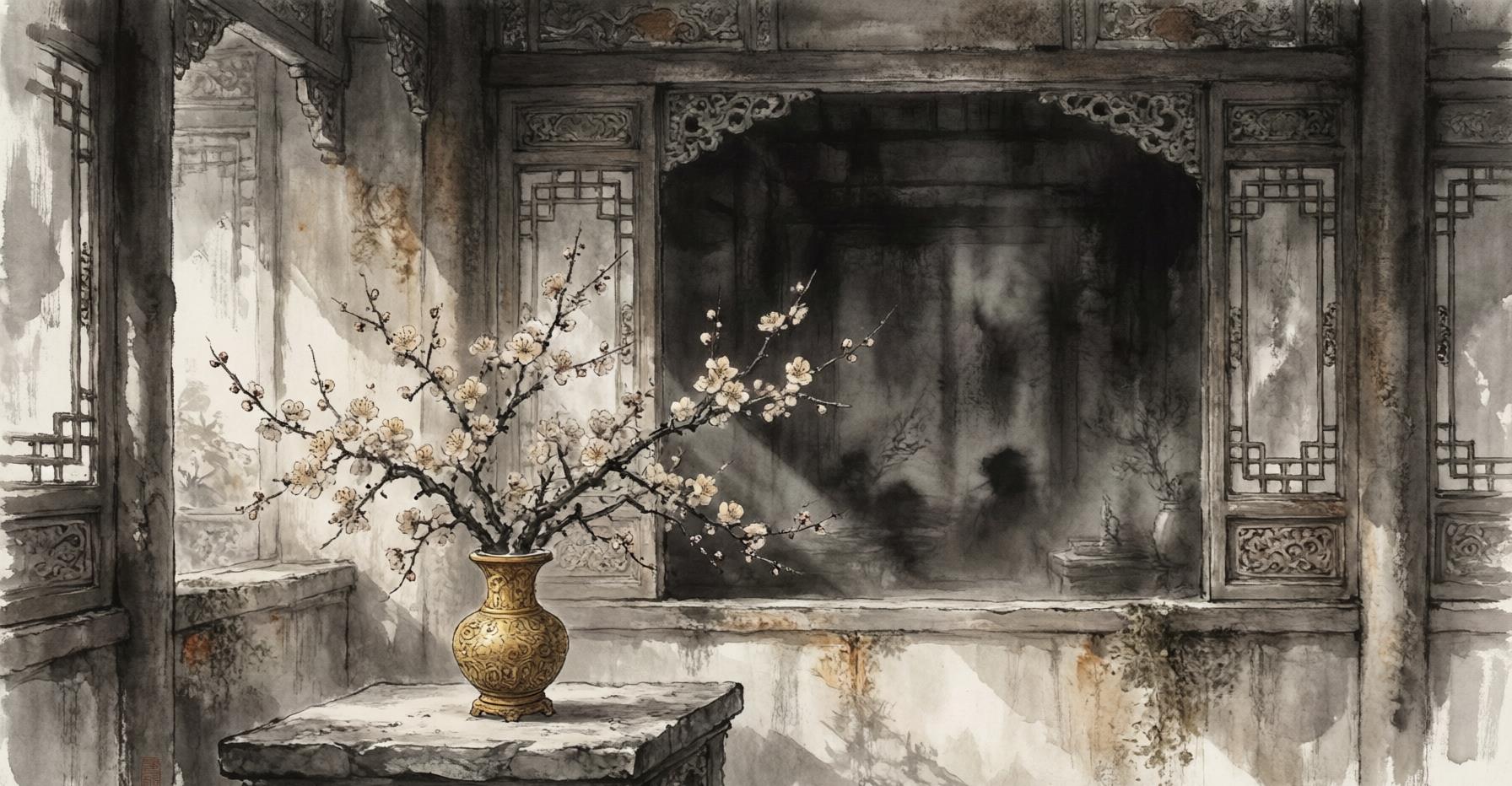
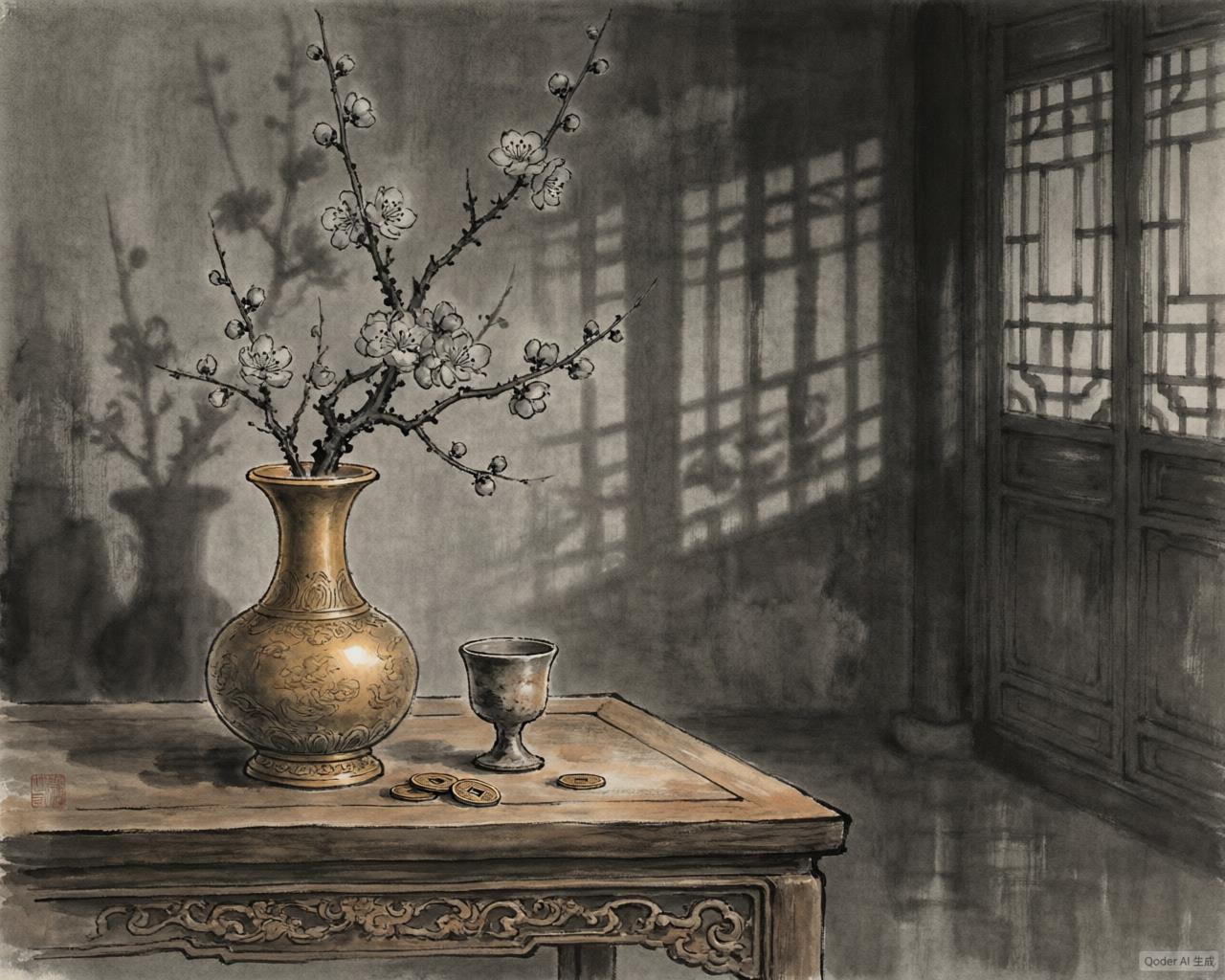
The title itself is a puzzle. It is assembled from the names of three women: Pan Jinlian (潘金莲), "Golden Lotus"; Li Ping'er (李瓶儿), "Little Vase"; and Pang Chunmei (庞春梅), "Spring Plum." Three women, three characters plucked from the name of the book like ingredients from a recipe. But the title also evokes something else entirely — a golden vase holding plum blossoms, an image of beauty arranged and contained, of luxury that is also a kind of imprisonment. Both readings are correct. That ambiguity is the novel's native element.
For four centuries, Jin Ping Mei has been called pornography, satire, social criticism, and masterpiece — often by the same critic in the same paragraph. It has been banned, censored, pirated, bowdlerized, and secretly passed hand to hand among scholars who would never admit to owning a copy. And yet it endures, not because it is shocking, but because it is true. It looked at the world — at money, at desire, at the small cruelties of domestic life — and refused to look away. In doing so, it invented something that had never existed before in Chinese fiction: the novel of ordinary life.
Born from the Ribs of Water Margin
To understand where Jin Ping Mei came from, you have to understand what it grew out of. The great Ming Dynasty novel Water Margin (Shuihu Zhuan, 水浒传) — that rollicking epic of 108 outlaws who take refuge in the marshes and wage war against corrupt officials — contains, in its chapters 23 through 27, a comparatively small story. It concerns Wu Song (武松), a legendary hero of superhuman strength, and his brother Wu Dalang (武大郎), a meek seller of flatcakes. Wu Dalang's wife, Pan Jinlian, is beautiful, restless, and catastrophically unfaithful. She takes a lover: Ximen Qing (西门庆), a wealthy apothecary and local bully. Together they murder Wu Dalang. Wu Song returns, discovers the crime, and exacts a bloody, righteous vengeance.
In Water Margin, this episode is a sideshow — a vivid little morality play nested inside a much larger adventure. The anonymous author of Jin Ping Mei looked at this episode and saw something no one else had seen: a whole novel hiding inside it. What if, instead of following Wu Song's heroic rampage, we stayed in the house? What if we followed Ximen Qing home? What if we watched what happened the morning after the murder, and the morning after that, and the hundred mornings that followed?
The result is a work of roughly one hundred chapters that takes those five chapters of source material and explodes them into a vast, granular, unflinching portrait of a single household in the fictional town of Qinghe (清河). Ximen Qing is no longer a minor villain dispatched by a hero's fist. He is the protagonist — or rather, the subject. We watch him bribe officials, seduce neighbors, manipulate tax collectors, acquire wives, discard servants, gorge himself at banquets, and slowly, grotesquely, destroy himself through his own appetites. The hero Wu Song still appears, but he is marginal, almost irrelevant. The real drama is domestic. The real violence is quiet.
The World Inside the Walls
What makes Jin Ping Mei revolutionary is not its plot. The plot, summarized, sounds like a sensationalist pamphlet: a corrupt merchant accumulates wealth and women, indulges every appetite without restraint, and dies a hideous death while his household collapses around him. What makes the novel revolutionary is its attention. No Chinese novel before it had bothered to record, with such obsessive specificity, the texture of daily existence.
We learn what Ximen Qing's wives eat for breakfast — not in a general sense, but dish by dish, preparation by preparation. We learn the exact fabrics of their robes, the precise weights of silver exchanged in bribes, the hierarchy of servants and who sleeps in which room and who is jealous of whom. We learn how a household budget works, how a concubine negotiates her position, how gossip travels through a compound from the main wife's quarters to the servants' kitchen. The novel is, among other things, an accidental encyclopedia of late Ming material culture: its commerce, its medicine, its food, its clothing, its music, its funeral rites.
This is the novel's great innovation, and it is easy to underestimate because it now seems obvious. Before Jin Ping Mei, Chinese fiction dealt primarily in heroes, gods, generals, and bandits — figures whose lives were extraordinary by definition. The domestic sphere, the world of women and merchants and servants, was considered too small, too mundane for sustained narrative attention. The anonymous author disagreed. He or she understood that a household of six wives and concubines jockeying for position is as dramatic as any battlefield, and that the slow erosion of a man's health through gluttony and lust is as tragic as any hero's fall.
The Scoffing Scholar of Lanling
Who wrote this book? The question has consumed scholars for four centuries and remains, as of this writing, genuinely unresolved. The earliest surviving editions attribute the work to "Lanling Xiaoxiao Sheng" (兰陵笑笑生) — the Scoffing Scholar of Lanling, or the Laughing Student of Lanling. Lanling is a place name associated with the region around modern-day Cangshan in Shandong province. The "scoffing" or "laughing" in the pen name suggests an author who views his subject with detached, sardonic amusement — which is, indeed, the novel's dominant tone.
Beyond that, speculation proliferates. Over the centuries, scholars have proposed more than fifty candidates. The most persistent theories point to figures connected with the literary circles of the late Ming: the dramatist and critic Wang Shizhen (王世贞), the writer Xu Wei (徐渭), or various members of the so-called Gong'an School of literary reform. Some scholars argue for a single author; others suggest the text shows signs of multiple hands, perhaps a gifted writer revising and expanding an earlier, cruder manuscript. The linguistic evidence is complex — the novel mixes standard Mandarin with Shandong dialect, with occasional passages in a southern register that complicates any simple geographic attribution.
The anonymity may be deliberate. In the late Ming, a novel this frank about sex, corruption, and the failures of the gentry class was dangerous to own, let alone to have written. The pen name is a mask, and the mask is part of the work's meaning: this is a book that laughs at what it describes, and its author refuses to step forward and be held accountable. The scoffing scholar laughs, and vanishes, and leaves the book to speak for itself.
The Question of Obscenity
Let us address the matter directly, because it cannot be avoided. Jin Ping Mei contains approximately two dozen extended sexual scenes, some of them graphic by any standard, in any century. These passages are the reason the novel has been banned in various forms throughout its history, the reason it circulates in censored editions, and the reason its literary reputation has always been complicated by its notoriety.
But to reduce the novel to its sexual content is to make a fundamental error of reading. The sex in Jin Ping Mei is not erotic in any celebratory sense. It is, almost without exception, an expression of power, manipulation, desperation, or self-destruction. Ximen Qing's sexual encounters are transactions — they advance his commercial interests, cement his political alliances, or demonstrate his dominance. The women's sexual agency, where it exists, is a survival strategy within a system that offers them few others. The novel's most famous sexual passages are also its most clinically observed: they read less like arousal than like case studies.
"The author's intention is to write of the corruption of the age... He writes of sex not to titillate but to show how desire, unchecked, becomes a force of annihilation."
— Zheng Zhenduo (郑振铎), in his assessment of the novel's literary purpose, c. 1930s
The great modern critic Lu Xun (鲁迅) placed Jin Ping Mei in a category he called "novels of human feeling" (renqing xiaoshuo, 人情小说), distinguishing it from the heroic and supernatural traditions that preceded it. For Lu Xun, the novel's significance lay precisely in its refusal to idealize. It showed people as they were — petty, greedy, lustful, vain — and in doing so, it created the foundation upon which all subsequent Chinese realist fiction would be built. The sexual content, in this reading, is not an indulgence. It is evidence. It is the novel saying: this too is part of life, and I will not pretend otherwise.
Two Editions, Two Books
Readers approaching Jin Ping Mei today should be aware that they are, in a sense, approaching two different novels. The earliest surviving complete edition, dating from around 1617, is known as the "word edition" or ci hua ben (词话本) — literally, the "song-words edition." This version retains a large number of songs, ballads, and verse passages interspersed throughout the prose, many of them borrowed or adapted from existing popular literature. It reads, at times, like a performance text — something closer to a storyteller's script than a modern novel.
The second major version, appearing around 1628–1644, is the "embroidered edition" or chong xiu ben (崇祯本), named for the reign period of the Chongzhen Emperor during which it was published. This edition was substantially revised: many of the songs were cut, the prose was tightened, the chapter openings were rewritten, and the overall structure was made more conventionally novelistic. The Chongzhen edition is generally considered more polished and more readable; it is the basis for most modern printed editions. But some scholars argue that the rougher, more digressive ci hua ben preserves something essential — a connection to oral storytelling traditions that the later revision smoothed away.
The differences matter because they affect tone. The ci hua ben, with its interpolated ballads, constantly reminds the reader that this is a constructed text, a performance. The Chongzhen edition creates a more seamless illusion of reality. Both approaches have their merits, and the choice between them shapes how one experiences the novel's famous irony. Is the author a storyteller winking at his audience, or an invisible observer recording what he sees? The two editions give different answers.
The Death of Ximen Qing and the Architecture of Consequence
Spoilers for a four-hundred-year-old novel: Ximen Qing dies. The manner of his death is the novel's masterstroke. There is no assassin, no heroic avenger, no divine punishment delivered from above. Ximen Qing dies because he cannot stop consuming. His death is an accumulation — of food, of sex, of elixirs and aphrodisiacs, of excess piled upon excess until the body simply fails. It is grotesque, prolonged, and deeply undignified. The great merchant, the man who could buy magistrates and seduce any woman in Qinghe, dies in his own filth while his wives begin dividing his possessions before his body is cold.
This is the novel's moral architecture, and it is more sophisticated than simple punishment. Ximen Qing is not struck down for his sins in the manner of a cautionary tale. He is not punished by an external moral force. He simply continues — continues eating, continuing taking, continuing consuming — until continuation becomes impossible. The novel's morality is not retributive but entropic. Things fall apart. Appetites exhaust their objects. The household that was built on bribery and desire cannot sustain itself, because bribery and desire are not foundations. They are solvents.
After Ximen Qing's death, the novel does not end. It continues for another twenty chapters, tracing the dissolution of his household — the wives scattered, the servants freed or sold, the wealth dispersed. Pan Jinlian, the woman whose name leads the title, meets a violent end. Li Ping'er, the gentlest of the wives, has already died of grief and illness. Only Pang Chunmei, the maidservant elevated to concubine, survives into a kind of diminished future. The novel's final chapters gesture toward Buddhist redemption — a monk appears, a son is ordained, the cycle of karma is acknowledged — but the gesture feels almost perfunctory, a conventional ending imposed on a book that has spent ninety chapters demonstrating that conventional endings are lies.
The Grandfather of the Red Chamber
No discussion of Jin Ping Mei is complete without acknowledging its most famous descendant. Dream of the Red Chamber (Honglou Meng, 红楼梦), written by Cao Xueqin in the mid-eighteenth century and widely regarded as the supreme achievement of Chinese fiction, is inconceivable without the precedent of Jin Ping Mei. The connection is not merely genealogical; it is structural, philosophical, and aesthetic.
Both novels center on a single household in decline. Both are obsessed with the material texture of domestic life — the food, the clothing, the architecture, the social hierarchies. Both populate their worlds with large casts of women whose inner lives are rendered with extraordinary sympathy. Both use the domestic sphere as a microcosm for larger social and moral decay. And both understand that the most profound tragedies are not dramatic but gradual — not a murder or a war, but the slow dimming of a household's lights.
The difference, of course, is one of sensibility. Where Jin Ping Mei is satirical, clinical, and savage, Dream of the Red Chamber is elegiac, poetic, and suffused with genuine tenderness. Cao Xueqin took the formal innovations of Jin Ping Mei — its domestic focus, its psychological realism, its attention to material detail — and infused them with a lyricism and emotional depth that the earlier novel, in its sardonic detachment, does not quite achieve. But the foundation is the same. Without the Scoffing Scholar's unflinching gaze, there is no Red Chamber. Without the novel that dared to make a merchant's household the subject of epic, there is no Cao Xueqin.
"Since the appearance of Jin Ping Mei, the scope of Chinese fiction was enlarged beyond the heroes and the supernatural to encompass the whole of human society in its ordinary manifestations."
— Lu Xun (鲁迅), A Brief History of Chinese Fiction (Zhongguo Xiaoshuo Shilue, 中国小说史略), 1923
Reading It Now
What does it mean to read Jin Ping Mei in the twenty-first century? The novel is long — roughly a million Chinese characters in its full form — and its rhythms are alien to readers accustomed to modern pacing. Its digressions into songs and ballads can test patience. Its sexual content, stripped of the shock value it once carried, can feel clinical or even tedious. Its worldview is bleak, its sympathies limited, its humor cruel.
And yet. There are passages in Jin Ping Mei that achieve a kind of terrible beauty precisely because of their refusal to console. The death of Li Ping'er, the gentle concubine who loves Ximen Qing with a devotion he does not deserve, is rendered with an attention to physical suffering and emotional devastation that anticipates the great death scenes of European naturalism by two centuries. The banquets, the parties, the endless negotiations over money and status, carry an anthropological richness that no history book can replicate. And the novel's formal audacity — its decision to make the unheroic, the domestic, the merely human, into the subject of a hundred-chapter epic — remains genuinely radical.
Jin Ping Mei is not a comfortable book. It was not meant to be. It is a book that looks at the world and says: this is what people are like when no one is performing heroism. This is what desire looks like when it is not dressed up as romance. This is what power looks like when it is not dressed up as justice. It is, in the deepest sense, a grown-up novel — the first in its tradition. And like all grown-up things, it is more complicated, more ambiguous, and more rewarding than the myths we tell about it.