The Monkey Who Broke Heaven
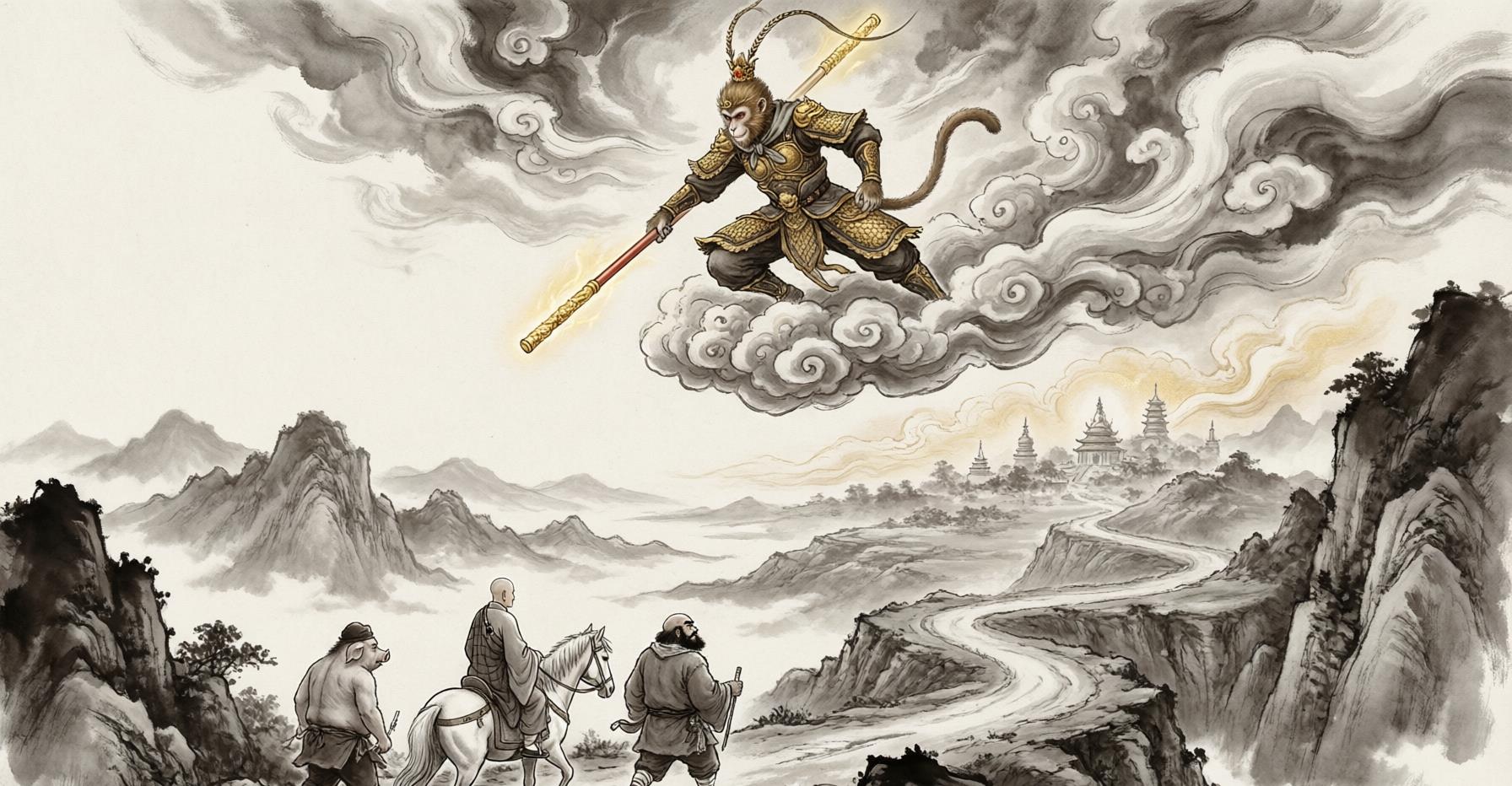
On the Mountain of Flowers and Fruit (花果山, Huaguo Shan), at the edge of the Eastern Sea, a stone nourished by eons of sunlight and moonlight cracks open. From it leaps a monkey — not born, exactly, but erupted, fully formed and already furious with vitality. He will learn to speak, to fight, to fly between worlds. He will storm the Dragon King's palace and steal a magic staff. He will eat the peaches of immortality, drink the Jade Emperor's wine, and erase his own name from the ledger of death. He will be given a title — "Great Sage Equal to Heaven" (齐天大圣, Qitian Dasheng) — and find it insufficient. He will wage war on the entire celestial bureaucracy, defeat its armies single-handedly, and be brought low only by the Buddha himself, who pins him beneath a mountain for five hundred years.
This is the opening act of Journey to the West (Xi You Ji, 西游记), and it is, by any reasonable measure, the greatest character introduction in Chinese literature. In seven chapters, Wu Cheng'en (吴承恩) — the author to whom tradition ascribes the novel, though scholars debate the attribution — creates Sun Wukong (孙悟空), the Monkey King, a character so vivid, so irrepressible, so fundamentally alive that he has outgrown the novel that contains him. Four centuries after the book's first publication around 1592, Sun Wukong remains China's most recognizable fictional creation: a trickster, a rebel, a devotee, a god, a cartoon, a video game protagonist, a national metaphor for restless genius constrained by authority.
The rest of the novel — ninety-three more chapters, a pilgrimage spanning fourteen years and 108,000 li — is, in a sense, the story of what happens when that boundless energy is given a purpose. It is also the funniest, strangest, and most philosophically layered adventure story ever written in Chinese.
From History to Myth: Xuanzang's Real Journey
Like Water Margin, Journey to the West grows from a historical seed. In 629 CE, the monk Xuanzang (玄奘) left Chang'an — the Tang dynasty capital, modern Xi'an — and traveled overland to India. His purpose was to retrieve authentic Buddhist scriptures, which he believed had been corrupted in Chinese translation. The journey took him through the Gobi Desert, across the Pamir Mountains, through the kingdoms of Central Asia, and into the great monastic university of Nalanda, where he studied for years before returning to China in 645 with 657 Sanskrit texts.
The historical Xuanzang was extraordinary: a scholar, a diplomat, a physical endurance athlete. His own travelogue, the Great Tang Records on the Western Regions (大唐西域记), is a sober geographical and ethnographic document. But within a century of his death, the story began to mutate. Popular accounts added supernatural guardians, demonic encounters, and divine interventions. By the Song dynasty, a short narrative called The Story of How Tripitaka of the Great Tang Procured the Scriptures (大唐三藏取经诗话) already featured a monkey companion — a pale ancestor of Sun Wukong.
The Yuan dynasty (1271–1368) accelerated the transformation. A cycle of Journey to the West plays (西游记杂剧) gave the story its episodic, monster-of-the-week structure and introduced characters recognizable as Zhu Bajie (猪八戒) and Sha Wujing (沙悟净). The pilgrim's journey became less a travelogue and more a procession through a bestiary of demons, each representing a spiritual obstacle. By the time the novel crystallized in the late sixteenth century, the historical monk had been almost entirely subsumed by his mythological avatar: a pious, somewhat helpless figure surrounded by supernatural protectors who do the actual fighting.
The Pilgrimage Itself: Structure and Rhythm
The novel's plot, once Sun Wukong is freed from his mountain prison (by Xuanzang, who removes the Buddha's sealing talisman), settles into a rhythm as reliable and satisfying as a musical form. The four pilgrims — Xuanzang, Sun Wukong, Zhu Bajie, and Sha Wujing, plus a dragon-horse who carries the monk — travel westward toward India. Along the way, they encounter eighty-one tribulations (八十一难), each typically structured as a variation on a theme: a demon captures Xuanzang (often because eating his flesh grants immortality), Sun Wukong fights the demon, the demon proves too powerful or too well-connected, Sun Wukong ascends to heaven to identify the demon's celestial master, the master descends to reclaim their wayward servant or pet, and the journey resumes.
This repetitiveness, which might sink a lesser novel, is here a source of pleasure. Each demon is a fresh invention — a spider spirit who weaves webs of desire, a bull demon king with a jealous wife and a concubine, a child-eating goddess who turns out to be a bodhisattva in disguise. The episodic structure allows Wu Cheng'en to vary tone freely: one chapter is slapstick comedy, the next is genuine horror, the next is a sly satire of bureaucratic incompetence. The reader never knows whether the next encounter will be a fight, a farce, or a philosophical puzzle.
Sun Wukong: China's Eternal Rebel
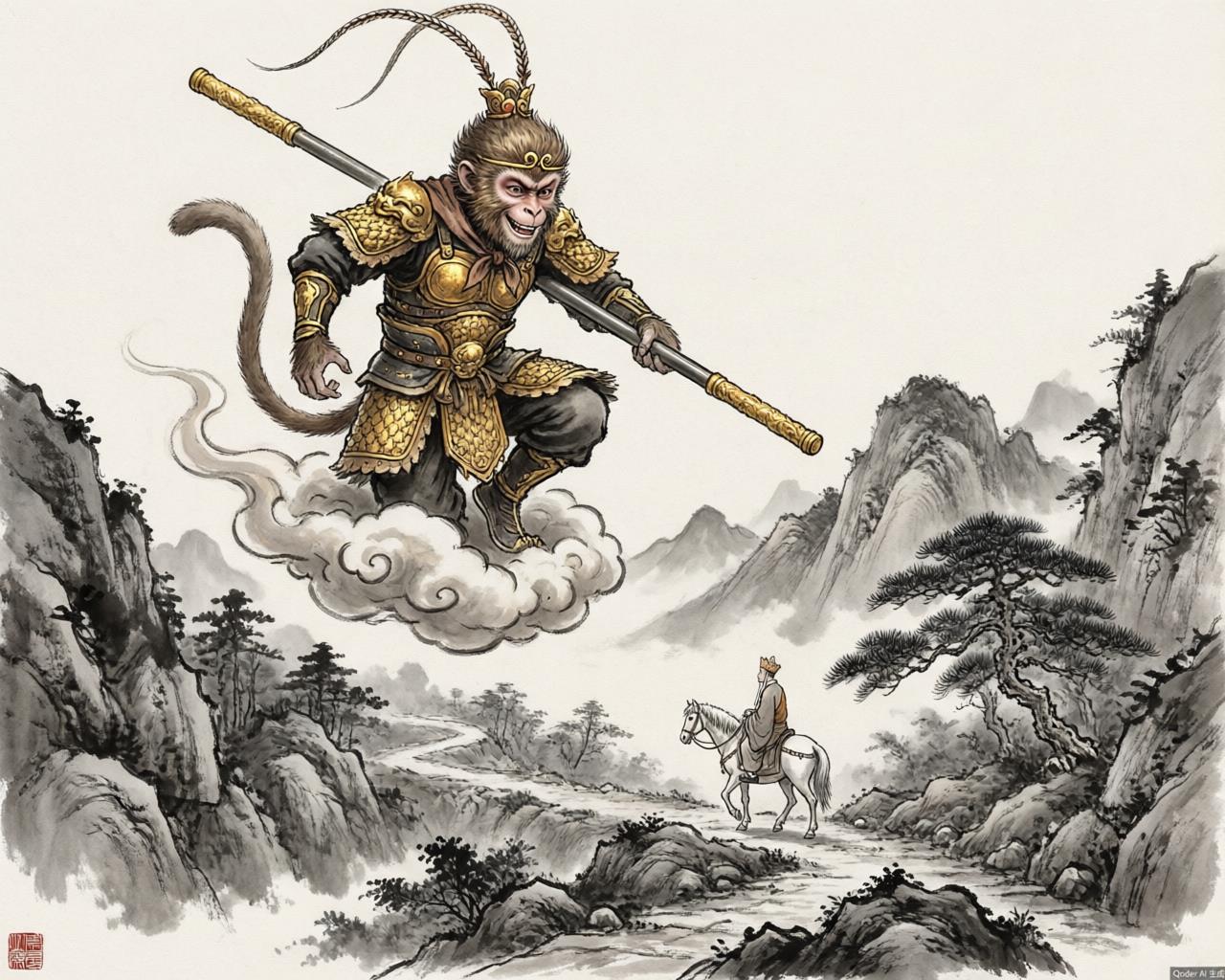
Why does the Monkey King endure? Partly it is the sheer pleasure of his competence. Sun Wukong can somersault 108,000 li in a single leap. His staff, the Ruyi Jingu Bang (如意金箍棒), weighs 13,500 jin and shrinks to the size of a needle, which he keeps behind his ear. He has seventy-two transformations, a cloud that obeys his thought, and eyes that see through any disguise. Watching him operate is watching a virtuoso performer who knows he is the best in the room and enjoys proving it.
But competence alone does not explain four centuries of devotion. Sun Wukong endures because he is a contradiction held in perfect tension: the ultimate individualist who submits to a cause. The monkey who declared war on heaven now wears a golden fillet (紧箍儿, jingu'er) on his head — placed there by the bodhisattva Guanyin (观音) — that causes agonizing pain whenever Xuanzang chants a tightening spell. The fillet is the novel's central symbol: freedom voluntarily constrained by love, duty, or faith. Sun Wukong resents it. He also, by the novel's end, no longer needs it. The discipline has become internal.
"The Mind Monkey is hard to tame, the Will Horse is hard to rein; only when both are stilled does the pilgrim reach Thunder Monastery."
— A traditional critical reading of the novel's allegorical structure, referencing Sun Wukong (Mind Monkey, 心猿) and the White Dragon Horse (Will Horse, 意马)
His companions are foils designed to illuminate different facets of his character. Zhu Bajie (猪八戒), the pig demon, is pure appetite — gluttonous, lustful, lazy, and endlessly comic. He wants to quit the pilgrimage at every difficulty, to settle down with a wife and a farm. He is the part of us that finds spiritual striving exhausting and would prefer a nap. Sha Wujing (沙悟净), the sand monk, is steady, loyal, and almost entirely devoid of personality — a deliberate contrast to the other two. Together, the three disciples represent, in traditional Buddhist allegory, the restless mind (monkey), the unruly desires (pig), and the patient will (sand) that must be harmonized for enlightenment to occur.
Three Readings in One Book
Journey to the West is, famously, a novel that supports multiple allegorical readings simultaneously — and resists being reduced to any single one.
The Buddhist reading is the most obvious. The pilgrimage is a spiritual journey; the demons are mental afflictions (kleshas); the eighty-one tribulations are stages of cultivation; the arrival in India and the receipt of the scriptures represent enlightenment. Xuanzang's final apotheosis — he is made a Buddha, and Sun Wukong a Buddha as well, the "Victorious Fighting Buddha" (斗战胜佛) — confirms the soteriological arc. The novel's chapter titles are studded with Buddhist terminology, and its moral logic rewards patience, compassion, and the subordination of ego.
The Daoist reading runs equally deep. The novel is saturated with internal alchemy (内丹, neidan) imagery. The "cinnabar furnace" in which Sun Wukong is supposedly refined (and instead made invulnerable) is a standard alchemical metaphor. The pilgrims' journey westward mirrors the alchemist's internal circulation of vital energy. Many Daoist practitioners have read the novel as a coded manual of neidan practice, with each demon representing a stage of energetic transformation. The Jade Emperor's court, with its elaborate hierarchy and its startling incompetence, reads as a satire of institutional Daoism — the religion of bureaucracy rather than cultivation.
The satirical reading requires no esoteric key. The celestial bureaucracy in Journey to the West is a mirror of the Ming dynasty civil service: rigid, self-important, riddled with nepotism, and ultimately dependent on a single monkey to solve problems it cannot handle. Demons with heavenly connections are simply recalled to their posts; demons without connections are killed. The implication is not subtle, and it was not lost on Ming readers. Wu Cheng'en — if he is indeed the author — was a minor official who spent decades in low-level posts, and the novel's mockery of institutional mediocrity has the ring of personal grievance elevated to art.
Humor as Philosophy
What distinguishes Journey to the West from other allegorical novels is its relentless, irreverent comedy. This is not a solemn spiritual text that occasionally permits a joke. The comedy is the philosophy. Sun Wukong mocks demons to their faces. He transforms into a fly and lands on their noses. He impersonates their mothers, their husbands, their servants. He urinates on the Buddha's finger (mistaking it for a pillar at the edge of the universe) and writes his name on it as a territorial marker. The sacred is perpetually punctured by the profane, and the profane is perpetually revealed as sacred.
Zhu Bajie is the novel's comic engine. His attempts to seduce women (he is, remember, a pig demon with a taste for human wives), his schemes to divide the luggage and quit, his transparent lies that fool no one — these episodes provide a ground-level humor that keeps the novel's cosmic ambitions tethered to the body. When Bajie is transformed into a fish by a demon and flops helplessly on a riverbank, the novel is saying something about the nature of desire that no amount of doctrinal exposition could convey as effectively.
"Emperor轮流做, 明年到我家" — "Emperors take turns; next year it's my family's turn."
— Sun Wukong, Chapter 7, declaring his intention to seize the Jade Emperor's throne
This line — delivered during Sun Wukong's rebellion against heaven, before his imprisonment — has become one of the most quoted sentences in Chinese literature. It is funny because it is absurd (a monkey claiming the throne of the cosmos). It is also, in its context, genuinely revolutionary: a declaration that hierarchy is contingent, that power is not natural, that the established order has no divine right to permanence. The fact that Sun Wukong is immediately and decisively punished for saying it does not erase the sentence. It remains in the text, grinning.
The Most Adapted Novel in Chinese History
No Chinese novel has been adapted, reimagined, parodied, and reinvented as many times as Journey to the West. The count is genuinely uncountable: Peking Opera adaptations dating to the Qing dynasty, silent films in the 1920s, the landmark 1986 CCTV television series (which holds the Chinese record for most-viewed drama, with estimated audiences exceeding three billion cumulative views across its reruns), Japanese television adaptations (the 1978 series Monkey introduced the story to Western audiences), animated films, video games, manga, theme park rides, and an endless stream of cinematic reboots.
The novel's influence on Japanese pop culture alone would fill a book. Osamu Tezuka's My Son Goku (1952) drew directly on the story. Akira Toriyama's Dragon Ball (1984) began as a loose adaptation — its protagonist, Son Goku, is Sun Wukong's Japanese name, complete with a magic staff and a flying cloud. The Saiyuki manga and anime franchise reimagines the pilgrims as gun-toting bishonen. Video games from Warriors Orochi to the 2024 blockbuster Black Myth: Wukong place the Monkey King at their center.
Within China, Sun Wukong functions as something close to a secular saint. His image appears in temples, on children's clothing, in political cartoons, and in the branding of technology companies. He is invoked as a symbol of innovation (the disruptive genius who challenges incumbents), of loyalty (the protector who never abandons his master despite repeated ingratitude), and of justified rebellion (the outsider who exposes the corruption of established authority). That a single fictional character can carry all three meanings simultaneously — and that none of them feel forced — is a testament to the novel's depth.
Arrival: The Scriptures and the Silence
The novel's ending is quieter than its beginning. After fourteen years and eighty-one tribulations, the pilgrims reach Thunder Monastery (雷音寺, Leiyin Si) in India. They receive the scriptures — though not without one final indignity: the attendant monks demand a bribe, and the first set of scriptures they receive is blank. (The Buddha, informed of this, remarks that the scriptures were sold too cheaply. Even in paradise, the novel suggests, there is commerce.)
The return journey is swift — a single cloud carries them back to Chang'an. Xuanzang delivers the scriptures to the Tang emperor. The pilgrims ascend to heaven and receive their rewards. Xuanzang becomes a Buddha. Sun Wukong becomes a Buddha. Zhu Bajie, whose desires were never fully purified, is made a "Cleanser of the Altars" (净坛使者) — a demotion dressed as an honor, which suits him. Sha Wujing becomes an arhat. The dragon-horse resumes his celestial form.
And then the novel ends. No sequel, no epilogue, no final joke. The monkey who once erased his name from the book of death now has a new name inscribed in the register of the enlightened. The rebellion is over. The fillet is gone. The question the novel leaves — the question it has been circling for a hundred chapters — is whether this is a happy ending. Has Sun Wukong been fulfilled, or has he been domesticated? Is Buddhahood a reward, or is it the final, most elegant cage?
The novel does not say. It simply shows you the monkey, at last still, and lets you decide whether stillness is what he wanted, or merely what he learned to want. After four centuries of readers arguing about it, the ambiguity remains intact. That, perhaps, is the truest mark of a great novel: it outlives every interpretation offered to it, and goes on grinning.