A Rebellion That Refused to Stay Dead
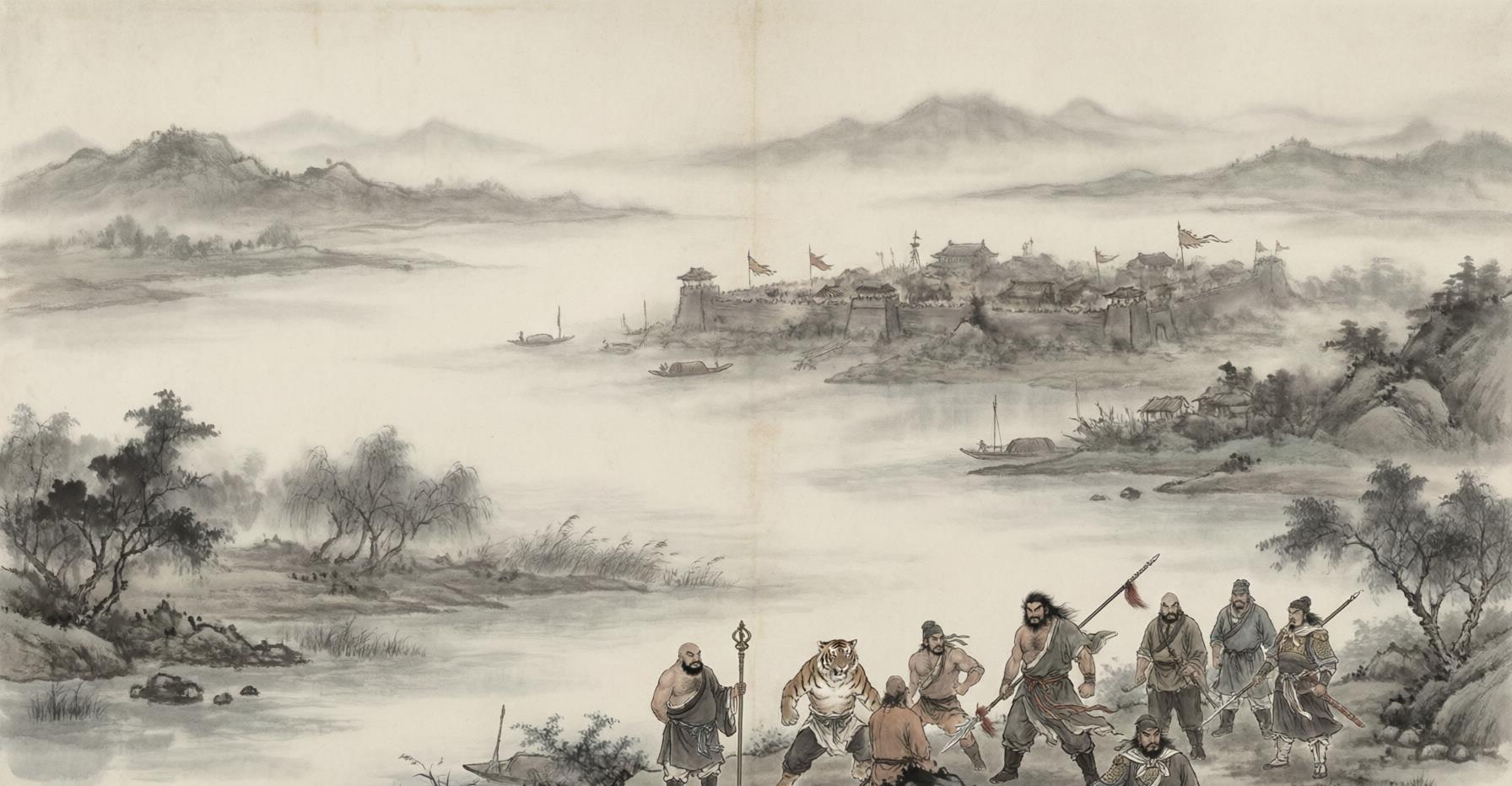
In the winter of 1119, a man named Song Jiang (宋江) led thirty-six followers on a rampage across northern China. They raided government offices, killed corrupt magistrates, and humiliated imperial armies sent to suppress them. The historical record is thin — a few lines in the Song Shi (宋史), the official dynastic history — but those few lines ignited something extraordinary. Over the next two and a half centuries, that small band of desperadoes grew, in the telling and retelling, into an army of 108 superhuman heroes. And the story they generated, Water Margin (Shuihu Zhuan, 水浒传), became perhaps the most politically dangerous novel in Chinese history.
Tradition attributes the novel to Shi Nai'an (施耐庵), a shadowy figure about whom almost nothing is reliably known. Scholars debate whether he was a single author, a compiler of existing tales, or even a pseudonym. What is not debatable is the result: a sprawling, violent, tender, and morally complicated epic that has been banned, censored, praised as revolutionary scripture, and condemned as a manual for bandits — sometimes by the same government, in different decades.
To read Water Margin for the first time is to discover why the phrase "forced onto Liangshan" (逼上梁山, bi shang Liangshan) entered everyday Chinese as an idiom meaning "driven to desperate action by injustice." Six centuries after its composition, the novel still resonates because its central question remains uncomfortably alive: what do you owe a system that has betrayed you?
From Campfire Tales to Printed Pages
The novel did not spring fully formed from one man's brush. Its roots reach back to the Southern Song dynasty (1127–1279), when professional storytellers (说话人, shuohua ren) in the teahouses and markets of Hangzhou and Kaifeng began dramatizing the exploits of Song Jiang and his companions. These oral performances were episodic, sensational, and endlessly mutable — a storyteller who could make an audience weep for Lin Chong one afternoon might invent an entirely new adventure for Wu Song the next.
By the Yuan dynasty (1271–1368), the material had migrated to the stage. Yuan zaju (杂剧) plays featuring Li Kui (李逵), Wu Song, and other outlaws survive in fragmentary form, and they reveal characters already recognizably close to their novelistic incarnations. The playwrights gave the heroes fixed personalities, comic rhythms, and a theatrical vocabulary of loyalty and betrayal that the novel would inherit wholesale.
The written compilation likely crystallized in the late Yuan or early Ming period (c. 1360s–1400). The earliest surviving complete edition dates from the mid-sixteenth century, but internal evidence — linguistic, structural, thematic — points to an earlier genesis. Whoever held the final brush was working not as an inventor but as an architect, arranging generations of communal storytelling into a coherent narrative arc. The genius of Water Margin is editorial as much as creative: the decision to structure 108 individual stories into a rising and falling tide, gathering the heroes like tributaries flowing into a single river, then dispersing them again into tragedy.
The Architecture of Outlawry
The novel's plot follows a shape as old as rebellion itself. In the opening chapters, a corrupt court — dominated by the villainous Grand Tutor Cai Jing (蔡京) and the scheming Marshal Gao Qiu (高俅) — poisons the machinery of justice. Good men are framed, exiled, beaten, and hunted. One by one, sometimes in pairs, sometimes in cascading chains of consequence, the heroes are driven beyond the reach of law.
They converge on Liangshan Marsh (梁山泊), a vast lake-and-mountain fastness in what is now Shandong province. There, under a succession of leaders culminating in Song Jiang himself, they build a parallel society: a brotherhood bound not by blood but by yi (义), a word that means something like "righteous loyalty" and carries more moral weight in the novel than any imperial edict. They rob the corrupt, protect the weak, and drink enormous quantities of wine.
The novel's middle section — the gathering — is pure pleasure, a picaresque parade of individual heroism. But the final act turns bitter. Song Jiang, despite his brothers' misgivings, accepts an imperial amnesty (招安, zhao'an). The outlaws are pardoned, redeployed as government troops, and sent to fight other rebels. They win, but the victories are pyrrhic. Heroes die in battle. Survivors are poisoned by the very court they served. Song Jiang himself is given a cup of poisoned wine by Gao Qiu's faction, and he drinks it — some readings suggest willingly — rather than rebel again.
Lin Chong, Wu Song, and the Grammar of Heroism
The novel's characters are its immortal achievement. Consider Lin Chong (林冲), the "Panther Head" (豹子头), an imperial martial arts instructor whose story occupies some of the novel's finest chapters. Gao Qiu's adopted son covets Lin Chong's wife. What follows is a slow, meticulous campaign of persecution: a false accusation, a beating, exile, an assassination attempt at a remote posting. Lin Chong endures everything, hoping the system will eventually vindicate him. It does not. When he finally kills his tormentors in a snowstorm outside a grass-storage depot — the famous "Wind and Snow at the Mountain Spirit Temple" (风雪山神庙) episode — the violence feels less like triumph than like the snapping of a wire held too long under tension. Lin Chong does not want to be an outlaw. That is precisely the point.
Wu Song (武松), by contrast, seems born for violence. His tiger-slaying episode on Jingyang Ridge (景阳冈打虎) — in which he drinks eighteen bowls of wine, ignores all warnings, and beats a man-eating tiger to death with his bare fists — is the novel's most celebrated set piece. Yet Wu Song's later chapters reveal a man whose capacity for violence curdles into something disturbing. His massacre at the Mandarin Duck Tower (血溅鸳鸯楼), where he kills not only his enemies but their servants and family members, forces the reader to confront the limits of heroic vengeance.
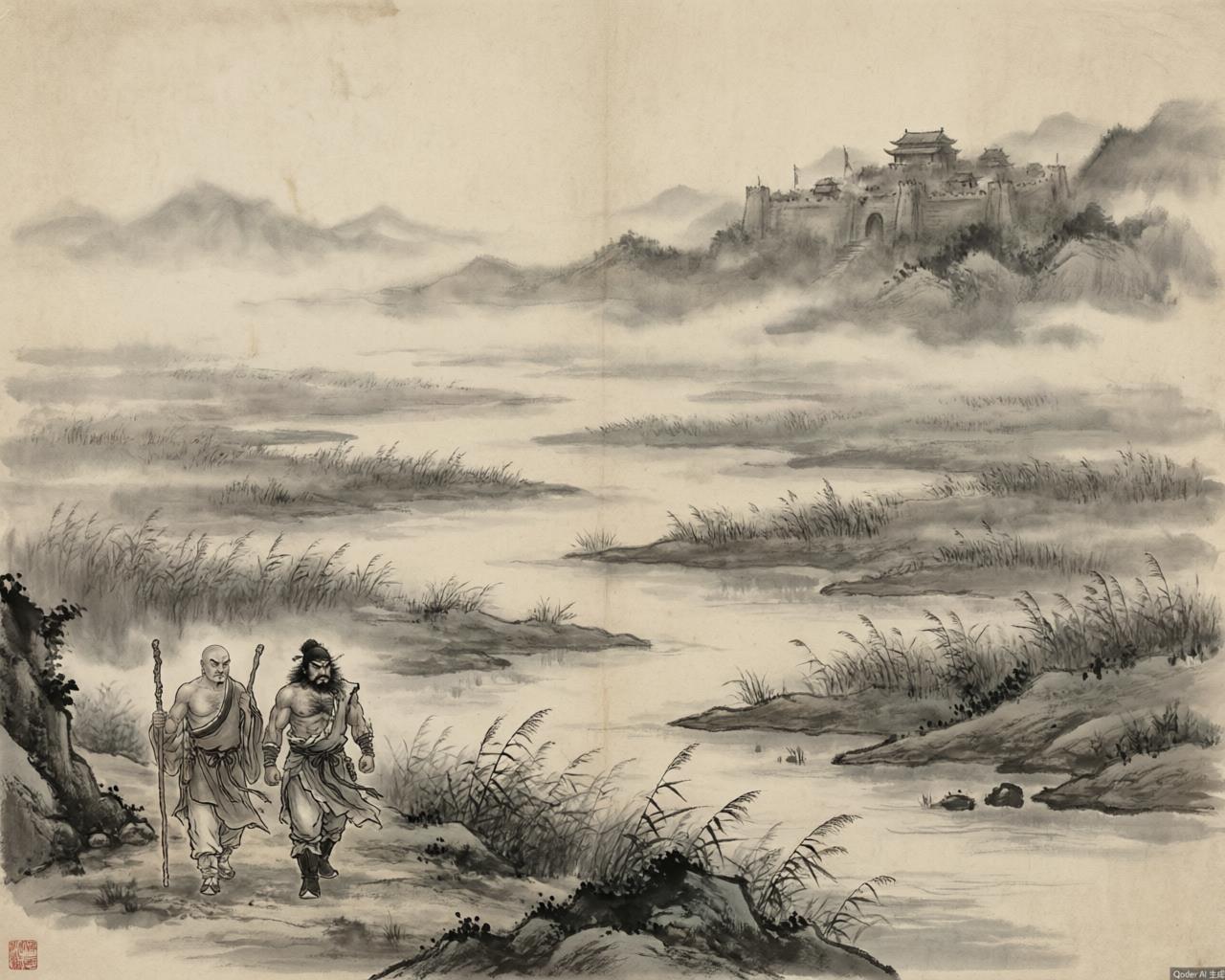
Then there is Lu Zhishen (鲁智深), the "Flowery Monk" (花和尚), a former military officer turned Buddhist monk who cannot stop fighting. He is, in many readers' estimation, the novel's moral center — a man of enormous physical power and zero guile, who uproots a tree to impress some hooligans, beats a bully to death for harassing a father and daughter, and ultimately achieves Buddhist enlightenment at the moment of his death. Where Lin Chong is restraint pushed to breaking, and Wu Song is violence as identity, Lu Zhishen is violence as instinctive compassion. He hits first and asks questions never.
"Throughout the day I look for the good man and cannot find him; when I stop looking, I meet him face to face. He is the one who rides the ox and asks where the ox has gone."
— Lu Zhishen's enlightenment verse, Chapter 119 (translated)
Song Jiang and the Problem of Loyalty
No character in the novel generates more argument than Song Jiang (宋江) himself. The leader of Liangshan is physically unimposing — short, dark-faced, no great warrior — yet he commands the loyalty of men who could snap him in half. His power lies in his reputation for generosity (he is called "Timely Rain," 及时雨, because his aid always arrives when most needed) and, more controversially, in his unwavering commitment to the emperor.
Song Jiang's tragedy is that he cannot conceive of justice outside the imperial framework. He hates corrupt officials with genuine passion, but he reveres the throne as an institution. His insistence on amnesty — on returning the brotherhood to legitimate service — reads, to modern eyes, as either noble fidelity or catastrophic naivety. The novel refuses to resolve the ambiguity. The final chapters, in which the surviving heroes are picked off by poison and political murder, can be read as an indictment of Song Jiang's faith or as a confirmation that the system was always rotten beyond repair. Both readings are textually supported. Both are devastating.
This tension — loyalty to the sovereign versus resistance to the sovereign's agents — is not merely a plot device. It is the novel's political DNA, and it reflects a genuine fault line in Chinese political thought. The Confucian tradition holds that a minister may remonstrate, may withdraw, may even (in Mencius's most radical formulation) justify the overthrow of a tyrant. But the emperor himself, as the Son of Heaven, occupies a sacral position that makes direct rebellion a kind of cosmic crime. Water Margin dramatizes this contradiction with unmatched force: its heroes are righteous, their cause is just, and their leader's solution destroys them.
Forced onto Liangshan: A Novel Becomes an Idiom
The phrase "bi shang Liangshan" (逼上梁山) — "forced onto Liangshan Mountain" — has long since escaped the novel's pages to become a living idiom in Chinese speech. It describes anyone driven to extreme action by intolerable circumstances: a whistleblower who leaks documents after internal channels fail, a worker who strikes after years of unpaid wages, a student who protests after exhausting every polite appeal. The idiom carries a moral judgment: the action may be extreme, but the blame lies with those who made it necessary.
This linguistic afterlife testifies to the novel's deepest cultural function. Water Margin gave Chinese civilization a vocabulary for legitimate anger. Before the novel, rebellion in popular literature tended toward the mythological or the dynastic — the Mandate of Heaven shifting, gods intervening. Water Margin grounded rebellion in the personal and the procedural: a man is framed by his superior, a woman is harassed by a powerful man's son, a monk is expelled for defending the weak. The injustice is specific, bureaucratic, recognizable. You have met Gao Qiu. You have worked for him.
"In the beginning, the officials force the people to rebel; in the end, the rebels long to become officials."
— A common critical summary of the novel's political arc
The Textual Tangle: 70, 100, or 120 Chapters?
Water Margin does not exist as a single stable text. Three major recensions circulate, and the differences among them are not trivial — they change the novel's meaning.
The 100-chapter edition (百回本), the earliest complete version surviving, includes the full arc: gathering, amnesty, campaigns against other rebels, and the heroes' destruction. The 120-chapter edition (百二十回本) expands the military campaigns, adding a lengthy sequence in which the Liangshan heroes fight the rebel Fang La (方腊) — episodes that many scholars consider later interpolations, less stylistically accomplished than the core narrative.
The 70-chapter edition (七十回本) is the most radical. Attributed to the late Ming critic Jin Shengtan (金圣叹), who published it in 1641, this version simply ends the novel at the heroes' grand assembly — cutting the entire amnesty-and-destruction sequence. Jin Shengtan argued that the later chapters were inferior additions by a lesser hand (he named Luo Guanzhong, author of Romance of the Three Kingdoms) and that Shi Nai'an's true vision ended with the brotherhood united. His edition was enormously influential; for centuries, many Chinese readers knew Water Margin only in this truncated form, which transforms the novel from a tragedy into something more like a revolutionary fantasy — the gathering without the dispersal, the rebellion without the reckoning.
Modern scholarship generally treats the 100-chapter version as the most authoritative, but the question remains genuinely open. The novel's textual instability is, in a way, thematically appropriate: a story about outlaws has itself refused to submit to a single authorized version.
The Grandfather of Wuxia and Beyond
Every swordfight in every Chinese martial arts film owes a debt to Water Margin. The novel codified the grammar of wuxia (武侠) fiction: the wandering hero who rightes wrongs outside the law, the code of brotherhood sworn in wine and blood, the tension between personal vengeance and collective justice, the martial arts school as both family and army. Jin Yong (金庸), the twentieth century's great wuxia novelist, acknowledged the debt explicitly; his Legend of the Condor Heroes and its sequels are, in structural terms, Water Margin's descendants.
The novel's influence extends well beyond genre fiction. During the Taiping Rebellion (1850–1864), rebel leaders drew on its imagery of righteous brotherhood. In the twentieth century, the novel's political valence swung wildly: praised during the May Fourth era as a proto-democratic protest text, condemned during the Cultural Revolution as "capitulationist" for Song Jiang's acceptance of amnesty, then rehabilitated and celebrated again in the reform era. Few novels have been so thoroughly instrumentalized by so many contradictory political projects.
In popular culture, the heroes of Liangshan are inexhaustible. They appear in video games, television adaptations (the 1998 CCTV series remains a cultural touchstone for an entire generation), manga, and theme parks. Wu Song's tiger fight is taught in Chinese middle schools. Lin Chong's story is performed in Peking Opera. The phrase "bi shang Liangshan" appears in newspaper editorials about labor disputes. The novel is not a museum piece; it is infrastructure.
Why It Still Burns
Return to the novel's opening image: a stone tablet unearthed during a plague, bearing the names of 108 stars — 36 Heavenly Spirits (天罡星) and 72 Earthly Fiends (地煞星) — imprisoned since the dawn of time, now released into the world. The framing is cosmic, almost playful. But the novel that follows is anything but detached. It is soaked in the specific textures of injustice: the bribe demanded at the yamen gate, the forged letter, the midnight knock, the wife taken by force, the friend who informs for a promotion.
Water Margin endures because it takes anger seriously — not as a political abstraction but as a lived, bodily experience. Its heroes do not philosophize about justice; they feel it in their fists, in the wine they pour for strangers, in the tears they shed for brothers they will bury. The novel asks its reader to believe that goodness can exist outside the law, that brotherhood can be more binding than hierarchy, and that a system which destroys its best people has forfeited the right to call itself legitimate.
It also asks something harder: whether those who fight corruption can avoid being consumed by the fight, whether the outlaw who dreams of amnesty is a fool or a saint, whether the brotherhood can survive its own success. It does not answer. It simply shows you 108 men and women drinking together in a mountain hall, knowing — as the reader knows, as they perhaps suspect — that the wine will run out, the rankings will be posted, and the road down the mountain leads only one direction.