Seven Parts Fact, Three Parts Fiction
There is a saying in Chinese literary criticism that the Romance of the Three Kingdoms (Sanguo Yanyi, 三国演义) is "seven parts fact, three parts fiction" (qi fen shishi, san fen xugou, 七分实事,三分虚构). The formula is attributed to the Qing dynasty historian Zhang Xuecheng (章学诚), and it captures something essential about the book's peculiar power. It is not history—though it follows history closely. It is not pure invention—though it invents freely. It occupies the fertile borderland between the two, and it has lived there, gloriously, for nearly seven hundred years.
The novel is traditionally attributed to Luo Guanzhong (罗贯中), about whom almost nothing certain is known. He is said to have lived in the late Yuan and early Ming dynasties, roughly the 1330s through the 1400s. Some scholars place him in Hangzhou, others in Taiyuan. A few have even questioned whether "Luo Guanzhong" represents a single author or a tradition. What is not in question is the existence of the book itself: a sprawling narrative of roughly 750,000 characters across 120 chapters (in the standard Mao Zonggang edition of 1679), covering nearly a century of Chinese history from the Yellow Turban Rebellion of 184 CE to the reunification under the Jin dynasty in 280 CE. It is, by common scholarly consensus, China's first full-length novel—and arguably the most influential work of narrative fiction in East Asian history.
From Chronicle to Campfire: The Sources
The Romance did not spring fully formed from a single imagination. Its deepest root is the Records of the Three Kingdoms (Sanguozhi, 三国志), the official history compiled by Chen Shou (陈寿) in the third century CE, with the celebrated commentary by Pei Songzhi (裴松之) added in the fifth century. Chen Shou's work is spare, factual, and organized in the biographical format established by Sima Qian's Shiji. It provided the skeleton: the names, the dates, the battles, the political maneuvers.
But bones need flesh, and the flesh came from centuries of oral storytelling. By the Song dynasty (960–1279), professional storytellers (shuoshu ren, 说书人) in the teahouses and marketplaces of Hangzhou and Kaifeng had developed an extensive cycle of Three Kingdoms tales. The audience knew these stories the way modern audiences know superhero franchises: they had favorites, they argued about character motivations, they demanded certain scenes. A Song dynasty guide to entertainment districts, the Dongjing Meng Hua Lu (东京梦华录), records specialist storytellers who performed nothing but Three Kingdoms material.
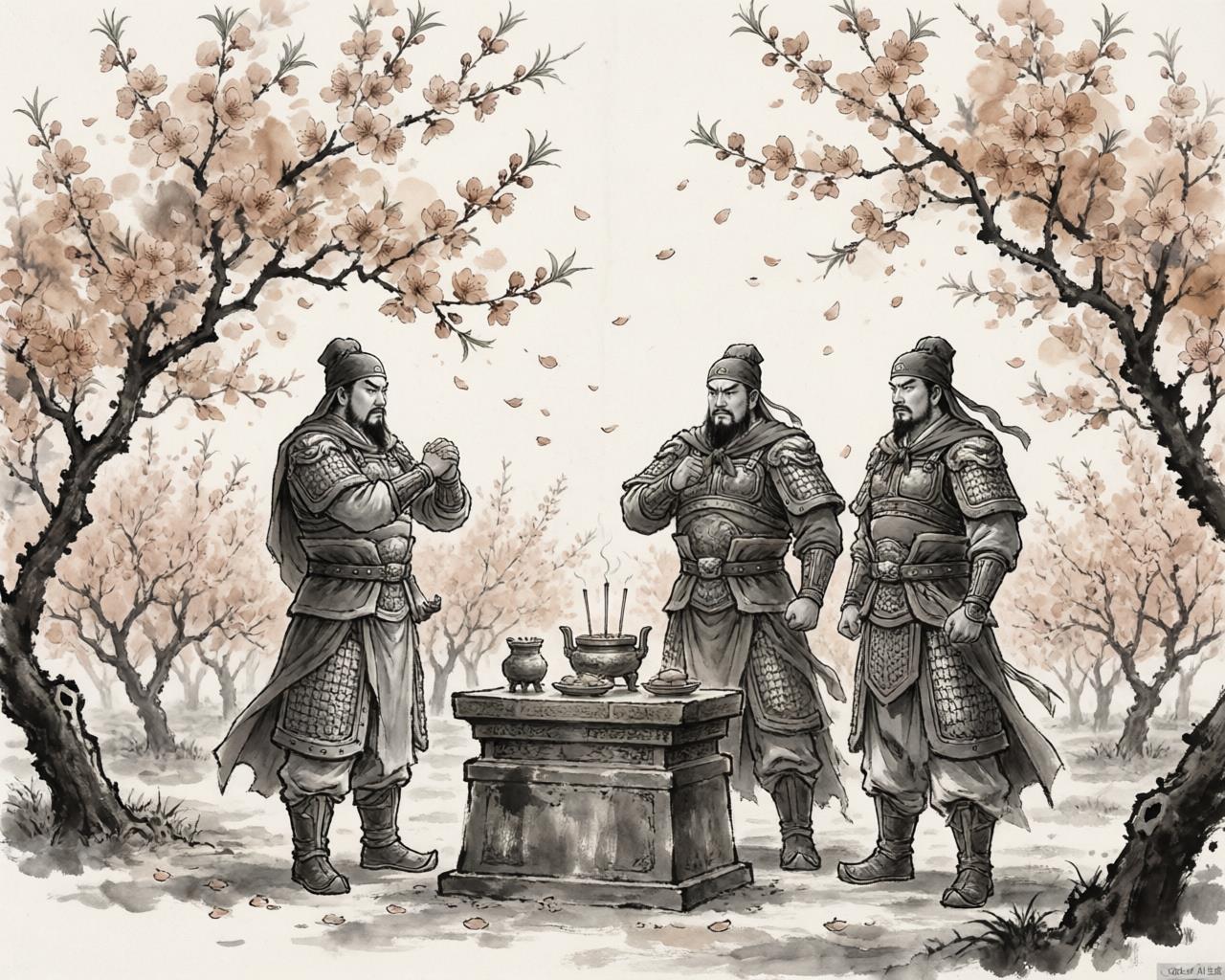
The Yuan dynasty (1271–1368) added another layer: drama. More than fifty surviving Yuan zaju (杂剧) plays take Three Kingdoms subjects—the oath of the Peach Garden, the Battle of Red Cliffs, Zhuge Liang's borrowing of the east wind. These plays established set pieces, fixed characterizations, and codified the moral framework that the novel would inherit. When Luo Guanzhong (or whoever compiled the final text) sat down to write, he was not creating from nothing. He was weaving together a historical chronicle, a storytelling tradition, and a theatrical repertoire into a single continuous narrative. The achievement was not invention but synthesis—and synthesis of the highest order.
The Arc of Empire: Plot and Structure
The novel's famous opening line sets its philosophical frame: "The empire, long divided, must unite; long united, must divide. Thus it has ever been" (hua shuo tianxia dashi, fen jiu bi he, he jiu bi fen, 话说天下大势,分久必合,合久必分). This is not merely a plot summary. It is a theory of history—cyclical, inevitable, almost geological in its patience. The entire novel enacts this principle.
The story begins with the collapse of the Han dynasty. The Yellow Turban Rebellion (Huangjin Zhi Luan, 黄巾之乱) of 184 CE shatters imperial authority. The warlord Dong Zhuo (董卓) seizes the capital and tyrannizes the court. A coalition of regional lords rises against him—and immediately fractures into rivalries. From this chaos, three figures emerge as the poles around which the narrative will revolve: Cao Cao (曹操) in the north, Liu Bei (刘备) in the southwest, and Sun Quan (孙权) in the southeast.
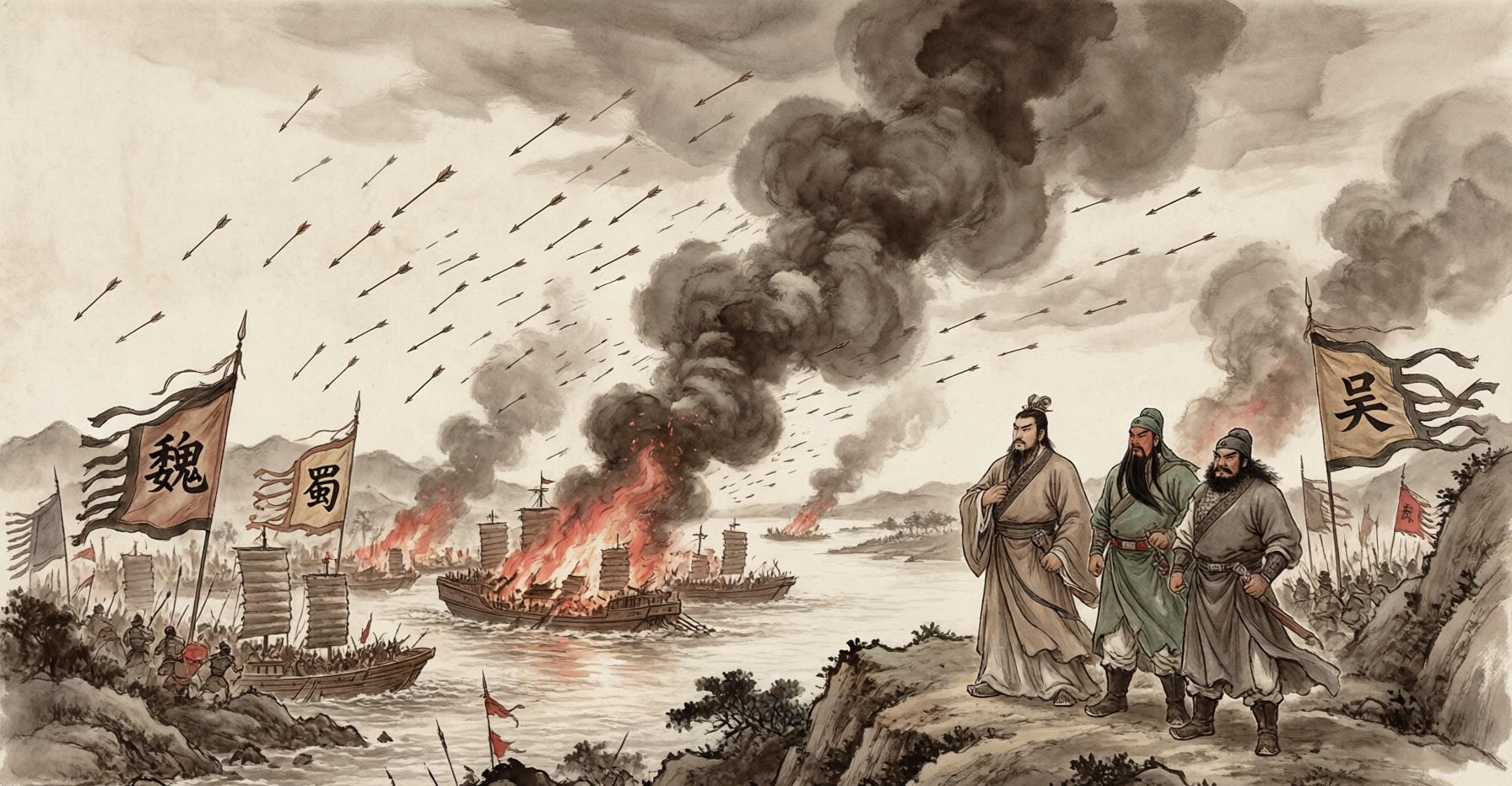
The middle section of the novel builds toward its supreme set piece: the Battle of Red Cliffs (Chibi zhi Zhan, 赤壁之战) in 208 CE, where the allied forces of Liu Bei and Sun Quan, commanded by the strategist Zhuge Liang (诸葛亮) and the admiral Zhou Yu (周瑜), destroy Cao Cao's vastly superior fleet through a combination of deception, fire attack, and borrowed wind. It is the novel's longest sustained sequence—spanning roughly eight chapters—and it functions as a kind of narrative opera, with each stratagem building on the last: the false defection of Huang Gai, the chain-link ruse for Cao Cao's ships, the summoning of the southeast wind, the conflagration itself.
After Red Cliffs, the three kingdoms—Wei (魏), Shu (蜀), and Wu (吴)—settle into an uneasy equilibrium. The final third of the novel follows Zhuge Liang's six northern expeditions (liu chu Qishan, 六出祁山) against Wei, his slow attrition by impossible odds, and his death at Wuzhang Plains (Wuzhangyuan, 五丈原) in 234 CE. With Zhuge Liang gone, the narrative momentum shifts. The Sima family gradually usurps Cao Cao's Wei dynasty, conquers Shu in 263 and Wu in 280, and founds the Jin dynasty (晋). The empire is united again. The cycle closes. The opening sentence is fulfilled.
Archetypes in Armor: The Characters
The Romance endures not because of its plot mechanics but because of its characters—or more precisely, because its characters have become archetypes so deeply embedded in Chinese culture that they function as a shared moral vocabulary. To call someone "a Zhuge Liang" is to say they are preternaturally clever. To call someone "a Cao Cao" is to say they are brilliant and ruthless in equal measure. These are not literary references; they are living language.
Guan Yu (关羽) is loyalty incarnate. The novel's most famous scene involving him is not a battle but a refusal: captured by Cao Cao, showered with gifts and honors, he nevertheless rides a thousand li through enemy territory to rejoin his sworn brother Liu Bei. He is the god of war in Chinese popular religion (Guandi, 关帝), worshipped in temples across the Chinese-speaking world. Police stations and triad halls alike keep his image. He transcends the novel entirely.
Zhuge Liang (诸葛亮), styled Kongming (孔明), is wisdom made flesh. The novel introduces him through absence: Liu Bei must visit his thatched cottage three times (san gu maolu, 三顾茅庐) before the young strategist agrees to emerge. Once he does, he never stops working. He invents, strategizes, governs, and fights simultaneously. His "Empty Fort Strategy" (kong cheng ji, 空城计)—sitting calmly on the city walls playing a lute while an enemy army approaches, betting that his reputation for caution will convince them it is a trap—is the novel's purest expression of intellect triumphing over force. He dies exhausted, still campaigning, still loyal. The novel makes clear that his cause was doomed from the start. He fights anyway. This is what makes him tragic rather than merely clever.
Cao Cao (曹操) is the novel's magnificent antagonist—though "antagonist" undersells him. He is a poet, a strategist, a political genius, and a man capable of extraordinary cruelty. The novel gives him the famous line "I would rather betray the world than let the world betray me" (ning jiao wo fu tianxia ren, xiu jiao tianxia ren fu wo, 宁教我负天下人,休教天下人负我). Historically, Cao Cao was a more sympathetic figure than the novel allows; the text's pro-Shu bias (favoring Liu Bei's legitimacy) shapes its moral architecture. But the novel's Cao Cao is more interesting than the historical one precisely because he is contradictory: generous and murderous, visionary and paranoid, a man who writes tender poetry about the brevity of life while ordering massacres.
The Art of Historical Fiction
What makes the Romance a novel rather than a versified chronicle is its treatment of interiority and dramatic structure. Chen Shou's historical Records tell us what happened. The Romance tells us what it felt like—or rather, what it must have felt like, imagined through the conventions of dramatic storytelling. When Zhuge Liang debates the scholars of Wu before Red Cliffs, the historical record gives us a diplomatic meeting. The novel gives us a rhetorical tournament, with each interlocutor posing a challenge and Zhuge Liang demolishing it in turn, building to a crescendo of intellectual dominance. The scene is almost certainly invented. It is also more true to the character than any factual account could be.
The novel's prose style—written in a hybrid of classical and vernacular Chinese (wenbai xiangjian, 文白相间)—gives it a particular music. Battle scenes are compressed, percussive, almost cinematic in their rapid cutting. Political scenes expand into long dialogues where every sentence carries double meaning. The narrator's voice, inherited from the oral storytelling tradition, addresses the reader directly: "Dear reader, if you wish to know what happened next, listen to the next chapter" (yu zhi hou shi ru he, qie ting xia hui fen jie, 欲知后事如何,且听下回分解). This formula, repeated at the end of every chapter, is a fossil of the teahouse—a reminder that this book was born from performance.
The empire, long divided, must unite; long united, must divide. Thus it has ever been.
— Opening line of the Romance of the Three Kingdoms (Sanguo Yanyi, 三国演义)
A Continent of Influence
The Romance of the Three Kingdoms is not merely a book. It is a cultural operating system for much of East Asia. Its influence extends into domains that have nothing to do with literature:
Language. Hundreds of Chinese idioms and proverbs originate in the novel or its source traditions. "Three visits to the thatched cottage" (san gu maolu) means making sincere, repeated efforts to recruit talent. "Speaking of Cao Cao, and Cao Cao arrives" (shuo Cao Cao, Cao Cao dao, 说曹操,曹操到) is the Chinese equivalent of "speak of the devil." "Everything is in place except the east wind" (wan shi ju bei, zhi qian dong feng, 万事俱备,只欠东风) describes a plan awaiting one final condition. These phrases are used daily by hundreds of millions of speakers, many of whom have never read the novel.
Strategy and business. The novel is required reading in Chinese business schools and, famously, among Japanese corporate strategists. Its lessons on alliance formation, timing, deception, and resource management are treated as directly applicable to market competition. The "Thirty-Six Stratagems" (Sanshiliu Ji, 三十六计), while not part of the novel itself, are popularly illustrated through Romance episodes. Sun Tzu's Art of War provides the theory; the Romance provides the case studies.
Popular culture. The novel has been adapted into countless operas (particularly in Peking opera, where Red Cliffs alone has generated dozens of distinct plays), television series (the 1994 CCTV adaptation ran 84 episodes; a 2010 remake ran 95), films, comic books, and video games. The Japanese Sangokushi game series by Koei, running since 1985, and the Dynasty Warriors franchise have introduced the characters to generations of global gamers. In Korea, Vietnam, and Thailand, the story circulates in locally adapted forms. It is, without exaggeration, the most widely disseminated narrative in East Asian civilization.
The Mao Edition and the Question of Authorship
The text most readers encounter today is not quite what Luo Guanzhong wrote. The earliest surviving editions date from the late fifteenth century and differ significantly from one another. The version that became standard was edited by Mao Lun (毛纶) and his son Mao Zonggang (毛宗岗) in 1679, during the early Qing dynasty. The Maos tightened the prose, sharpened the moral contrasts, added the famous opening poem ("The Yangtze flows east, its waves wash away heroes" [da jiang dong qu, lang tao jin, qian gu feng liu ren wu, 大江东去,浪淘尽,千古风流人物]—actually borrowed from a Song ci poem by Su Shi), and reinforced the pro-Shu, anti-Wei bias that characterizes the received text.
Scholars debate how much of the novel's final shape belongs to Luo Guanzhong and how much to the Maos. The debate is, in a sense, unresolvable—and perhaps beside the point. The Romance is a palimpsest: a historical chronicle overwritten by oral tradition, overwritten by dramatic convention, overwritten by editorial revision. It is the work of centuries as much as of a single hand. This collective authorship is not a weakness. It is the source of the book's peculiar authority. It speaks not with one voice but with the accumulated voice of a culture telling itself its own story, refining it with each retelling, until the narrative achieves the density and resonance of myth.
Why It Still Matters
Seven centuries after its composition, the Romance of the Three Kingdoms remains the gateway through which most Chinese readers first encounter their own history. Children grow up knowing Guan Yu's loyalty, Zhuge Liang's cleverness, Cao Cao's ambition before they encounter these figures in any historical source. The novel shapes expectations about leadership, friendship, strategy, and moral compromise in ways that are difficult to measure precisely because they are so total. It is the air the culture breathes.
For the non-Chinese reader, the novel offers something equally valuable: an entry point into a narrative tradition that operates on different assumptions than the Western novel. Its heroes are not individuals struggling against society but individuals embedded in networks of obligation, loyalty, and historical necessity. Its tragedies are not personal but structural—the tragedy of Zhuge Liang is not that he fails but that the pattern of history (the "divided must unite, united must divide" of the opening line) makes his success impossible regardless of his genius. The novel's deepest subject is not any character but time itself: the way human effort meets historical force, and the way both are eventually washed away, like the Yangtze's waves, carrying heroes eastward into silence.
The great river flows east, its waves washing away a thousand ages of heroes. Right and wrong, success and failure—all turn to emptiness. The green hills remain; the sunset reddens again and again.
— Opening poem of the Mao Zonggang edition, adapted from Su Shi's "Nian Nu Jiao" (念奴娇)
That poem, added by the Maos in the seventeenth century, is the novel's perfect epilogue. It tells you that everything you are about to read—the battles, the oaths, the stratagems, the deaths—matters enormously and not at all. The heroes are real. The river does not care. Read it anyway. Everyone does.