The Son of the Grand Astrologer
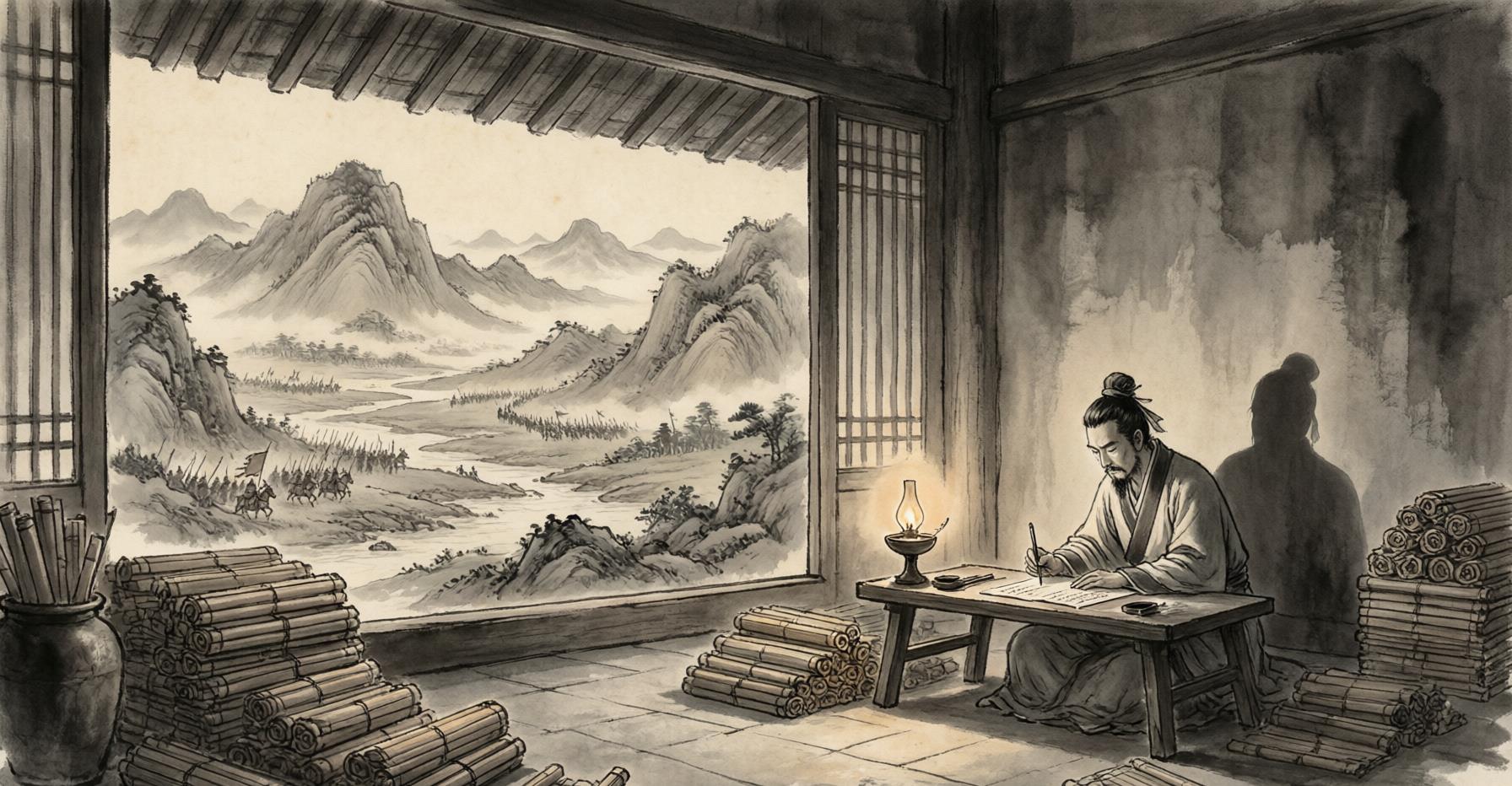
Every great book has an origin story, but few are as harrowing as the one behind the Shiji (史记), known in English as the Records of the Grand Historian. Its author, Sima Qian (司马迁, c. 145–86 BCE), did not set out to become a martyr for truth. He set out to finish his father's work. That modest inheritance would cost him everything a man of his era could lose—except his life, which he kept only because the book was not yet done.
Sima Qian was born in Longmen (龙门), in what is now Shaanxi Province, into a family that had served as court historians for generations. His father, Sima Tan (司马谈), held the title of Grand Astrologer (Taishi Ling, 太史令)—a position that combined the duties of astronomer, calendar-keeper, and custodian of imperial records. It was Sima Tan who conceived the grand project: a comprehensive history of the known world, from the legendary Yellow Emperor (Huangdi, 黄帝) down to the reigning Han emperor. On his deathbed in 110 BCE, the old man grasped his son's hand and wept. "Our ancestors were historians for the Zhou kings," he is said to have told Sima Qian. "Since I die without completing what I began, you must carry on. Do not let this work die with me."
Sima Qian was thirty-five. He had already traveled extensively through the old kingdoms—collecting oral traditions, visiting the sites of ancient battles, interviewing descendants of famous men. He had served as a minor court official and accompanied Emperor Wu (Wudi, 武帝) on inspection tours. He was, in short, prepared. What he was not prepared for was what would happen nine years later.
The Li Ling Affair and the Price of Truth
In 99 BCE, the Han general Li Ling (李陵) led five thousand infantry deep into Xiongnu territory and was surrounded by eighty thousand cavalry. After days of fighting, his arrows exhausted and his men slaughtered, Li Ling surrendered. The court erupted in outrage. Emperor Wu demanded that his officials denounce the traitor. One by one, they complied—everyone except Sima Qian.
Sima Qian spoke in Li Ling's defense. He argued that the general had fought with extraordinary valor, that his surrender might be a ruse to find an opportunity to return to Han service, that the court's rush to condemn was unjust. It was, by any measure, a reasonable argument. It was also, in the paranoid atmosphere of Emperor Wu's later reign, the wrong thing to say. The emperor interpreted the defense as an implicit criticism of Li Guangli, the emperor's own brother-in-law, whose failure to reinforce Li Ling had contributed to the disaster.
Sima Qian was arrested and charged with "deceiving the emperor" (qishang, 欺上). The sentence was death. Under Han law, a condemned man could commute his sentence in one of two ways: pay an enormous fine of five hundred thousand coins, or submit to castration (gongxing, 宫刑). Sima Qian had no money. No powerful friends came forward. And so, in the winter of 98 BCE, the Grand Historian was castrated.
A man has only one death. It may be as heavy as Mount Tai, or as light as a goose feather. The difference lies in what he uses it for.
— Sima Qian, "Letter to Ren An" (Bao Ren An Shu, 报任安书)
He chose to live. In his famous letter to his friend Ren An (任安), Sima Qian explained why. The great men of antiquity, he wrote, all produced their masterworks in adversity: Confucius wrote the Spring and Autumn Annals (Chunqiu, 春秋) after his wanderings ended in failure; Qu Yuan (屈原) composed the Lisao (离骚) in exile; Zuo Qiuming (左丘明) wrote his commentary after going blind. "All these men had something pent up inside them that they could not express," Sima Qian wrote, "and so they set down what had happened, in order to make their thoughts known to those who would come after." He would add his own name to that list. The Shiji would be his vindication—not in his lifetime, but in every lifetime thereafter.
An Architecture of Memory: The Five Sections
What Sima Qian produced was not merely a history. It was an architecture for organizing the entire Chinese past—a structure so elegant and so comprehensive that every subsequent dynastic history would adopt it, with minor variations, for the next two thousand years. The Shiji comprises 130 chapters (pian, 篇), totaling roughly 526,000 characters, divided into five sections:
Basic Annals (Benji, 本纪) — Twelve chapters covering the major rulers and dynasties from the Yellow Emperor through Emperor Wu. These are chronological narratives of political events: wars, successions, reforms, natural disasters. They form the spine of the work.
Tables (Biao, 表) — Ten chapters of chronological charts, synchronizing the events of different states and kingdoms. Think of them as spreadsheets for the ancient world: who ruled where, and when, laid out in grids so the reader can see parallel developments at a glance.
Treatises (Shu, 书) — Eight chapters on institutional and cultural topics: rites, music, calendars, astronomy, economics, waterways, and the feng and shan sacrifices. These are thematic essays that step outside chronology to explain how things worked.
Hereditary Houses (Shijia, 世家) — Thirty chapters on the major feudal families and kingdoms, particularly those of the Spring and Autumn and Warring States periods. The name reflects the hereditary nature of their power.
Biographies (Liezhuan, 列传) — Seventy chapters, the largest section, covering individuals from every stratum of society: generals, philosophers, assassins, merchants, jesters, diviners, and foreign peoples. This is where Sima Qian's genius blazes brightest.
The proportions are telling. More than half the work is devoted not to emperors or institutions, but to individual human lives. Sima Qian understood something that many later historians forgot: that history is made by people, and people are interesting.
The Biographies as Literature
The Liezhuan section is where the Shiji transcends its genre. Sima Qian was not content to list offices held and battles fought. He built scenes. He gave his subjects dialogue, gesture, psychological interiority. He structured chapters like short stories, with rising action, climax, and denouement. Two thousand years before the term "creative nonfiction" existed, Sima Qian was practicing it at the highest level.
Consider his portrait of Jing Ke (荆轲), the assassin sent to kill the King of Qin in 227 BCE. The chapter does not begin with the assassination attempt. It begins with Jing Ke drinking in a wine shop, weeping with his friends, singing songs no one else can understand. We see him as a man before we see him as a hero. When the famous scene in the Qin court finally arrives—the map unrolling to reveal the dagger, the king scrambling around his pillar, the assassin's final failed throw—Sima Qian has already made us care whether this man lives or dies. We know he will die. We read on anyway.
Or consider the biography of Xiang Yu (项羽), the warlord who nearly united China after the fall of the Qin dynasty. Sima Qian—who served the Han dynasty that defeated Xiang Yu—nevertheless gives his subject a portrait of tragic grandeur. The chapter culminates in the famous scene at Gaixia (垓下), where Xiang Yu, surrounded and doomed, sings a farewell to his concubine Lady Yu (虞姬): "My strength plucked up the hills, my might shadowed the world; but the times were against me, and Wuzhui will run no more." Sima Qian records that the great warrior wept, and that his men wept with him, unable to look up. It is one of the most famous passages in all Chinese literature, and it appears in a history book.
This literary quality is not accidental. Sima Qian consciously modeled his prose on the great narrative traditions before him—the Zuo Commentary (Zuozhuan, 左传), the Intrigues of the Warring States (Zhanguo Ce, 战国策)—and pushed them further. His sentences are muscular, rhythmic, varied. He shifts register effortlessly from the formal to the colloquial. He uses repetition and parallelism for emphasis, then breaks the pattern for shock. Later critics would call his style "the prose equivalent of Du Fu's poetry": capacious, precise, and inexhaustible.
The Model for Two Millennia
The Shiji established the template for what Chinese scholars call the "standard histories" (zhengshi, 正史)—the twenty-four (sometimes twenty-five) dynastic histories that collectively document Chinese civilization from antiquity to the fall of the Qing dynasty in 1912. Every one of them, from Ban Gu's Book of Han (Hanshu, 汉书) in the first century CE to the Draft History of Qing (Qing Shigao, 清史稿) in the twentieth century, follows the five-part structure Sima Qian devised. The names change slightly—Shu becomes Zhi (志), Shijia disappears in most later works—but the architecture holds.
This is an achievement almost without parallel in world historiography. Imagine if a single Greek historian had established the format for every European national history written until the present day. The comparison is not merely quantitative. Sima Qian did not merely provide a filing system; he provided a philosophy of history. His famous stated aim was "to investigate the relationship between heaven and humanity, to understand the changes from past to present, and to establish the words of one family" (jiu tianren zhiji, tong gujin zhi bian, cheng yijia zhi yan, 究天人之际,通古今之变,成一家之言). History, for Sima Qian, was not a record of divine providence or a simple chronicle of events. It was an instrument for understanding patterns—moral, political, human—and for asserting an individual interpretive voice against the pressure of official narratives.
That last phrase, "the words of one family" (yijia zhi yan), is quietly revolutionary. In an age when the emperor's word was law, Sima Qian claimed the right to his own judgment. He praised men the Han court condemned. He criticized emperors. He gave the defeated Xiang Yu a "Basic Annals" entry—a category reserved for sovereigns—effectively arguing that legitimacy comes from deeds, not titles. The Han authorities noticed. Tradition holds that certain chapters critical of Emperor Wu were suppressed or altered. The book survived, but its author's safety was never guaranteed.
Famous Passages and Living Idioms
The Shiji is not merely studied; it is quoted. Dozens of Chinese idioms (chengyu, 成语) in daily use derive directly from its pages. When someone says "breaking the cauldrons and sinking the boats" (po fu chen zhou, 破釜沉舟) to describe a point-of-no-return commitment, they are quoting Sima Qian's account of Xiang Yu's army before the Battle of Julu. When a speaker refers to "pointing at a deer and calling it a horse" (zhi lu wei ma, 指鹿为马) to describe blatant gaslighting, the source is the Shiji's biography of the Qin eunuch Zhao Gao. "The peach tree does not speak, yet a path forms beneath it" (tao li bu yan, xia zi cheng xi, 桃李不言,下自成蹊)—Sima Qian's own metaphor for the quiet magnetism of the general Li Guang—remains a proverb about integrity that needs no advertisement.
These phrases survive because Sima Qian embedded them in stories so vivid that they became part of the cultural bloodstream. Chinese students encounter the Shiji in school not as dry historiography but as literature—reading the assassination of Jing Ke, the humiliation of Han Xin (韩信) crawling between a bully's legs, the tragic friendship of Guan Zhong (管仲) and Bao Shuya (鲍叔牙). The book functions simultaneously as a historical source, a literary anthology, and a moral education.
The Grandfather of Chinese Fiction
The Shiji's influence on Chinese narrative fiction is so pervasive that it is difficult to overstate. The great novels of the Ming and Qing dynasties—Water Margin (Shuihu Zhuan, 水浒传), Romance of the Three Kingdoms (Sanguo Yanyi, 三国演义), Journey to the West (Xiyou Ji, 西游记), Dream of the Red Chamber (Honglou Meng, 红楼梦)—all inherit Sima Qian's narrative techniques: the dramatic scene as the unit of storytelling, characterization through action and speech rather than exposition, the use of parallel and contrasting figures, the author's voice intervening with moral commentary (the famous "The Grand Historian says" [Taishigong yue, 太史公曰] passages at the end of each chapter are the direct ancestors of the storyteller's intrusions in later fiction).
The Ming dynasty critic Jin Shengtan (金圣叹) placed the Shiji alongside Zhuangzi, Du Fu's poetry, and Water Margin as one of the "six works of genius" (liu caizi shu, 六才子书) in the Chinese language. This was not merely an aesthetic judgment. It was a recognition that the boundary between "history" and "literature" in the Chinese tradition is far more permeable than in the Western one—and that Sima Qian is the reason why. He proved that factual rigor and narrative art were not enemies but allies. The truth, rendered with sufficient skill, needs no embellishment. It needs only a writer brave enough, and skilled enough, to tell it whole.
Reading the Shiji Today
For the English-language reader, the Shiji is available in Burton Watson's celebrated partial translation (Records of the Grand Historian, Columbia University Press) and in the ongoing complete translation by William Nienhauser and collaborators (The Grand Scribe's Records, Indiana University Press). Neither fully captures the prose rhythms of the original—no translation can—but both convey the narrative power that has kept this book alive for twenty-one centuries.
What strikes the modern reader most, perhaps, is the book's humanity. Sima Qian writes about emperors, but he is equally fascinated by the minor-key figures: the loyal retainer who dies for a lord who barely noticed him, the merchant who builds a fortune through intelligence rather than connections, the jester who speaks truth to power because no one takes him seriously enough to punish him. The Shiji is, in the end, a monument to the proposition that every life contains a story worth telling well—and that telling it well is a form of justice that outlasts empires.
Sima Qian did not live to see his vindication. He died around 86 BCE, in obscurity, his punishment a permanent mark of shame. The Shiji itself was not widely circulated until his grandson, Yang Yun (杨恽), brought it to public attention during the reign of Emperor Xuan, decades later. But the book endured. It endured through the fall of the Han, through centuries of division, through the Tang and Song golden ages, through the Mongol conquest and the Ming restoration, through the twentieth century's upheavals, into the present. Every Chinese schoolchild knows its stories. Every Chinese historian works in its shadow. And every reader who opens it encounters, across two millennia, the voice of a man who chose mutilation over silence—and won.