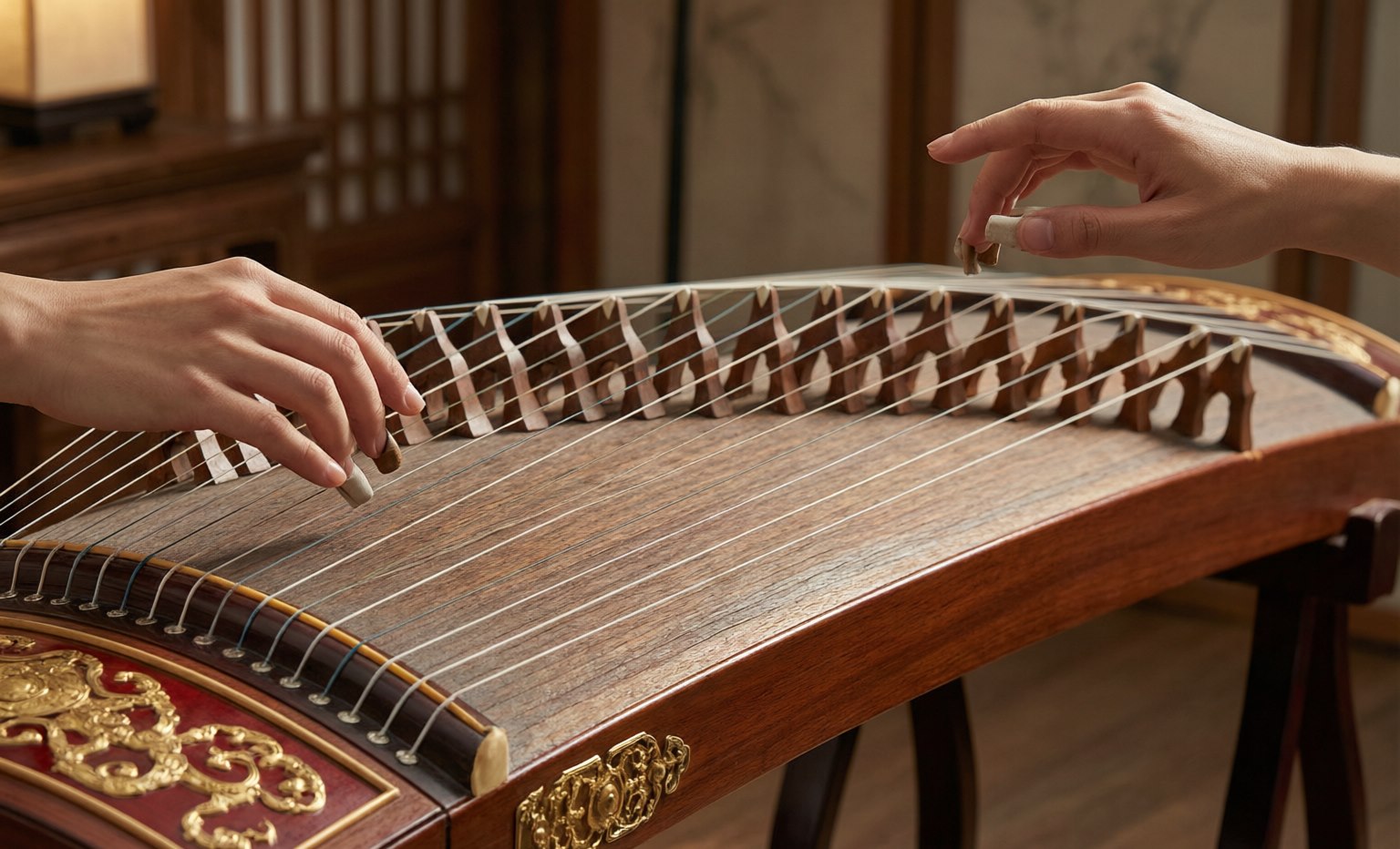
If the guqin is the sound of a single scholar alone in a mountain hut, the guzheng (古筝, gǔzhēng) is the sound of a whole civilization celebrating. It is bright where the qin is hushed, generous where the qin is austere, public where the qin is private. Run a hand across its twenty-one strings and you get that instantly recognizable cascade — a waterfall of pentatonic brilliance that has become, for listeners around the world, the very signature of "Chinese music." Yet behind that shimmering surface lies an instrument more than two and a half millennia old, one that has reinvented itself in every dynasty and that today is played by millions, from conservatory virtuosos to children in suburban music schools. The guzheng is China's most popular traditional instrument, and its story is the story of how an ancient court voice became the people's favorite.
Two and a Half Thousand Years of Strings
The guzheng is old enough to have been ancient when the guqin was already venerable. Its earliest reliable references come from the Warring States period (475–221 BCE), and it was already associated with the state of Qin (秦) — which is why it is sometimes called the Qin zheng (秦筝). The historian Sima Qian, writing around 94 BCE, records that the people of Qin delighted in "striking the urns and beating the jars" while playing the zheng, a detail that places the instrument firmly in popular, earthy entertainment rather than rarefied court ritual. By the Han dynasty it had spread across the empire and begun its long evolution in size and shape.
That evolution is, in miniature, the history of Chinese music itself. The early zheng had a handful of strings — five, then twelve, then thirteen. For centuries the standard was the thirteen-string instrument, and the great regional schools that crystallized in the Ming and Qing dynasties — Shandong, Henan, Chaozhou (Teochew), Hakka, Zhejiang — were built on it. Each school developed its own repertoire, its own ornaments, its own temperament: the Shandong style bold and rhythmic, the Chaozhou style delicate and lyrical, the Hakka style restrained and melancholy. The twentieth century brought the most dramatic change of all. In the 1950s and 1960s, makers and players expanded the instrument to twenty-one strings and added mechanical levers and, later, pedals, dramatically widening its range and chromatic flexibility. The modern concert guzheng — the one you will see on stage today — is essentially a mid-twentieth-century invention built on a two-thousand-year-old foundation.
The Architecture of Falling Water
Look at a guzheng and the first thing you notice is the row of small inverted-V bridges standing like a flock of geese across the soundboard. These are the yan zhu (雁柱, "goose-pillar" bridges), and they are the secret of the instrument. Unlike the guqin, whose strings run over a fixed flat surface, the guzheng's strings each pass over their own movable bridge. The bridges are not glued or screwed; they stand freely, held in place only by the tension of the strings and the player's careful positioning. To tune the instrument, you nudge each bridge forward or back, shortening or lengthening the vibrating span of the string. To play, you pluck on the right side of the bridge; to bend a note, you press the string on the left side, raising its tension and sliding the pitch upward.
The body is a long, gently arched resonating box, traditionally of paulownia wood (桐木) for the soundboard — the same light, resonant timber favored for the qin — with a harder wood for the frame. The twenty-one strings are tuned to a pentatonic scale (do, re, mi, sol, la), which is why a careless sweep across them still sounds harmonious: there are no semitone clashes built into the layout. Modern strings are steel wound with nylon, bright and sustaining; older instruments used silk, softer and more fleeting. Players wear small plectra — yi jia (义甲), false nails of plastic, tortoiseshell, or bone — on the fingers of the right hand, and increasingly on the left as well, to produce a clean, projecting attack.
The division of labor between the hands is the instrument's grammar. The right hand plucks: a vocabulary of strokes including tuo (thumb outward), mo, gou, da, and the rapid yao zhi (摇指), a sustained tremolo produced by rocking the finger back and forth so quickly that single notes blur into a singing line. The left hand does the expressive work: pressing the strings to bend pitch, producing the weeping portamenti and shimmering vibrato that give the guzheng its vocal, almost human quality. It is the left hand that makes a cascade of notes feel like falling water, and a single sustained tone feel like a sigh.
Fisherman's Song at Dusk
Every guzheng student learns a small canon of pieces that together form the instrument's emotional autobiography. Chief among them is Yuzhou Changwan (渔舟唱晚, "Fisherman's Song at Dusk"), perhaps the single most famous guzheng piece of the modern era. Composed (or arranged) in the 1930s and often attributed to the player Lou Shuhua drawing on older material, it paints a scene in sound: a calm lake at evening, fishing boats drifting homeward, the water gently lapping, the day's labor dissolving into twilight peace. It begins slowly and lyrically, then accelerates through a passage of quickening figures that suggest the boats picking up speed, before settling back into stillness. For generations of Chinese listeners, its opening phrases are as familiar as any folk song.
"The evening sun falls on the returning boats; the sound of oars and the sound of strings become one water."
— A listener's description of Yuzhou Changwan (渔舟唱晚), the guzheng piece that has defined the instrument's lyrical voice for nearly a century
Equally canonical is the guzheng's claim on Gaoshan Liushui (高山流水, "High Mountains and Flowing Water") — the same legendary material associated with the guqin's Boya and Zhong Ziqi, but realized here in the zither's brighter, more cascading idiom. The Zhejiang-school version, in particular, turns "flowing water" into a literal torrent of arpeggios and glissandi, the right hand sweeping across the strings in waves that seem to gather and break. It is the piece that taught the world what the guzheng could sound like, and it remains a rite of passage for advanced students.
Schools, Regions, and Rival Temperaments
One of the guzheng's glories is that it is not one instrument but several. The regional schools that matured over the past few centuries each treat the same hardware as a different musical personality. The Shandong school (山东筝派) is vigorous, rhythmic, and direct, fond of bold accents and lively folk-derived melodies. The Henan school (河南筝派) leans on the dramatic inflections of local opera, with sharp, speech-like bends. The Chaozhou school (潮州筝派), from the Teochew region of the south, is refined and lyrical, its ornaments delicate as embroidery. The Hakka school (客家筝派) carries a quieter, more introspective melancholy, the music of a displaced people preserving their culture through sound.
These schools were transmitted master to student, often within families, and their differences are not merely technical but temperamental — different ideas about what the instrument is for. The twentieth century, with its conservatories and standardized pedagogy, blurred some of these distinctions, but the great regional pieces remain the backbone of the repertoire, and serious players still speak of "Shandong flavor" or "Chaozhou flavor" as a mark of authenticity. The instrument is large enough to contain all of them.
From Courtyard to Concert Hall
The modern guzheng was forged in the twentieth century's upheavals. As China built new conservatories and national orchestras after 1949, the instrument was standardized, expanded, and given a solo concert literature of unprecedented ambition. Composers and players such as Zhao Yuzhai (赵玉斋) pushed technique forward — his 1955 piece Qing Feng Nian (庆丰年, "Celebrating the Harvest") famously liberated the left hand to play melody and chords as well as ornament, breaking the old division of labor and opening the instrument to a richer, more pianistic style. Later works added rapid chromatic passages, percussive effects on the soundboard, and harmonics that earlier players would scarcely have recognized.
The result is an instrument that now lives comfortably in two worlds. In one, it accompanies regional opera and folk ensemble, exactly as it has for centuries. In the other, it is a solo concerto instrument capable of filling a modern hall, playing newly composed works that demand virtuosity rivaling any Western instrument. Contemporary composers continue to write for it, sometimes combining it with electronics or Western orchestra, testing how far the ancient voice can be stretched before it stops being itself. So far, it has proven remarkably elastic.
Why the Guzheng Endures
The guqin was the instrument of the scholar; the pipa was the instrument of the storyteller; the guzheng is the instrument of everyone. Its pentatonic layout makes it forgiving to beginners — a child can produce a beautiful sound on the first day, a psychological gift that has made it the default entry point for millions of young Chinese musicians. Its expressiveness keeps advanced players engaged for a lifetime. And its sound — that bright, watery, unmistakable cascade — has become a kind of cultural shorthand, instantly evoking China in film scores, television, advertising, and popular music around the world.
"To hear the zheng is to hear water finding its way downhill — effortless, inevitable, and impossible to hurry."
— A common image in Chinese writing on the instrument, comparing the guzheng's glissandi to the motion of streams
There is something fitting about an instrument that began among the common people of Qin, beating time on pottery jars, and ended as the most widely played traditional instrument in the country. The guzheng never forgot that it was meant to be enjoyed. It carries within its twenty-one strings the discipline of the conservatory and the joy of the village festival, the precision of the modern concert stage and the memory of fishing boats drifting home at dusk. When the right hand sweeps and the left hand bends and the notes fall like water over the bridges, you are hearing two and a half thousand years of refinement — and, beneath all of it, the simple, enduring pleasure of a beautiful sound.