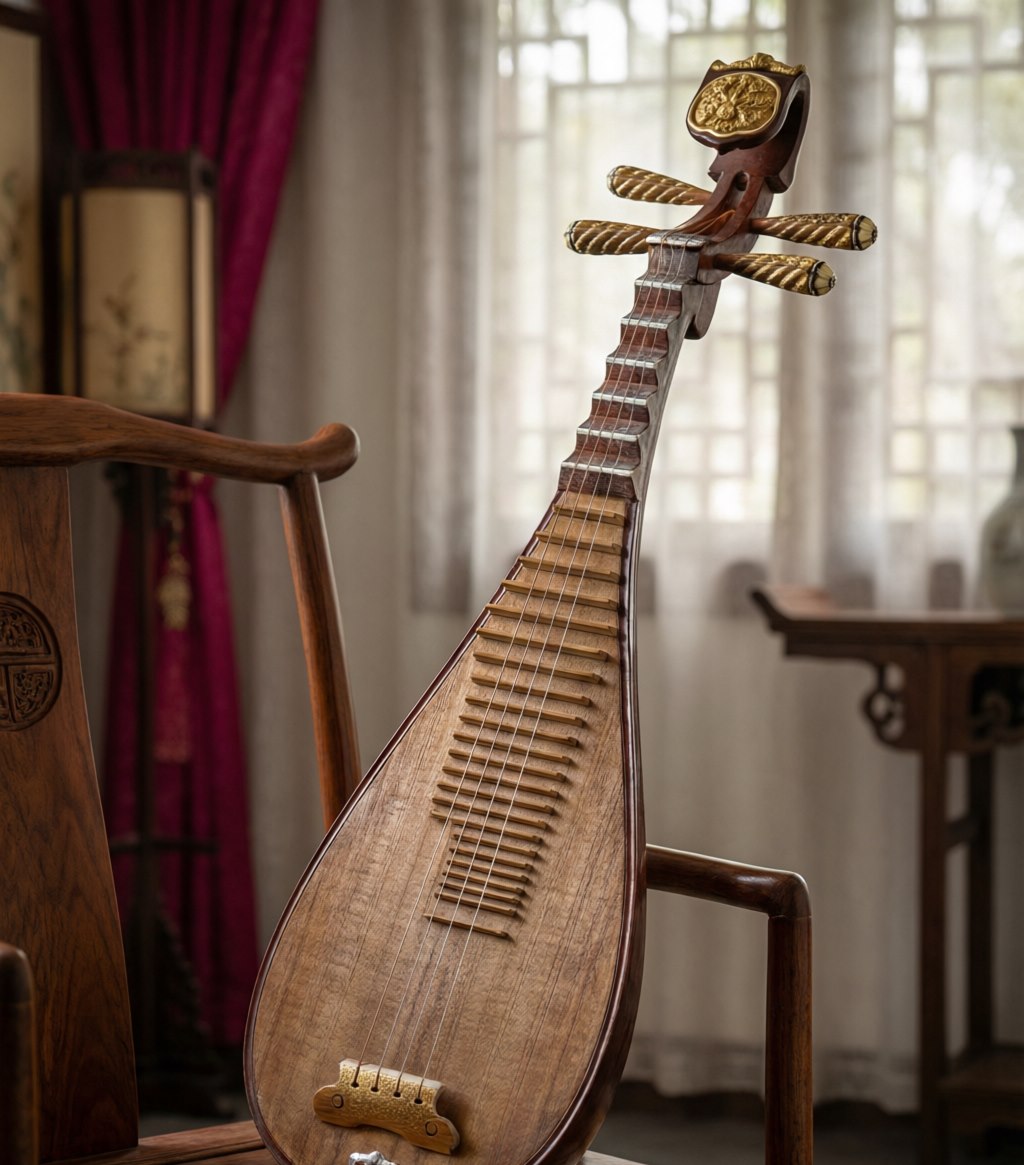
In the year 816, the poet Bai Juyi (白居易) was living in exile on the banks of the Yangtze, demoted and melancholy, when one autumn evening he heard music drifting across the water from a neighboring boat. A woman was playing the pipa. He rowed over, asked her to play again, and listened as she told him her story: once a celebrated musician in the capital, now aging and married to a traveling merchant who left her alone for months. Moved, Bai Juyi wrote one of the most famous poems in the Chinese language — Pipa Xing (琵琶行, "Song of the Pipa") — and in it he fixed forever the sound of the instrument in a single image: "The louder strings clamored like urgent rain; the softer strings whispered like private talk. Clamoring and whispering, then mingling together — like big pearls and small pearls falling on a plate of jade." No description of the pipa has ever been bettered. For more than a millennium, the instrument has been the sound of pearls on jade: brilliant, percussive, intimate, and a little heartbreaking.
A Traveler From the West
For all its Chinese soul, the pipa is, in origin, an immigrant. The pear-shaped, bent-neck lute reached China along the Silk Road, carried by musicians from Central Asia — the regions of Kucha (龟兹) and the broader Western Territories — and it flourished first in the cosmopolitan courts of the Northern dynasties and the Sui and Tang (581–907 CE). The Tang capital Chang'an was the most international city on earth, and the pipa was its signature instrument: played at banquets, in dance music, in the great orchestras that accompanied court spectacle. Its very name is thought to be onomatopoeic — pi (琵) and pa (琶) imitating the two directions of the plucking stroke, forward and back — a fitting name for an instrument whose sound is so physical, so percussive, that it seems to name itself.
China had, in fact, known plucked lutes long before the pear-shaped version arrived; the term pipa was once applied loosely to several instruments. But it was the Central Asian form that won out, gradually sinicized over the centuries: held horizontally at first, then tilted upward; played with a large plectrum, then with the bare fingers and, eventually, with small plectra on each fingertip. By the Ming and Qing dynasties the pipa had become fully Chinese in technique and repertoire, the centerpiece of a solo tradition of astonishing virtuosity. The immigrant had become a native, and in the process had acquired a literature, a legend, and a soul.
Pear-Shaped, Four-Stringed, Fretted
The pipa's silhouette is unmistakable: a half-pear-shaped wooden body, a bent neck, and a scroll, often carved into a bat's head or a simple curl. The soundboard is typically of light paulownia wood (桐木), the same resonant timber used for the qin and guzheng; the back and neck are of a harder wood such as rosewood or mahogany, sometimes inlaid with bone or jade. Four strings run from the pegbox down over a series of frets — historically fewer, now commonly twenty-four to twenty-six, arranged to allow a full chromatic range. The strings were once silk; today they are usually steel wound with nylon, bright and cutting.
The instrument is held upright on the player's lap, tilted slightly outward, and played with both hands in a division of labor that produces its characteristic brilliance. The right hand plucks and strums across the strings with a battery of techniques: tan (弹) and tiao (挑), the basic outward and inward strokes; lun zhi (轮指), the celebrated "wheel finger," in which all five fingers rotate rapidly across the strings to produce a continuous, tremolo sustain — the sound that lets the pipa sing a long, unbroken line despite being a plucked instrument; and sao (扫) and fu (拂), sweeping chords that crash across all four strings at once. The left hand stops the strings against the frets and adds bends, vibrato, slides, and the percussive tapped notes that give the pipa its speech-like drama.
The combination is what makes the pipa so theatrical. It can whisper and it can thunder; it can sustain a lyrical melody like a bowed instrument and then, in an instant, erupt into a percussive storm. Few acoustic instruments cover so wide an emotional range, and few are so physically spectacular to watch — the right hand a blur of rotating fingers, the left hand sliding up and down the neck, the whole body of the player leaning into the sound.
Ambush From Ten Sides
The pipa's repertoire is traditionally divided into two broad families, and the contrast between them reveals the instrument's double nature. The wu qu (武曲, "martial pieces") are dramatic, programmatic, and loud, depicting battles and heroic struggle. The supreme example is Shi Mian Mai Fu (十面埋伏, "Ambush from Ten Sides"), which dramatizes the final battle of the Chu–Han contention in 202 BCE, when the warlord Xiang Yu (项羽) was surrounded and destroyed by the forces of Liu Bang, the future founder of the Han dynasty. The piece is a tone-painting of extraordinary vividness: the mustering of armies, the clash of weapons, the sound of the besieged enemy's songs designed to break their morale (the famous "songs of Chu"), the desperate last stand, and the death of the hero. Played at full force, with sweeping chords and galloping rhythms, it turns a single lute into an entire battlefield.
"Listen — and you hear a hundred thousand soldiers. The strings become spears; the soundboard becomes the plain where an army dies."
— A traditional description of Shi Mian Mai Fu (十面埋伏), the martial pipa masterpiece that conjures the fall of Xiang Yu
Its companion piece, Bawang Xie Jia (霸王卸甲, "The Warlord Doffs His Armor"), treats the same battle from Xiang Yu's side — less the spectacle of victory than the tragedy of defeat, the hero laying down his armor in his final moments. Together the two pieces show the martial pipa at its most cinematic, narrating a story more than two thousand years old with an immediacy that still startles.
The Civil Repertoire: Sorrow in a Minor Key
Opposite the martial pieces stand the wen qu (文曲, "civil" or lyrical pieces) — introspective, melodic, often melancholy. Here the pipa becomes the instrument of Bai Juyi's aging musician and of a hundred stories of separation and longing. The most famous is Zhaojun Chu Sai (昭君出塞, "Wang Zhaojun Leaves the Frontier"), which tells the story of Wang Zhaojun (王昭君), the Han dynasty court lady who, according to legend, was sent to marry the Xiongnu chieftain to secure peace on the northern border. As she rode out beyond the Great Wall, the story goes, she played the pipa, and the wild geese overhead, hearing the beauty of the music and seeing the beauty of the woman, forgot to fly and fell from the sky. The piece is a portrait of dignified sorrow — a woman leaving everything she knows, her grief made bearable only by the instrument in her hands.
Other civil masterpieces include Yang Chun Bai Xue (阳春白雪, "White Snow in Spring"), a bright, virtuosic evocation of the thaw and the returning season, and Yue'er Gao (月儿高, "The Moon Is High"), a serene nocturne. The civil repertoire is where the pipa's left-hand artistry shines: the slow bends, the sighing portamenti, the delicate ornaments that make a single phrase carry the weight of an entire life. If the martial pieces prove the instrument's power, the civil pieces prove its tenderness — and it is the rare performer who commands both.
The Poet, the Princess, and the Legend
The pipa is unusually rich in literary and legendary association. Bai Juyi's Pipa Xing is only the beginning. The instrument appears throughout Tang poetry as the sound of the frontier, of banquet and farewell, of women's private grief. It is linked to Wang Zhaojun and to Cai Wenji (蔡文姬), another woman of legend carried into captivity beyond the border; to the dancers of the Tang court who spun with the instrument held behind their backs; to the Buddhist cave temples of Dunhuang, where painted feitian (飞天), flying apsaras, are depicted playing the pipa in mid-air, their bodies inverted, their ribbons streaming.
"The big strings clamor like urgent rain; the small strings whisper like private talk... like big pearls and small pearls falling on a plate of jade."
— Bai Juyi (白居易), Pipa Xing (琵琶行, "Song of the Pipa"), 816 CE
These associations are not decoration; they are part of how the instrument is heard. To play Zhaojun Chu Sai is to step into a story every Chinese listener already knows. To hear the pipa is to hear, faintly beneath the notes, the sound of a woman riding toward a frontier she will never return from, and a poet on a riverbank weeping at the recognition that her exile and his are the same exile. The instrument carries its literature with it, and that literature deepens every note.
The Pipa in the Modern World
The pipa entered the twentieth century as a solo and ensemble instrument of the literati and the opera house; it leaves the first quarter of the twenty-first as a global concert instrument. The great modernizers — players and pedagogues such as Liu Dehai (刘德海), whose technical and interpretive innovations expanded what the instrument could do — bridged the old solo tradition and the new conservatory world. New compositions have pushed the pipa into contemporary classical territory, and the instrument now appears with Western orchestras, in chamber music, and in cross-genre collaborations that would have astonished Bai Juyi.
Its reach into popular culture is just as striking. The pipa has become a favorite in film scores and in the wave of "national style" (国风, guofeng) popular music that blends traditional timbres with modern production; its bright, percussive attack cuts through a mix in a way few traditional instruments can. International virtuosos have carried it onto the world's stages, and a new generation of players — many of them young, many of them online — has made the pipa a presence on concert platforms and social media alike. The instrument that arrived as a foreigner two thousand years ago now travels the world again, this time as an ambassador of the culture that adopted it.
Pearls That Never Stop Falling
What explains the pipa's hold on the Chinese imagination across so many centuries? Partly it is sheer expressive range — no other traditional Chinese instrument moves so convincingly from the battlefield to the boudoir, from the roar of an army to the whisper of a single woman's grief. Partly it is its physicality: the pipa is an instrument you can see being played, the drama of the hands inseparable from the drama of the sound. And partly it is the depth of its stories — Wang Zhaojun at the frontier, Bai Juyi on the river, Xiang Yu surrounded on the plain — which give the music a narrative weight that pure abstraction could never provide.
When a great player strikes up, the old image returns as if for the first time. The loud strings and the soft strings, the clamor and the whisper, the wheeling fingers and the sliding notes — and then that unmistakable cascade, bright and round and falling, like pearls striking jade. Bai Juyi heard it on an autumn night more than twelve hundred years ago and wrote it down. The pearls have not stopped falling since.