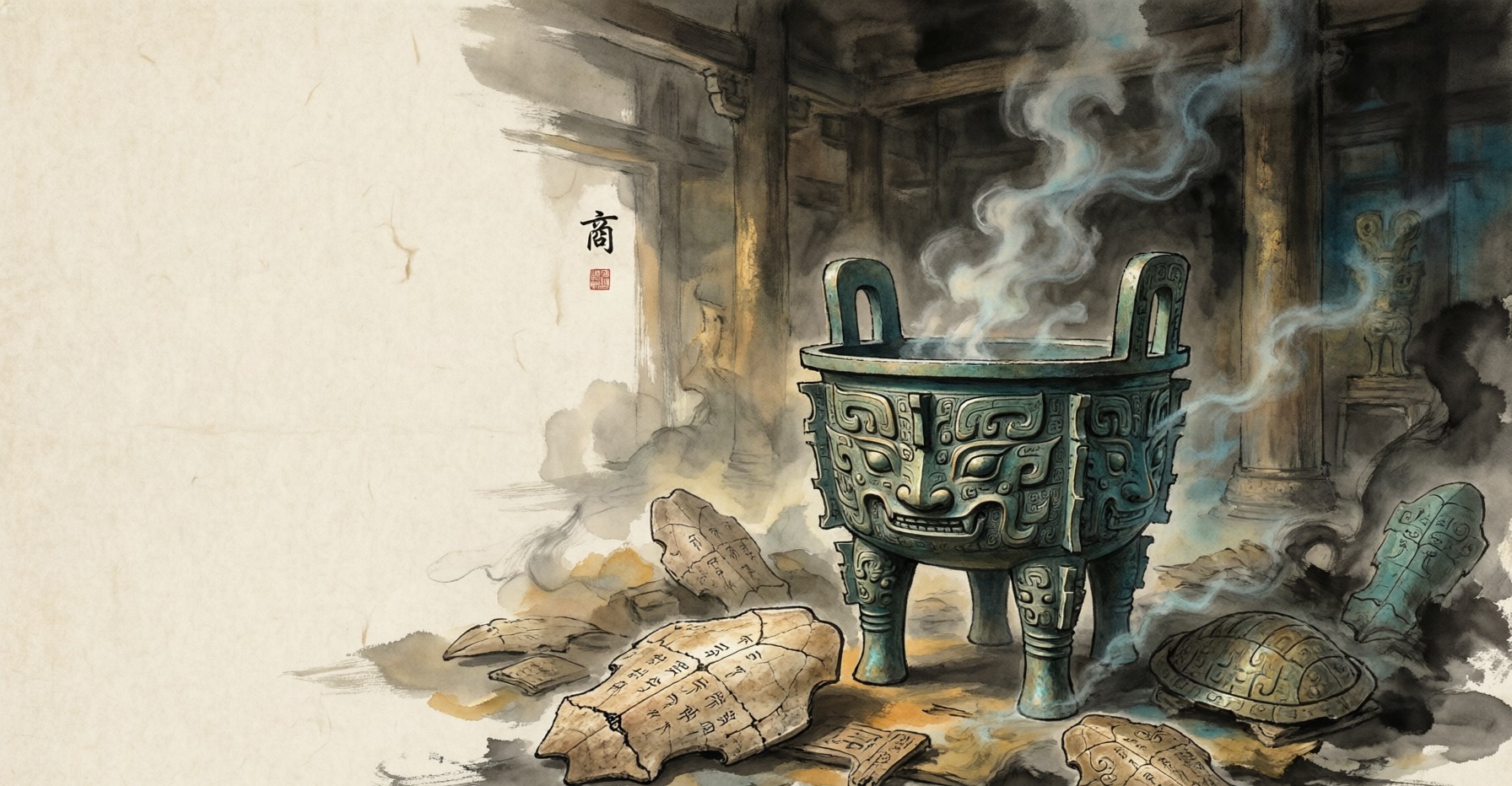
If the Xia are a whisper, the Shang are a voice. With them, Chinese history steps out of legend and into the light of evidence — for the Shang left behind the two things that turn a people from a rumor into a civilization: writing, and works of art so accomplished that they still stop the breath. From the cracked shoulder blades of oxen and the shells of turtles they carved the first Chinese words we can read. From molten bronze they cast ritual vessels of a beauty and technical mastery that the ancient world could scarcely match. They were a kingdom of priests and warriors, of ancestor cults and human sacrifice, ruled from a capital whose buried treasures would astonish the modern world. The Shang are not always comfortable to admire; they were fierce, and their piety had a terrible edge. But they are the true beginning of the Chinese record, and everything that makes China China — its script, its reverence for the dead, its ritual sense, its very habit of writing things down — was already alive in their courts three thousand years ago.
China's Bronze Age
The Shang ruled for roughly five and a half centuries, conventionally dated from around 1600 to about 1046 BCE, though as with all the earliest Chinese chronology these dates are approximate and debated. Their heartland lay along the middle and lower reaches of the Yellow River, in the broad loess plains of what are now Henan, Hebei, Shandong, and Shanxi. They were not, by the standards of later empires, a vast territorial state; their power radiated outward from a royal center through a network of allied and subject polities, more a web of loyalties than a grid of borders. But within that web they presided over a cultural and technological flowering without parallel in East Asia at the time.
That flowering was, above all, a matter of bronze. The Shang lived in China's Bronze Age, and they worked the metal with a sophistication that still puzzles and delights metallurgists. Where other early civilizations often hammered or lost-wax cast their bronze, the Shang perfected an extraordinary technique of piece-mold casting: they built intricate clay molds in sections around a model, assembled them with hair's-breadth precision, and poured molten bronze into the seams. The result was vessels of a size, sharpness, and complexity that no contemporary culture could rival. Bronze, for the Shang, was not chiefly for weapons or tools. It was sacred. It was the medium through which the living fed and honored the dead, and the measure of a ruler's power and piety. To possess bronze was to possess the means of speaking to heaven and the ancestors — which is why the great bronze vessels would later become symbols of legitimate rule itself.
The Bones That Speak: The Birth of Chinese Writing
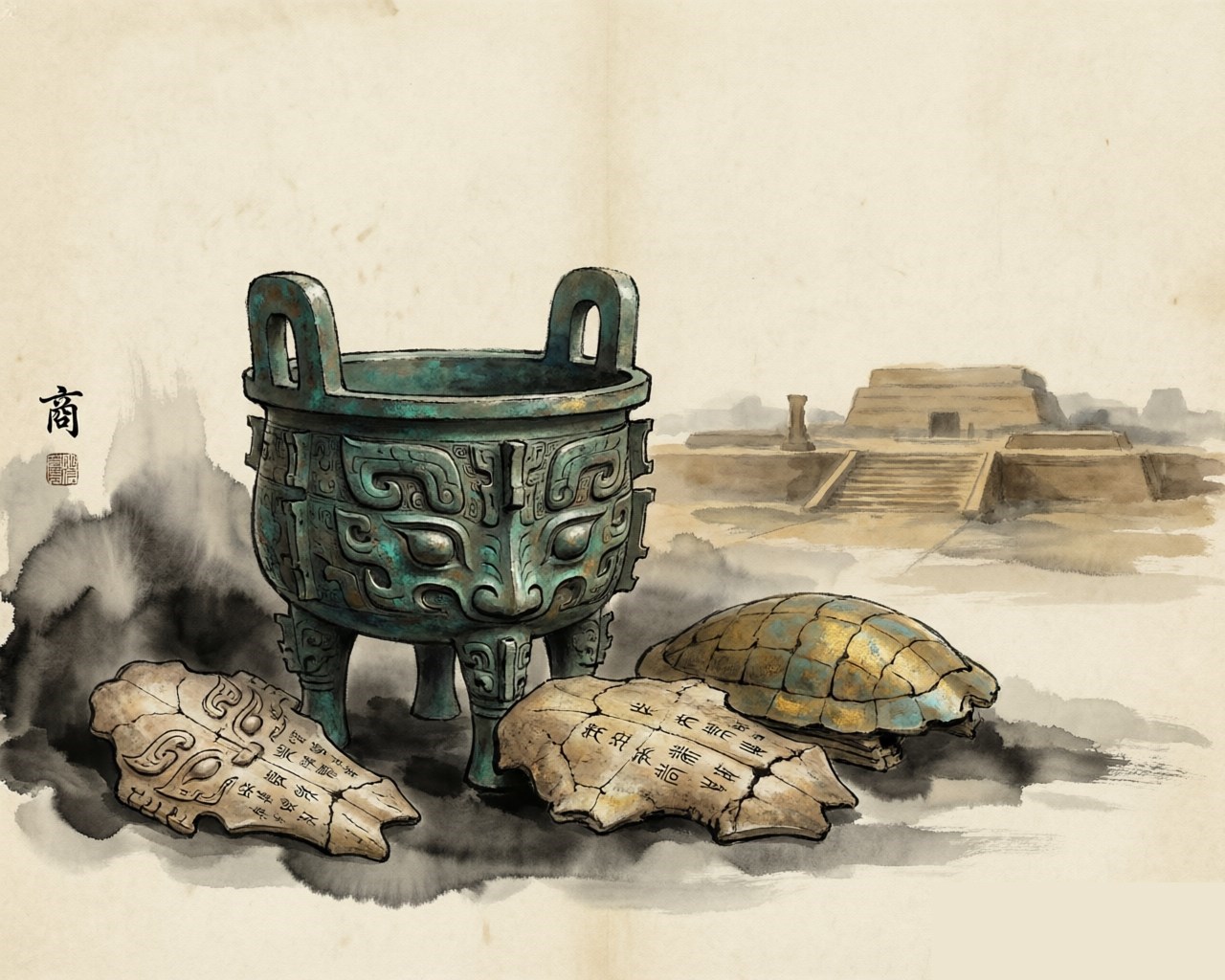
The single most fateful gift the Shang gave to China was writing. The earliest confirmed Chinese script is the oracle bone script (甲骨文, jiaguwen) — characters incised on turtle plastrons and ox scapulae, used for the most serious business the Shang court knew: divination. The process was elaborate. A question would be posed to the royal ancestors — about the weather, the harvest, a military campaign, the king's aching tooth, the safe delivery of a royal consort. The bone was prepared, heated until it cracked, and the pattern of the cracks read as the ancestors' answer. The question, and sometimes the outcome, were then carved into the bone itself. Tens of thousands of these fragments have now been recovered, and together they form an archive of the Shang kings' anxieties, written in their own hand.
What makes the oracle bones astonishing is how fully formed the writing already is. The script of the late Shang is not a primitive scratch of pictographs; it is a mature, flexible system capable of recording anything the scribes wished to say, with thousands of distinct characters, many of them recognizable ancestors of the Chinese characters in use today. A reader of modern Chinese can look at an oracle bone and, in many cases, recognize a word across a gulf of three millennia. This continuity is almost unique in human history. The scripts of ancient Egypt and Mesopotamia died and had to be deciphered anew; Chinese writing never broke. The line runs unbroken from the Shang diviner scratching a question into a turtle shell to the student texting on a phone in Beijing. Every character is, in a sense, a Shang inheritance.
"The oracle bones are the earliest surviving body of Chinese writing — and they reveal a civilization already confident enough to argue with its gods and to record the argument." — ChinaMaxxing Editorial
Ding, Taotie, and the Art of the Sacred
If the oracle bones show the Shang mind at work, the bronzes show the Shang soul at worship. The great ritual vessels — the three- or four-legged cauldrons called ding (鼎), the wine jars, the goblets, the food containers — were made to hold offerings of grain, meat, and wine set before the ancestors in solemn ceremony. They range from modest cups to enormous cauldrons weighing many hundreds of kilograms, and their surfaces are covered with decoration of hypnotic, almost hallucinatory intensity.
The dominant motif is the taotie (饕餮) — a symmetrical, frontal mask of a creature with bulging eyes, curling horns, and a great jaw, often split across the vessel's surface so that two profile bodies radiate from a single staring face. Scholars have argued for a century over what the taotie means: a dragon, an ogre, a tiger, a spirit of gluttony, a shamanic helper bridging the human and spirit worlds. No one knows for certain, and perhaps that is part of its power. What is clear is the effect: standing before a Shang bronze, one feels watched. The art is not meant to please; it is meant to awe, to mediate between the diner and the dead, to make the invisible presence of the ancestors felt in the firelight. The technical command is equally striking — the precision of the piece-mold casting, the crispness of the relief, the sheer ambition of casting a single vessel larger than a man could lift. The Shang bronzes remain among the supreme achievements of the ancient world's metalworkers.
A Court of Priests and Ancestors
To understand the Shang is to understand that, for them, the boundary between the living and the dead was thin and busy. The royal house practiced an elaborate cult of ancestor worship. The dead kings and their consorts were believed to remain active, powerful, and interested in the affairs of their descendants; they could bless or curse, and it was the duty of the living to keep them fed, honored, and well disposed. The king himself stood at the center of this system as chief priest of his own lineage, the one man who could approach the highest ancestors and, through them, the supreme deity the Shang called Di (帝) or Shangdi (上帝), the "Lord on High." Shang kingship was, in this sense, theocratic: to rule was to preside over a perpetual conversation with the spirit world.
This piety had a dark side that we should not soften. The Shang practiced human sacrifice on a scale that the archaeology makes undeniable. At royal tombs and ritual sites, excavators have found the remains of victims — war captives, above all from a people the texts call the Qiang — buried or killed to accompany and serve the dead in the afterlife, sometimes in considerable numbers. The oracle bones themselves record sacrifices of captives to the ancestors. It is a sobering reminder that the same civilization that produced such refinement also took human life as a routine offering to its gods. The Shang were not cruel by some timeless standard so much as by their own; their world was one in which the spirits demanded blood, and the powerful supplied it. Later ages, beginning with the Zhou, would recoil from the practice — and that recoil is itself part of the story of how Chinese civilization changed.
Yin, the Capital the Earth Kept
The Shang moved their capital several times over the centuries, but their last and most famous seat was at a place called Yin (殷), near the modern city of Anyang in Henan province. It is from this final phase that the richest evidence comes, so much so that the late Shang are often called the "Yin" period. For millennia the city lay buried and forgotten, its very existence doubted by many — until the late nineteenth and early twentieth centuries, when farmers in the Anyang area began turning up old bones, sold them as "dragon bones" for traditional medicine, and inadvertently set off one of the great discoveries in archaeology. Scholars recognized the markings as ancient writing, traced them to their source, and in the 1920s and 1930s systematic excavation began at Yinxu, the "Ruins of Yin."
What Yinxu yielded was a lost civilization in extraordinary preservation: the royal palace foundations, the workshops where the bronzes were cast, the archives of oracle bones, and the great royal tombs — vast earthen pits with sloping ramps, furnished with bronzes, jades, chariots, and the bones of the sacrificed. Among the most celebrated finds is the tomb of Fu Hao (妇好), a royal consort and, remarkably, a military commander who led armies in the field; her intact grave, opened in 1976, contained hundreds of bronze vessels and weapons and confirmed, against all expectation, that a woman could hold high command in the Shang world. The discovery of Yinxu did more than fill museums. It vindicated the ancient textual tradition: the list of Shang kings handed down by Sima Qian, long treated with suspicion, matched the names found on the oracle bones with uncanny accuracy. Legend and archaeology, so often at odds for the Xia, here shook hands.
The Tyrant, the Conqueror, and the Mandate of Heaven
The Shang ended, as the Xia were said to have ended, with a tyrant. The last king, known to history as King Zhou of Shang (商纣王, Shang Zhou Wang) — "Zhou" being a condemnatory posthumous name meaning something like "the cruel one" — is remembered as a monster of appetite and cruelty. The traditional accounts, written by his enemies' descendants, accuse him of drunkenness, sexual depravity, and sadism; of ignoring wise ministers and heeding flatterers; of devising hideous tortures and delighting in them. Whether every charge is true or whether some are the standard slanders that victors heap on the defeated, the moral of the story was never in doubt: the last Shang king had forfeited the right to rule.
His conqueror was King Wu of Zhou (周武王), lord of a rising western state. In a battle traditionally placed at Muye, around 1046 BCE — the date is widely used but remains debated — the Zhou forces defeated the Shang army, and King Zhou is said to have perished in the flames of his own palace. The Zhou dynasty began. But the Zhou faced a problem: they had overthrown a ruling house that had reigned for more than five centuries, and they needed to explain why this was not mere rebellion. Their answer became one of the most consequential ideas in human political thought — the Mandate of Heaven (天命, tianming).
Heaven, the Zhou argued, does not grant the right to rule to a family forever. It entrusts it to the virtuous, and withdraws it from the wicked. The Shang had once held the mandate; their early kings had been worthy, and heaven had blessed them. But the last king's crimes had exhausted heaven's patience, and the mandate had passed to the virtuous Zhou. The fall of the Shang was not usurpation but cosmic justice. This idea — that legitimate rule rests on moral conduct and can be forfeited — would echo through every subsequent dynasty, justifying revolution and restraining kings in equal measure. It was born in the ashes of the Shang, and it is, in a sense, the Shang's most enduring legacy: a civilization that learned, from its own overthrow, to hold power morally accountable.
The Shang Inheritance
The Zhou conquered the Shang, but in the deeper sense the Shang conquered the future. The Zhou adopted and adapted nearly everything the Shang had built: the bronze ritual tradition, the ancestor cult, the art of writing, the very forms of courtly ceremony. The script that began on Shang bones would evolve, unbroken, into the writing of a billion people. The reverence for ancestors that filled Shang temples remains, in humbler forms, a living force in Chinese family life to this day — the incense at a graveside, the offerings at a household shrine, the sense that the dead are still present and still owed respect. The bronze ding passed from a ritual cauldron into the language itself as a word for stability and legitimate power; to "question the ding" became, and remains, a phrase for challenging established authority.
There is a lesson in the Shang for anyone who loves a civilization. They were not gentle, and they were not modern, and to admire their art is not to excuse their sacrifices. But they were the first to give China a voice — to set down words that could outlast the speakers, to cast beauty in metal that could outlast the hands that made it. When you write a Chinese character, you are repeating a gesture first perfected in the firelight of a Shang diviner's court. When you stand before a bronze ding and feel, across three thousand years, that you are being watched by something vast and patient, you are feeling exactly what the Shang intended. They are the true threshold of the Chinese record: the dynasty at which memory becomes history, and the long conversation of a civilization begins.