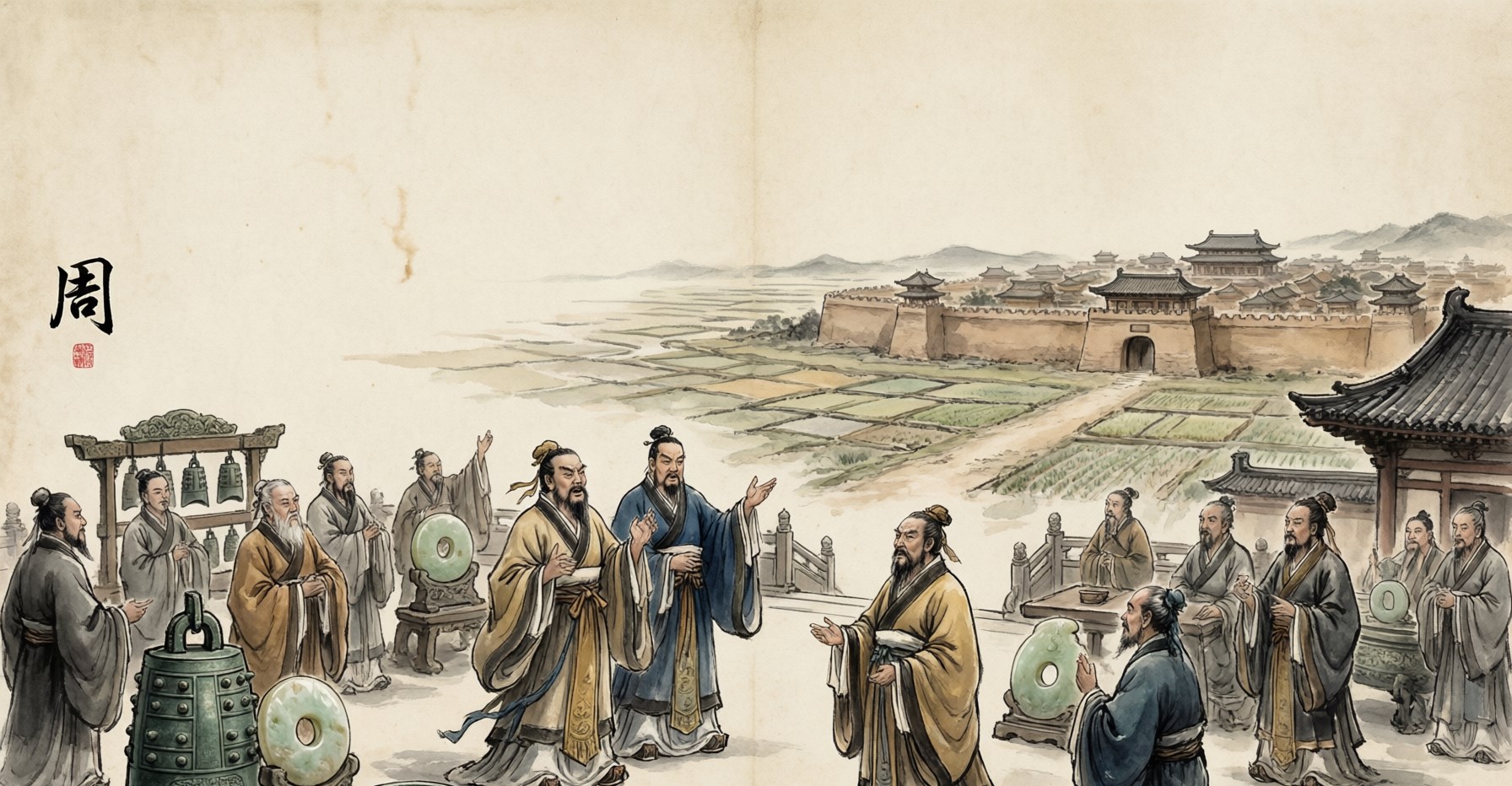
If the Qin Dynasty was the lightning that made China one, the Zhou Dynasty was the long, slow weather that made China think. No other dynasty in the Chinese record lasted so long. By the traditional reckoning it endured for close to eight centuries — from King Wu's conquest of the Shang, around 1046 BCE, until the last Zhou king was finally swept aside in 256 BCE, only a few decades before the Qin unification. Whole civilizations rose and fell in the time the Zhou name held sway. And yet, for all its longevity, the Zhou is remembered less for the power it wielded than for the ideas it set loose upon the world. It was under the long, weakening shadow of Zhou rule that Chinese civilization produced its greatest thinkers — Confucius, Laozi, Mozi, Mencius, Zhuangzi, Sunzi — and fought its most terrible wars. Out of fragmentation came a flowering that has never been surpassed.
The Conquest and the Duke of Zhou
The Zhou began, like the Qin after them, as a western people on the edge of the Shang world, in the Wei River valley of what is now Shaanxi. For generations they served the Shang as a frontier lordship, guarding the marches and absorbing Shang culture even as they chafed under its overlordship. The decisive turn came with King Wen, the "cultured king," who is said to have laid the moral foundations of the dynasty and to whom tradition attributes much of the Yijing, the Book of Changes. It was his son, King Wu — the "martial king" — who turned moral authority into military fact.
Around 1046 BCE — the date is traditional and still debated by scholars — King Wu led his army east and met the forces of the last Shang king at the Battle of Muye. The Shang ruler, the infamous tyrant Zhou Xin, was said to have grown so corrupt and cruel that his own people turned against him; legend holds that his slaves switched sides on the field. The Shang fell, and King Wu became master of the Chinese world. But he died only a few years later, leaving a young son and an unconsolidated realm. It was here that the dynasty's true architect stepped forward: King Wu's brother, the Duke of Zhou (周公, Zhou Gong).
The Duke of Zhou is one of the great figures of Chinese memory — a regent who held supreme power and yet, the tradition insists, never once grasped at the throne for himself. He put down a rebellion by rival princes and Shang loyalists, secured the eastern territories, and then handed authority back to his nephew when the boy came of age. Later ages, especially the Confucians, held him up as the model of the selfless minister, the man who wielded everything and coveted nothing. Confucius himself, centuries later, would say that he had grown so old he no longer dreamed of the Duke of Zhou — a confession of faded ambition that became famous in its own right.
"Heaven sees as my people see; Heaven hears as my people hear." — Book of Documents (Shujing), voicing the Zhou understanding of the Mandate of Heaven
The Mandate of Heaven
The Zhou faced a problem every usurper faces: how to justify having overthrown a king. The Shang had ruled for centuries; by what right had the Zhou taken their place? The answer the Duke of Zhou and his circle devised became one of the most consequential ideas in all of Chinese history — the Mandate of Heaven (天命, tianming).
The argument was as elegant as it was revolutionary. Heaven, the highest moral order, granted the right to rule not to a bloodline forever, but to a ruler of virtue. The Shang's founding kings had once been worthy, and so Heaven had blessed them. But the last Shang king had sunk into depravity, and so Heaven had withdrawn its favor and bestowed it instead upon the virtuous Zhou. The Mandate was not a permanent possession; it was a trust, conditional on good governance, and it could be — indeed, would be — transferred when a dynasty failed its people. Suffering, famine, and defeat were not mere misfortune; they were signs that the Mandate was slipping away.
This was a double-edged gift to Chinese civilization. On one side, it gave every successful rebel a ready-made moral vocabulary: to overthrow a corrupt dynasty was not treason but the will of Heaven. On the other, it laid upon every ruler a permanent burden of responsibility, a standard against which he could always be judged and found wanting. For more than three thousand years, Chinese politics would turn on this single idea. Every dynasty that followed would claim the Mandate, and every dynasty that fell would be said to have lost it.
The Feudal Order: A Kingdom of Kin
Having won the realm, the Zhou had to govern it — and the realm was vast, its communications slow, its peoples diverse. Their solution was the system called fengjian (封建), often translated as "feudalism," though it was feudalism of a distinctly Chinese kind. The Zhou kings enfeoffed their relatives, their allies, and the descendants of former sage-kings as lords across the land, granting each a territory to rule in the king's name. In return, these lords owed the king tribute, military service, and loyalty. It was, in effect, an attempt to bind the empire together not with bureaucrats — that would come later, with the Qin — but with blood and ritual.
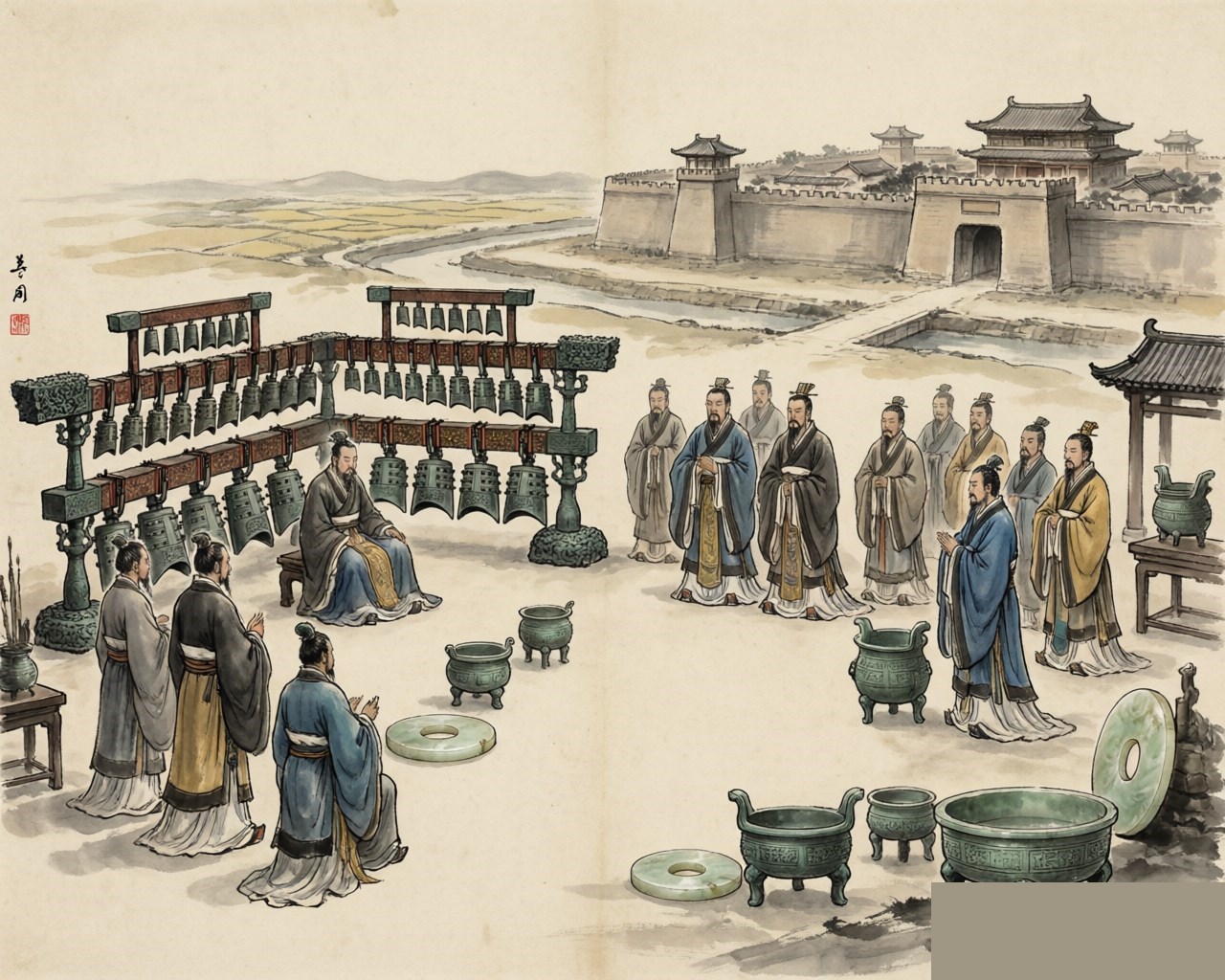
At its heart the system was familial. The great majority of the enfeoffed states were given to members of the royal Ji (姬) clan, so that the map of early Zhou China was, in theory, a map of one extended family. The king stood at the apex as both sovereign and senior kinsman, and the bonds of kinship were reinforced by an elaborate code of ritual and music (礼乐, li yue) that governed everything from sacrifices and court audiences to the number of dishes a lord might set upon his table. The great bronze ritual vessels of the age — the ding cauldrons, the wine jars, the bells — were not mere tableware but instruments of this sacred order, cast with inscriptions recording the king's favors and the lords' duties.
For a time it worked. The Western Zhou, ruling from their capital region near modern Xi'an, presided over a stable, expanding order. But the system carried within it the seed of its own undoing. Each generation, the ties of kinship grew more distant; a fifth cousin is not a brother. As the lords settled into their territories, they grew strong, and the kings grew comparatively weak. The center could command loyalty only so long as it commanded respect — and respect, unlike land, cannot be inherited forever.
Eastward: A Capital Lost, A Dynasty Diminished
The break came in 771 BCE. The last Western Zhou king, King You, had — so the famous story goes — so alienated his lords that when nomadic Quanrong tribesmen swept down on the capital, his beacons went unanswered. The capital fell, the king was killed, and the Zhou court was driven east. The following year, 770 BCE, the dynasty re-established itself at Luoyang, on the central plains. Historians mark this moment as the dividing line between the Western Zhou and the Eastern Zhou — and as the beginning of the long twilight of royal power.
The Eastern Zhou kings still sat on the throne, still performed the sacrifices, still nominally stood at the head of the Chinese world. But they were kings in name only. The real power now lay with the feudal lords, who grew ever more independent, ever more ambitious, and ever more willing to fight one another for supremacy. The Mandate of Heaven still belonged to the Zhou in theory; in practice, it had evaporated, leaving behind a hollow throne that everyone honored and no one obeyed. The dynasty would linger in this state for another five centuries — a long, slow dying that happened to coincide with the most creative era in Chinese history.
The Spring and Autumn, and the Warring States
The Eastern Zhou is traditionally divided into two great ages, named for the books that record them. The first is the Spring and Autumn period (roughly 770–476 BCE), after the Spring and Autumn Annals, the terse chronicle of the state of Lu attributed to Confucius himself. It was an age of many states and shifting alliances, in which a handful of powerful lords — the so-called Five Hegemons — contended for leadership while still paying lip service to the Zhou king. War was frequent but, by later standards, restrained, governed by an aristocratic code of honor in which a gentleman might refuse to attack an enemy before it had finished crossing a river.
That code did not survive. The second age, the Warring States period (roughly 475–221 BCE), was something else entirely. By now the smaller states had been swallowed up, and seven great powers remained, fighting not for precedence but for survival — and ultimately for the whole of China. War became total and industrial. Aristocratic chariotry gave way to massed infantry and cavalry; armies numbered in the hundreds of thousands, and campaigns ended not in negotiated settlements but in the annihilation of entire populations. The old ritual order of the early Zhou was gone beyond recall. It was an age of fear, of treachery, and of relentless innovation — and it was precisely this pressure that forced the Chinese mind to its greatest heights.
The Hundred Schools of Thought
Here is the central paradox of the Zhou, and one of the great wonders of human history: the age of China's worst political chaos was also the age of its supreme intellectual achievement. As the old order collapsed, thinkers of every kind rushed to answer the question that hung over the Warring States — how, in a world gone mad, should human beings live, and how should they be ruled? The result was the Hundred Schools of Thought (百家争鸣, baijia zhengming), the "contention of a hundred schools," a flowering of philosophy that has shaped Chinese civilization ever since. It happened, roughly, at the same time as the great flowering of thought in ancient Greece — a parallel that scholars have long marveled at and never fully explained.
The most influential of all was Confucius (孔子, Kongzi, "Master Kong"), who lived in the Spring and Autumn period in the state of Lu. Confucius looked back to the early Zhou — to the Duke of Zhou and the age of ritual and music — as a golden age, and argued that the chaos of his own time could be healed only by a return to virtue, to right relationships, and to the cultivation of moral character. He taught that a ruler should lead by example rather than by force, that the family was the school of all virtue, and that learning was the path to becoming fully human. He wandered from court to court in his own lifetime, largely unheeded; after his death, his teachings, gathered in the Lunyu — the Analects — became the foundation of Chinese moral and political thought for two thousand years.
Where Confucius spoke of duty and order, Laozi (老子, "the Old Master") spoke of the Dao, the Way — the nameless, effortless flow that underlies all things. The Daodejing attributed to him, a short and inexhaustibly mysterious text, counseled wuwei, non-action or effortless action: the wisdom of water, which is soft and yielding yet wears away stone. Whether Laozi was a single historical person is debated; the book that bears his name may be the work of several hands. But Daoism, the tradition it founded, became the great counterweight to Confucianism — the voice of nature, spontaneity, and withdrawal against the voice of society, effort, and engagement. The two have lived together in the Chinese mind ever since, like two lungs of the same body.
The other schools were no less brilliant. Mozi (墨子) preached "impartial concern" — a radical, universal love that crossed the boundaries of family and state — and combined it with a hard-headed practicality, opposing wasteful ritual and defensive war alike. Mencius (孟子, Mengzi), the great Confucian who came after, argued that human nature is innately good, as water naturally flows downward. Zhuangzi (庄子) turned philosophy into literature and laughter, telling parables of dreaming butterflies and useless trees to mock all certainty and celebrate the freedom of the unbounded mind. Sunzi (孙子) composed The Art of War, a treatise on strategy so penetrating that it is still read in boardrooms and military academies across the world. And the Legalists (法家, fajia) — thinkers such as Han Feizi — argued the opposite of the Confucians entirely: that people are moved not by virtue but by self-interest, and that a strong state must rest on clear laws and harsh punishments. It was Legalism, in the end, that the Qin would adopt to conquer China; it was Confucianism that the Han would adopt to keep it.
"The Way that can be spoken of is not the constant Way; the name that can be named is not the constant name." — Laozi, Daodejing, opening lines
The Long Twilight and the End
While the philosophers argued and the armies marched, the Zhou kings themselves faded almost from view. Confined to a small royal domain around Luoyang, dependent on the goodwill of greater powers, they became little more than ceremonial figures — the keepers of a legitimacy everyone acknowledged and no one needed. Occasionally a strong state would pay them court to borrow the prestige of their name; more often they were ignored, or bullied, or drawn unwillingly into the wars of others.
The end, when it came, was almost an afterthought. The state of Qin, that old western power, had spent the Warring States period growing stronger than all the rest, and in the decades before unification it systematically dismantled its rivals. In 256 BCE, Qin forces deposed the last Zhou king and absorbed the royal domain. The dynasty that had given China its deepest ideas simply ceased to exist — quietly, without the great conflagration that would attend the fall of so many later houses. Forty years later, in 221 BCE, the Qin completed the conquest of all the Warring States, and the age the Zhou had begun was over. The empire the Zhou had never managed to hold together was, at last, made one.
The Dynasty That Taught China to Think
It is tempting to judge the Zhou a failure: a dynasty that lost control of its own creation and presided, in its long decline, over centuries of bloodshed. But this is to mistake what mattered. The Zhou's true achievement was not the power they held but the world of thought they made possible. Every idea that would govern Chinese civilization for the next two millennia was born under their roof. The Mandate of Heaven became the theory by which all later dynasties justified themselves and were judged. The Confucian classics became the curriculum of every educated Chinese person until the twentieth century. The tension between Confucian duty and Daoist freedom became the inner rhythm of Chinese culture itself — the official at his post by day, the poet on the mountain by night.
There is something almost providential in the way it happened. A strong, centralized empire — the kind the Qin would soon build — might never have tolerated the Hundred Schools. It was the very weakness of the Zhou center, the competition among a hundred rival courts each hungry for any advantage, that gave the thinkers room to speak. Fragmentation, that great political evil, became the condition of intellectual freedom. China has spent its whole history weighing the two against each other — unity against vitality, order against creativity — and the debate begins here.
To read the Analects or the Daodejing today, more than two and a half millennia after they were written, is to discover that they have not aged. They still ask the questions we have not finished answering: how to be a good person, how to govern justly, how to live in a world that will not be made orderly. The Zhou kings are dust, and their bronze vessels stand silent in museums. But the conversation they began has never stopped. In that sense, the longest dynasty never really ended at all.