Theory without practice is empty; practice without theory is blind. In our introduction to yangsheng, we explored the philosophy of nourishing life. In our guide to Traditional Chinese Medicine, we mapped the theoretical landscape of qi, meridians, and pattern diagnosis. Here, we descend from the mountaintop into the kitchen, the park, and the daily routine — the concrete practices through which millions of Chinese people maintain their health not through heroic intervention but through the quiet, cumulative power of small, intelligent choices repeated every day.
Food as Medicine: The Chinese Dietary Way
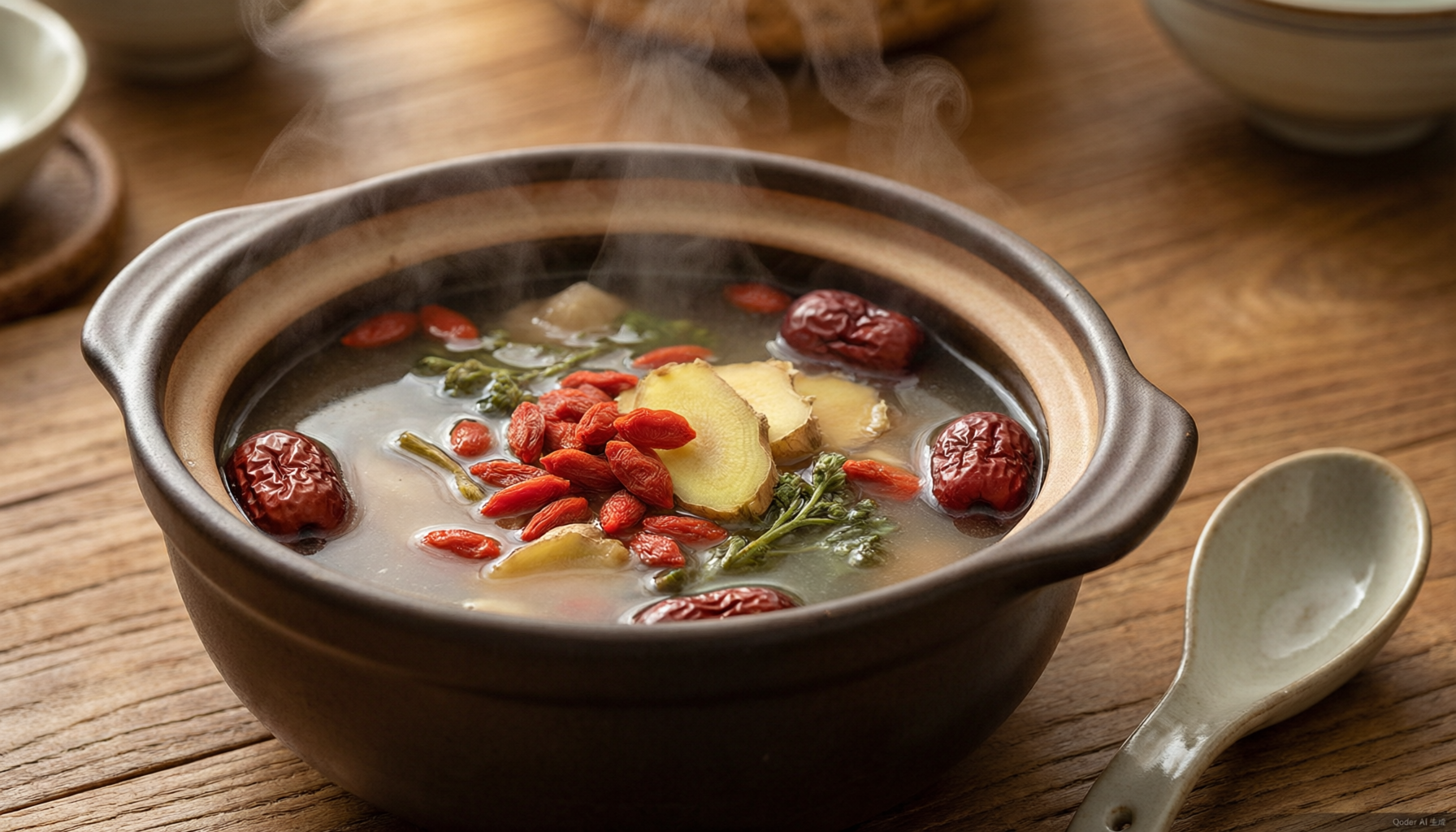
In a Chinese household, the boundary between cooking and prescribing is deliberately thin. A grandmother who adds a handful of dried longan to her congee is not merely flavoring breakfast — she is tonifying heart blood and calming the spirit. A father who steams a pear with rock sugar and fritillary bulb for his coughing child is administering a classic lung-moistening formula that appears in medical textbooks. The kitchen is the first clinic; the pot is the first prescription.
Chinese dietary therapy (食疗, shiliao) classifies all foods by their energetic properties. Thermal nature places each food on a spectrum from hot to cold: lamb, ginger, cinnamon, and chili are warming; watermelon, mung bean, pear, and crab are cooling; rice, potato, and carrot are neutral. Flavor determines directional action: sweet tonifies and harmonizes (dates, honey, rice); sour astringes and preserves (vinegar, plum, hawthorn); bitter dries and descends (bitter melon, green tea); pungent disperses and moves (ginger, scallion, pepper); salty softens and directs downward (seaweed, miso).
The practical principle is simple: eat according to your constitution and the season. A person who runs cold — pale, fatigued, with cold hands and loose stools — should favor warm, cooked foods and minimize raw salads and iced drinks. A person who runs hot — red-faced, restless, prone to dry mouth and constipation — benefits from cooling, moistening foods and should limit fried and spicy dishes. In summer, when external heat drives the body's energy outward, the digestive center is relatively weak — hence the Chinese preference for light congee and soups rather than heavy meals. In winter, when energy consolidates inward, richer, warming foods — stews, roasted meats, root vegetables — are appropriate and well-tolerated.
"Let food be thy medicine, and medicine be thy food."
— Hippocrates (echoing, across two millennia, the same principle Chinese cooks have practiced since the Shang Dynasty)
Qigong: The Art of Cultivating Energy
Qigong (气功) — literally "energy work" or "skill with qi" — is a family of practices combining slow movement, regulated breathing, and focused intention to cultivate, circulate, and balance the body's vital energy. Its forms range from the martial (hard qigong, iron shirt training) to the medical (therapeutic exercises prescribed for specific conditions) to the meditative (seated stillness with internal visualization). For daily health maintenance, the gentle, flowing forms are most widely practiced.
The Eight Brocades (八段锦, Baduanjin) is perhaps the most accessible qigong set for beginners. Eight standing movements, each targeting a specific organ system and meridian, can be completed in twelve minutes. "Two Hands Hold Up the Sky" stretches the triple burner and regulates the internal organs. "Drawing the Bow" opens the chest and stimulates the lung and large intestine meridians. "Separating Heaven and Earth" harmonizes the spleen and stomach. Practiced daily — in a park, a living room, a rooftop at dawn — the Eight Brocades build flexibility, deepen breathing, improve circulation, and quiet the nervous system with an efficiency that no gym session can match.
The Five Animal Frolics (五禽戏, Wuqinxi), attributed to the Han Dynasty physician Hua Tuo, imitates the movements of the tiger, deer, bear, monkey, and crane — each animal corresponding to an organ system and a quality of movement. The tiger strengthens the liver and develops fierce, grounded power. The deer nourishes the kidneys and cultivates graceful, turning flexibility. The bear fortifies the spleen with heavy, swaying stability. The monkey benefits the heart with quick, agile alertness. The crane supports the lungs with expansive, lifting lightness. Together, they form a complete physical vocabulary for the body's internal landscape.
Tai Chi: Meditation in Motion
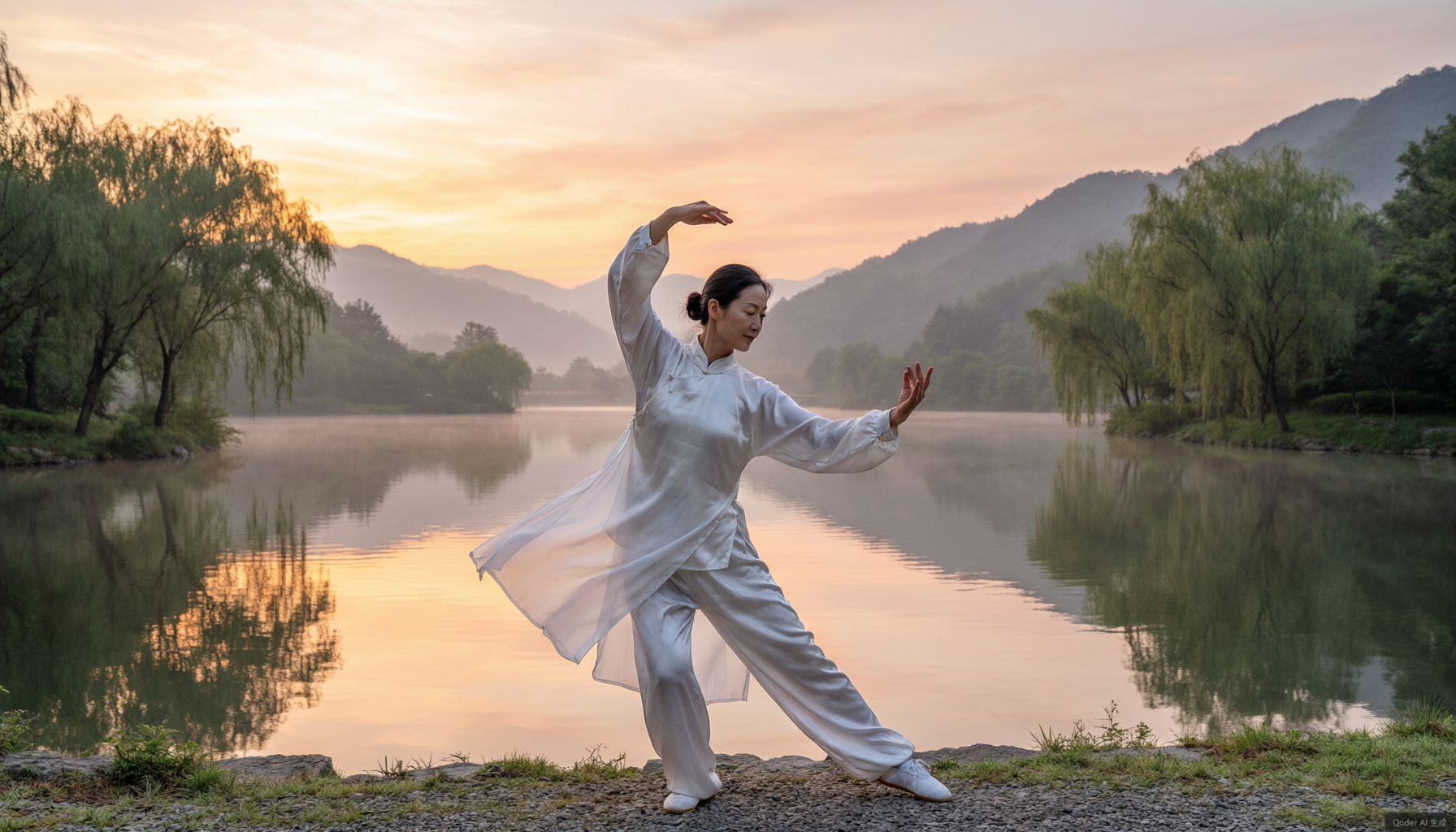
Tai chi (太极拳) — the "supreme ultimate fist" — is simultaneously a martial art, a health practice, and a moving meditation. Its slow, continuous, circular movements embody the Daoist principle of yielding to overcome: force is met not with resistance but with redirection, hardness is dissolved by softness, the opponent's energy is borrowed and returned. For health purposes, the martial applications recede into the background, and the practice becomes a form of dynamic meditation that unifies body, breath, and mind in a single flowing sequence.
Clinical research has confirmed what practitioners have known for centuries: regular tai chi practice improves balance and reduces fall risk in the elderly, lowers blood pressure, reduces cortisol and anxiety, enhances immune function, and improves quality of life in chronic conditions from arthritis to heart failure. The mechanism, in TCM terms, is the smooth circulation of qi and blood, the strengthening of the kidneys (which govern the lower body and balance), and the calming of the heart-mind (心, xin) through the integration of attention and movement.
Seasonal Wellness: Reading the Calendar with Your Body
The twenty-four solar terms (节气) are not merely agricultural markers; they are a wellness calendar. Each term signals a shift in the body's relationship to the external environment, and yangsheng practice adjusts accordingly.
Spring (Lichun to Guyu) is the season of the liver — the organ of expansion, planning, and emotional flow. Yangsheng in spring means rising early, walking outdoors, wearing loose clothing, allowing the hair to hang free (as the Neijing advises), and eating light, ascending foods: sprouts, young greens, scallions, celery. The emotional task is to avoid suppressing anger or frustration — to let the liver's energy rise and flow like sap in a thawing tree.
Summer (Lixia to Dashu) belongs to the heart. The days are long, the energy is expansive, and the body naturally sweats to release heat. Yangsheng in summer means permitting moderate perspiration (not over-air-conditioning), eating cooling foods — watermelon, cucumber, mung bean soup, lotus seed — and taking a short midday nap to nourish the heart during its peak hour. The emotional task is joy without mania: enthusiasm tempered by stillness.
Autumn (Liqiu to Shuangjiang) governs the lungs — the organ most vulnerable to dryness. As the air cools and loses moisture, yangsheng shifts to moistening: pears, honey, white fungus, lily bulb, and almonds become dietary staples. Exercise becomes gentler; one conserves energy as nature begins to withdraw. The emotional task is to release grief gracefully — to let go, as the trees let go, without clinging.
Winter (Lidong to Dahan) is the kidney's season — the time of storage, conservation, and deep rest. Yangsheng in winter means sleeping earlier and rising later (waiting for the sun, as the Neijing prescribes), keeping the lower back and feet warm, eating nourishing and warming foods — black sesame, walnuts, lamb, ginger, cinnamon — and minimizing excessive sweating or expenditure of energy. The emotional task is quietude: turning inward, storing essence, preparing for the spring's renewal.
Acupressure for Daily Life: The Pharmacy in Your Hands
You need not visit an acupuncturist to benefit from the meridian system. Simple acupressure — pressing specific points with the thumb or fingertip — can address common daily complaints with remarkable effectiveness. A few essential points belong in every person's self-care vocabulary:
Zusanli (ST-36), located four finger-widths below the kneecap on the outer shin, is the great tonic point — it strengthens digestion, boosts energy, and supports immune function. Pressing it firmly for two minutes daily is one of the most widely recommended yangsheng habits in China. Hegu (LI-4), in the webbing between thumb and index finger, relieves headaches, toothaches, and facial tension. Neiguan (PC-6), three finger-widths above the inner wrist crease, calms nausea, anxiety, and chest tightness. Yongquan (KI-1), on the sole of the foot, draws excess energy downward, calming insomnia and headaches — massaging it before sleep is a classic evening practice.
These points are not magic; they are access points to the body's own regulatory systems, stimulated through pressure in the same way that acupuncture uses needles. The key is consistency: a minute of daily attention to Zusanli does more than an hour of desperate pressing when crisis strikes. Yangsheng is, above all, a practice of prevention.
Building a Personal Yangsheng Routine
The beauty of yangsheng is its adaptability. It does not demand a monastery, a guru, or an expensive supplement regimen. It asks only for attention — a willingness to notice the season, the body, the breath, and the meal, and to make small adjustments in response. A minimal daily practice might look like this: rise with the light; drink a cup of warm water; perform ten minutes of qigong or tai chi; eat a warm, cooked breakfast suited to the season; take a walk after lunch; press Zusanli and Yongquan in the evening; sleep before eleven, when the gallbladder meridian begins its nightly repair.
This is not asceticism. It is not restriction. It is the ancient, radical proposition that health is not something that happens to you in a doctor's office but something you grow, daily, in the soil of your own attention. The Chinese have been tending this garden for two thousand years. The gate is open. The path is gentle. And the first step is simply this: pour yourself a warm cup, sit down, and breathe.