In the West, we visit the doctor when we are sick. In China, the wisest physician is the one who keeps you from ever arriving at his door. This is the foundational insight of yangsheng (养生) — literally "nourishing life" — a tradition of preventive health, bodily cultivation, and harmonious living that stretches back over two thousand years and remains vibrantly alive in the daily routines of hundreds of millions of Chinese people today. Yangsheng is not a single practice but an entire philosophy: the conviction that health is not the absence of disease but the active, daily, joyful maintenance of balance between body, mind, and the natural world.
The Roots of Yangsheng: Philosophy Before Medicine
The concept of yangsheng predates Chinese medicine as a formal system. Its earliest expressions appear in Daoist texts of the Warring States period (475–221 BCE), where "nourishing life" meant aligning oneself with the Dao — the natural flow of the cosmos — rather than struggling against it. The Zhuangzi contains an entire chapter titled "The Secret of Nourishing Life," in which the sage Cook Ding carves an ox with such effortless precision that his blade never dulls, a metaphor for moving through life without friction, preserving one's vital essence by following the natural grain of things.
By the Han Dynasty (206 BCE–220 CE), yangsheng had become systematized within the framework of Traditional Chinese Medicine. The Huangdi Neijing (Yellow Emperor's Classic of Internal Medicine), the foundational text of TCM, devotes its opening chapters to the principles of longevity: rising and sleeping with the seasons, eating according to one's constitution, moderating emotions, and cultivating qi (vital energy) through breath and movement. The text's famous dictum — "The sage does not treat disease but treats the not-yet-diseased" — encapsulates the entire yangsheng worldview: prevention is not merely preferable to cure; it is a higher form of wisdom.
"To administer medicine to treat disease is like digging a well when one is already thirsty, or casting weapons when war has already begun. Is it not too late?"
— Huangdi Neijing (The Yellow Emperor's Classic of Internal Medicine), c. 2nd century BCE
The Pillars of Yangsheng Practice
Yangsheng is not a single discipline but a constellation of interrelated practices, each addressing a different dimension of human vitality. Together, they form a comprehensive system of self-cultivation that touches every aspect of daily life.
Dietary therapy (食疗, shiliao) is perhaps the most accessible pillar. In the Chinese tradition, food is classified not by calories or macronutrients but by thermal nature (hot, warm, neutral, cool, cold), flavor (sweet, sour, bitter, pungent, salty), and its directional action on specific organ systems. Ginger warms the stomach and dispels cold; mung beans cool the liver and clear summer heat; black sesame nourishes the kidneys and darkens the hair. A yangsheng-minded cook designs each meal as a small prescription, adjusting ingredients to the season, the climate, and the diner's constitution. The kitchen, in this view, is the first pharmacy.
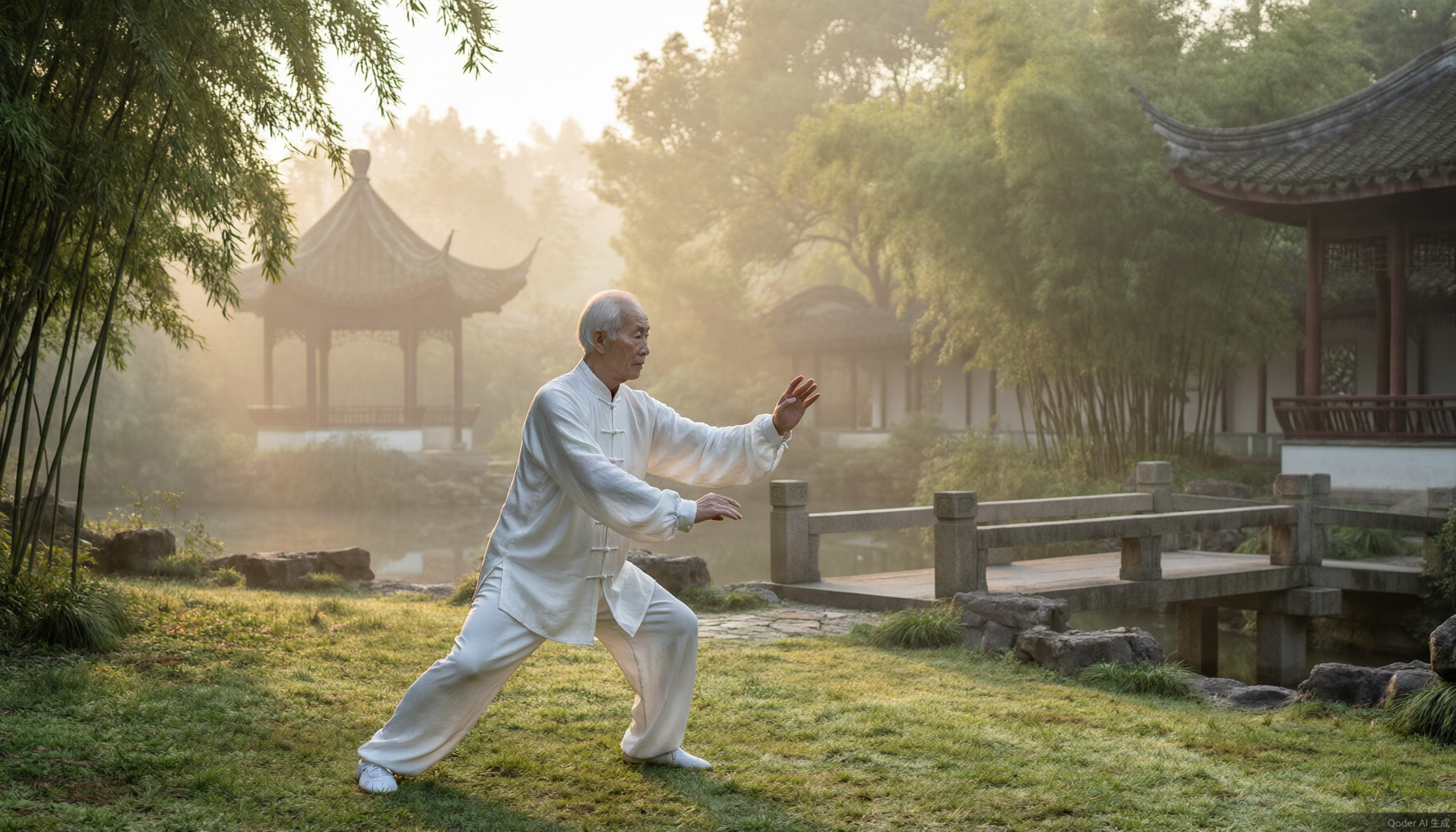
Movement cultivation encompasses the gentle, meditative exercise traditions of qigong (气功) and tai chi (太极拳). These are not "workouts" in the Western sense — they do not seek to exhaust the body or build muscular mass. Rather, they aim to circulate qi smoothly through the meridians, strengthen the internal organs, and unify breath, intention, and physical form. A tai chi practitioner moving slowly through the "Grasp the Sparrow's Tail" sequence is performing a moving meditation as much as an exercise: the body becomes a landscape through which energy flows like water through a well-tended garden.
Breath and meditation practices — including seated meditation (静坐), abdominal breathing (腹式呼吸), and the "six healing sounds" (六字诀) — address the mental and spiritual dimensions of health. In TCM, the emotions are not separate from the body: anger stagnates the liver, grief weakens the lungs, fear depletes the kidneys. Meditation and regulated breathing are therefore not luxuries but medical necessities, tools for preventing emotional extremes from calcifying into physical disease.
Seasonal living (四季养生) aligns daily habits with the rhythm of the twenty-four solar terms. In spring, one rises early and walks outdoors to nourish the liver's expansive energy. In summer, one permits moderate sweating to release heat. In autumn, one moistens the lungs with pear and honey. In winter, one conserves energy, sleeps longer, and warms the kidneys with lamb and cinnamon. This is not folklore; it is a sophisticated phenological medicine that reads the body as an ecosystem responsive to light, temperature, and humidity.
The Constitution Theory: One Size Does Not Fit All
A distinctive feature of Chinese wellness is its insistence on individuality. TCM recognizes nine basic body constitutions (体质, tizhi), ranging from the balanced "neutral" type to specific patterns such as qi-deficient, yang-deficient, yin-deficient, phlegm-damp, blood-stasis, and qi-stagnation types. A person with a cold, yang-deficient constitution — pale, fatigued, cold-handed, prone to loose stools — requires an entirely different dietary and lifestyle regimen than a yin-deficient person — thin, restless, night-sweating, prone to dry mouth and insomnia.
This constitutional approach means that yangsheng is never generic. The same food that heals one person may harm another. The same exercise that invigorates one constitution may deplete another. A skilled practitioner reads the individual — their tongue, their pulse, their complexion, their sleep patterns, their emotional tendencies — and prescribes a personalized path to balance. In an age of one-size-fits-all health advice, this ancient personalization feels remarkably modern.
Yangsheng in Daily Life: The Living Tradition
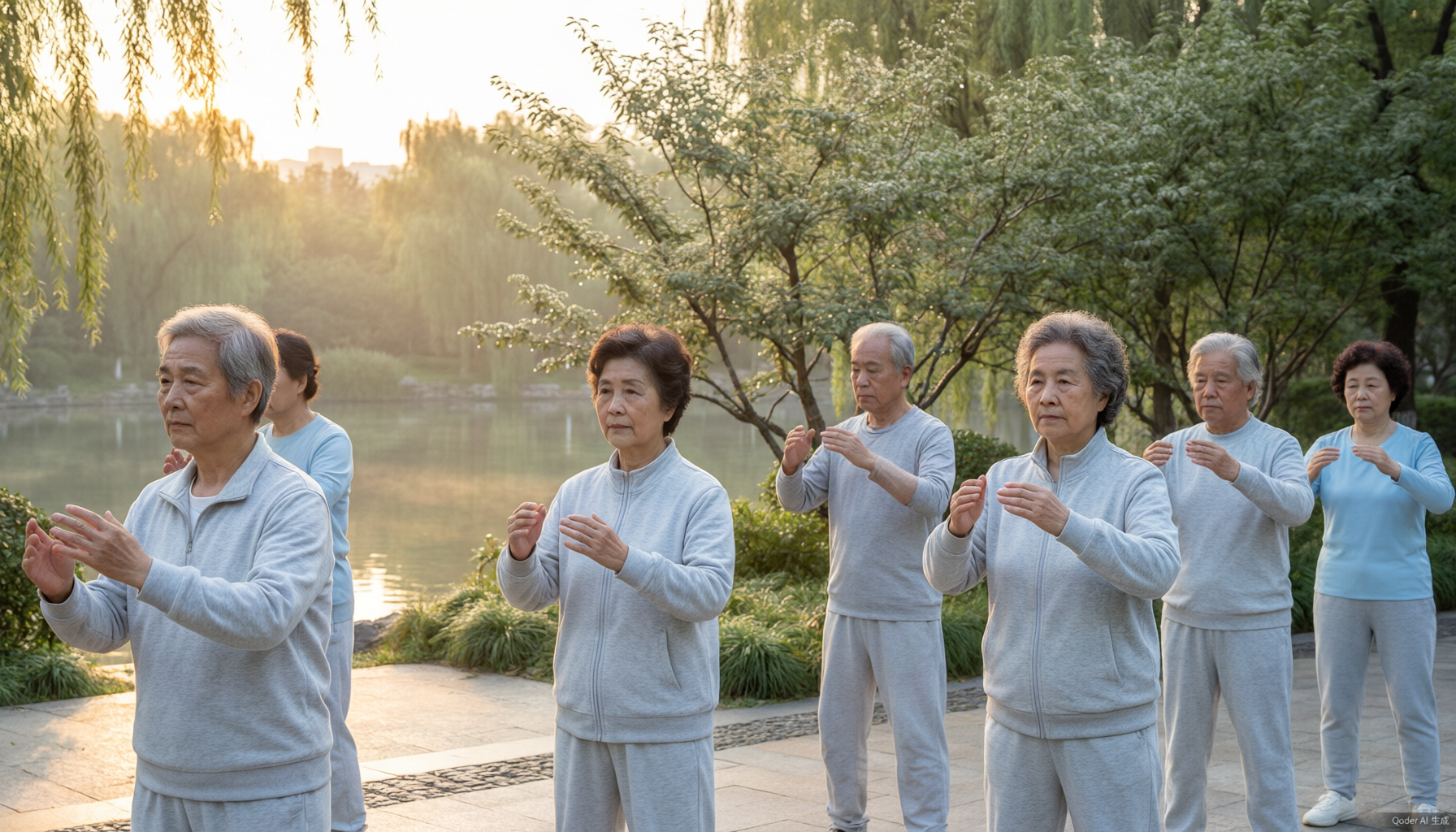
Walk through any Chinese city park at six in the morning and you will witness yangsheng in its full, democratic glory. Elderly men swing their arms in qigong sequences while women fan themselves through tai chi forms. Groups practice the "Eight Brocades" (八段锦) in synchronized slow motion. Others walk backward around the lake — a practice believed to strengthen the kidneys and improve balance. Near the exercise bars, a grandfather hangs upside down to "invert the qi flow." On the benches, thermoses of goji berry and chrysanthemum tea steam in the cool air.
This is not performance or nostalgia; it is living medicine. The Chinese government has actively promoted qigong and tai chi as public health infrastructure, and hospitals maintain dedicated "yangsheng" departments where patients receive dietary counseling, acupuncture, herbal prescriptions, and movement instruction as integrated care. The tradition has survived dynastic collapse, revolution, and modernization because it works — not as a replacement for acute medicine, but as a daily practice of maintenance that keeps the body resilient, the mind supple, and the spirit at ease.
"The superior physician treats the mind; the middle physician treats the body; the inferior physician treats the disease."
— Sun Simiao, "Essential Prescriptions Worth a Thousand Gold," 652 CE
The Philosophy of Longevity: Not Forever, but Well
Yangsheng does not promise immortality, though the Daoist alchemists certainly tried. Its deeper aspiration is more modest and more profound: to live out one's natural span in full vitality, clarity, and grace. The centenarians of China's "longevity villages" — in Guangxi, Hainan, and Xinjiang — are celebrated not merely for their years but for their continued engagement: tending gardens, walking to market, laughing with grandchildren. Their secret, when researchers investigate, is rarely a single superfood or exercise. It is a whole way of life: simple food eaten in season, daily gentle movement, strong community bonds, low stress, and a philosophical acceptance of aging as a natural unfolding rather than a disease to be fought.
This is the ultimate teaching of yangsheng. Health is not a destination but a practice. It is not achieved through heroic intervention but cultivated through a thousand small, daily acts of attention: the warm breakfast congee on a winter morning, the slow breath before sleep, the walk taken not to burn calories but to feel the season change in the air. To nourish life is to participate in it fully — and to trust that the body, given the right conditions, knows how to flourish.
Explore Further
This overview introduces the broad philosophy of yangsheng. For deeper exploration, we invite you to read our dedicated articles on Traditional Chinese Medicine — the theoretical framework of meridians, organs, and pattern diagnosis — and Chinese Health Practices — the practical arts of dietary therapy, qigong, and seasonal living that bring yangsheng philosophy into everyday routine.