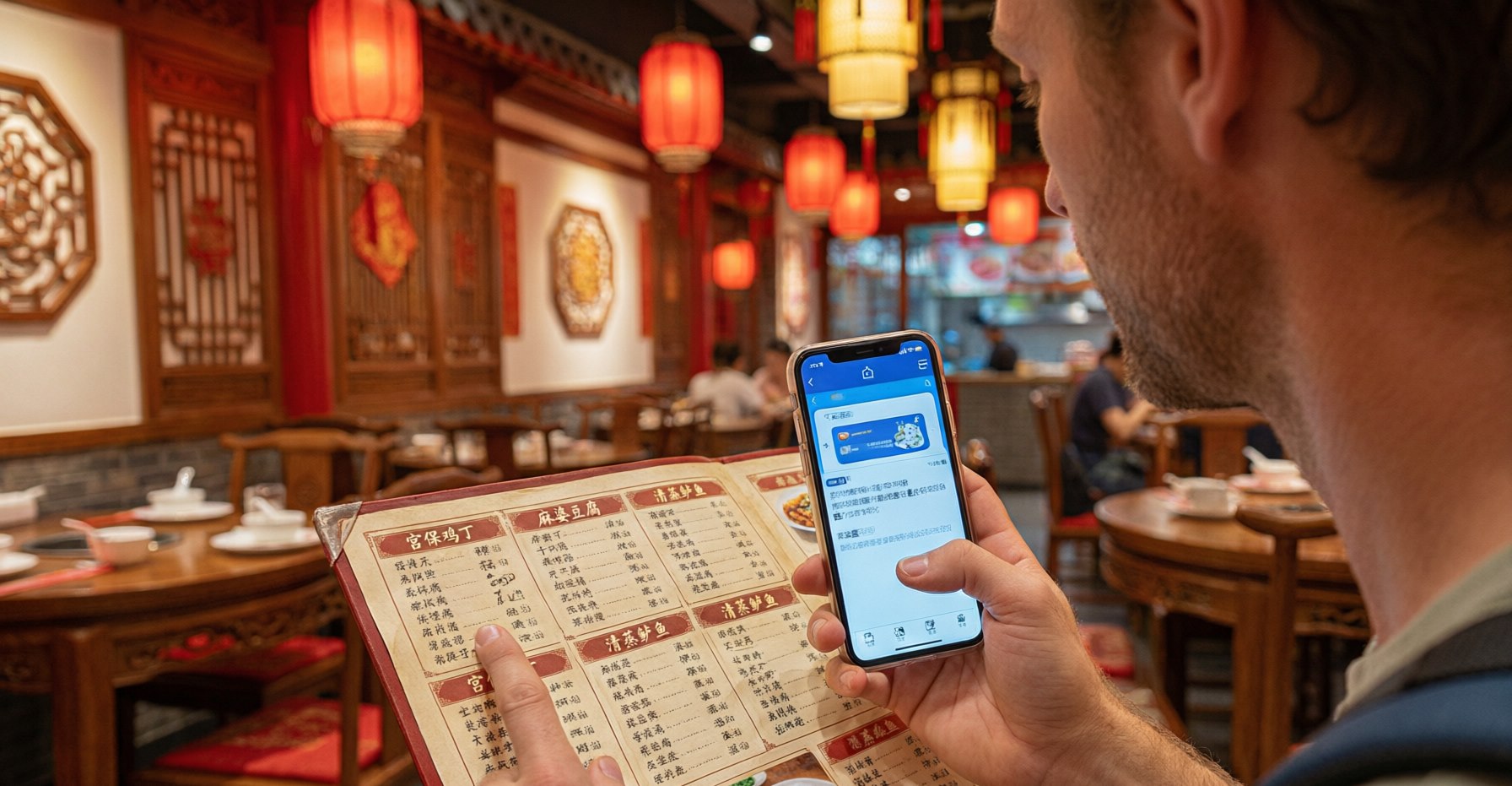
Let's start with the honest answer to the question every prospective traveler asks: can you get by in China without speaking Mandarin? Yes — with an important caveat. In the great tourist corridors of Beijing and Shanghai, you can survive a whole trip with zero Chinese. International hotel staff speak English, major attractions post bilingual signage, and the metro systems announce every stop in two languages. You will not be stranded, and you will not go hungry.
But "survive" is the operative word, and it earns its place. The moment you step outside that polished corridor — into a neighborhood restaurant, a taxi cab, a tier-2 city, or anywhere the tour buses don't reach — English effectively ceases to exist. Menus arrive with no translation, or with the gloriously garbled machine translations that have become a genre of comedy in their own right. The good news is that surviving, and even thriving, in this environment doesn't require fluency. It requires the right tools, a handful of phrases, and the willingness to point. This guide gives you all three.
The Essential Tools: Install These Before You Fly
Three apps will do the heavy lifting for you, and all three should be on your phone before you leave home.
Pleco is non-negotiable. This free Chinese dictionary app is the gold standard, beloved by every serious student of the language, and its killer feature for travelers is the camera OCR. Point your phone at any Chinese text — a menu, a sign, a label — and Pleco reads the characters and translates them on the spot. It works without an internet connection, which matters enormously in a country where your data may be unreliable. If you install only one language app, make it this one.
A translation app with offline capability. Google Translate works perfectly well offline — but only if you download the Chinese language pack before you depart. Once in China, its online features won't function without a VPN, but the offline mode is unaffected and genuinely useful. As a complement, Baidu Translate (百度翻译) works natively on Chinese networks with no workarounds, making it a reliable fallback when your connection is local but your Mandarin isn't. Between the two, you'll rarely be stuck.
Seven Phrases That Carry You Through
You do not need a phrasebook of five hundred entries. A small set of high-frequency phrases covers the overwhelming majority of daily interactions, and learning them — even imperfectly — earns you goodwill far beyond their literal meaning. These seven will carry you through roughly eighty percent of what you'll encounter.
Nǐ hǎo (你好) — hello. The universal opener; use it constantly. Xièxie (谢谢) — thank you. Equally universal, and appreciated every single time. Duōshǎo qián? (多少钱?) — how much? Your most-used phrase at any market, shop, or stall. Wǒ yào zhège (我要这个) — I want this one, ideally accompanied by a decisive point. This single sentence, plus a finger, will order you more meals than any amount of vocabulary.
Mǎidān (买单) — the check, please. Say it while miming writing on your palm and there is no ambiguity. Bù yào là (不要辣) — no spice. In a country where some regional cuisines treat chili as a food group, this phrase is, for the spice-averse, genuinely important. And Cèsuǒ zài nǎlǐ? (厕所在哪里?) — where is the bathroom? The question you will be most relieved to know how to ask. Master these seven and you can navigate an astonishing range of situations.
Practical advice: Don't worry about perfect tones. Mandarin is a tonal language, and yes, the same syllable can mean different things depending on its pitch — but in context, with a smile and a point, locals will almost always understand what you mean and appreciate the effort enormously. A clumsy "xièxie" delivered warmly beats perfect silence every time. Speak first, refine later.
The Point-at-the-Menu Strategy
In restaurants without English menus — which is to say, most restaurants outside the tourist zones — the most effective ordering technique requires no language at all. Look around at what other tables are eating, find a dish that appeals, point at it, catch your server's eye, and say "zhège" (这个) — this one. Done. This is how a great many travelers eat extraordinarily well across China without reading a single character.
The QR-code revolution. Increasingly, the problem solves itself. A huge number of restaurants now place a QR code on each table, scanned with WeChat, which opens a digital menu — often with photographs of every dish. You browse pictures, tap what you want, and the order goes straight to the kitchen. No shared language required at any point. This is one of the quiet conveniences of modern Chinese dining, and it turns the language barrier into a non-issue at the table.
When text is unavoidable, Pleco's camera steps in. Hold your phone over the menu and watch the characters resolve into English in real time. It's not literary translation — dish names can be poetic and idiomatic — but it reliably conveys the essentials: what the main ingredient is, how it's cooked, and whether it's likely to be spicy. Between photos, pointing, and the camera, you will rarely be genuinely stuck.
Beyond the Seven Phrases: Numbers and Directions
A little extra vocabulary stretches your reach considerably. Numbers matter most for prices: knowing the basics — yī (一, one), èr (二, two), sān (三, three), sì (四, four), wǔ (五, five), liù (六, six), qī (七, seven), bā (八, eight), jiǔ (九, nine), shí (十, ten) — lets you parse spoken prices and confirm amounts. Note that two is often said as liǎng (两) when counting objects rather than reciting digits.
For getting around, a few directional words unlock a lot: zuǒ (左, left), yòu (右, right), zhí zǒu (直走, go straight), and the ever-useful zhèlǐ (这里, here) and nàlǐ (那里, there). Combined with a map on your phone screen, these let you confirm a route with a local even when neither of you shares a language. Point at the destination, say "zhèlǐ?" with a questioning look, and you'll usually get a clear nod and a pointed finger in reply.
When Body Language Wins
There is a final tool no app can replace, and it's the one travelers underestimate most: gesture, expression, and good humor. A hand to the mouth signals hunger. Miming a drinking glass gets you water. A palms-together tilt of the head reads universally as "thank you." When words fail entirely — and occasionally they will — a patient smile and a willingness to act things out bridges the gap remarkably often.
Chinese people are, as a rule, generous with lost travelers. You will be helped, corrected, laughed with, and occasionally walked bodily to your destination by someone who decided you couldn't be trusted to find it alone. The language barrier is real, but it is not the wall it appears from home. With Pleco in your pocket, seven phrases on your lips, and a pointing finger at the ready, you'll find that getting by without Mandarin is not merely possible — it's one of the more charming parts of the journey.