This Friday, September 25, 2026, families across China and Chinese communities worldwide will mark the fifteenth day of the eighth lunar month. They will cut round mooncakes, light lanterns and look upward—not merely to inspect the moon, but to feel that everyone looking at it belongs, for a moment, to the same circle.
The Festival Moon Is a Calendar, Not a Stopwatch
Mid-Autumn Festival is fixed to the fifteenth day of the eighth month in the traditional Chinese calendar. In 2026, that date corresponds to September 25. It falls just two days after the autumnal equinox and opens a three-day public holiday in mainland China.
But the moon does not consult the printed holiday schedule. According to the Hong Kong Observatory, it will rise in Hong Kong at 5:20 p.m. on the festival, reach its highest point at 11:24 p.m. and still be approaching astronomical fullness. That exact full moon arrives at 12:49 a.m. on September 27. To the eye, however, the moon across these nights will appear generously round.
Eighth lunar month, day fifteen.
Three days in mainland China.
Hong Kong time, per the HKO.
This small gap matters because it clarifies what the festival has always been. Mid-Autumn is not a scientific appointment with one second of perfect illumination. It is a human arrangement around the moon: a harvest season, a family date and a ritual language in which roundness means wholeness.
Why Roundness Means Reunion
The Chinese word yuán (圆) means round. Its sound and shape live close to tuányuán (团圆), reunion—the restoration of a scattered family into a whole. A round moon, round table and round pastry therefore do more than repeat a pleasing form. Together they make an argument: what has been separated can be gathered again.
Historically, the festival grew from moon worship, harvest gratitude and autumn moon-viewing. The term zhōngqiū, “mid-autumn,” is ancient; moon appreciation flourished as a social and literary custom, and the fifteenth day of the eighth month became established as a festival by the Northern Song period. Over time, solemn offerings and elite moon-viewing became a broadly shared family celebration.
Today the reunion may happen around a crowded table, through a train journey home, in a video call across time zones or simply through the knowledge that absent relatives can see the same moon. The form changes; the desire to close distance remains.
The Moon’s Household: Chang’e, Hou Yi and the Jade Rabbit
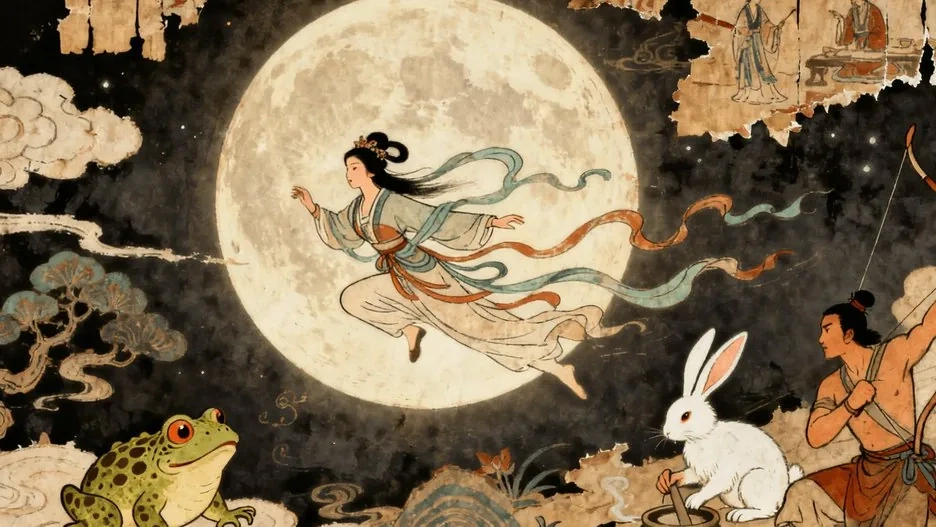
The best-known Mid-Autumn story begins with an impossible sky. Ten suns rise together, scorching the earth, until the archer Hou Yi shoots down nine and saves the world. As a reward, he receives an elixir of immortality. What happens next varies from telling to telling: Chang’e may drink it to protect it from a thief, take it by accident, or make a more ambiguous choice. In every version, she rises beyond her husband’s reach and comes to dwell on the moon.
Her solitude is not empty. The Jade Rabbit pounds medicine beneath a cassia tree. Wu Gang endlessly cuts a self-healing osmanthus tree, a lunar labor without completion. Older traditions also placed a three-legged toad on the moon. These figures turned the bright disc into a distant household—beautiful, populated and just beyond return.
The legend does not explain every custom, nor does it have one authoritative version. Its power lies elsewhere. Chang’e gives the moon a human ache. She transforms a celestial body into a place where love and separation can be imagined at cosmic scale.
Mid-Autumn Festival Explained
A friendly introduction to the festival’s origins, Chang’e, mooncakes, lanterns and the Chinese words associated with the celebration.
Watch the original video on YouTube · English audio by AL Language Cafe · 26 min 46 sec
It connects the stories and customs in this essay to spoken Chinese vocabulary and contemporary celebration, making it a useful visual companion rather than a repetition of the text.
Mooncakes: An Edible Geography of China
Mooncakes are the festival’s most recognizable gift, but there is no single definitive mooncake. Their round form carries the shared symbolism; their crusts and fillings map regional taste. A box passed between households can hold lotus paste and salted egg yolks, flaky pastry and savory pork, nuts and dried fruit, or Yunnan ham scented with honey.
Glossy & dense
A thin baked skin encloses smooth lotus seed or bean paste, often around salted duck egg yolks that resemble small moons.
Flaky & layered
A crisp laminated pastry can hold sweet fillings or warmly spiced minced pork, best eaten fresh.
Rustic & aromatic
Traditional northern styles favor a firmer crust and fillings of nuts, seeds, sugar and preserved fruit.
Sweet & savory
Yunnan ham mooncakes pair cured meat with sugar or honey for a distinctly regional balance.
The most meaningful action is not buying the most extravagant box. It is cutting one cake into wedges. A mooncake is rich enough to resist solitary consumption, and the act of dividing a circle lets everyone receive part of the whole. The symbolism survives even in miniature.
What People Do on Mid-Autumn Night
China’s regional and family traditions are too varied for one universal checklist. These are recurring forms through which the festival’s themes become visible.
Gather for dinner
Family reunion is the emotional center. Seasonal dishes matter, but the complete table matters more.
Share mooncakes
Families exchange gift boxes, then cut cakes into small wedges so several people can taste each style.
Admire the moon
Courtyards, balconies, lakesides and parks become places to talk, drink tea, recite poems and look upward.
Carry lanterns
Children carry illuminated lanterns; communities may stage displays, riddles and fire-dragon traditions.
Enjoy autumn flavors
Osmanthus, pomelo, pear, taro and crab can join the table according to region and season.
Play regional games
In Xiamen and southern Fujian, bo bing uses six dice and examination titles to distribute festive prizes.
A Moon Shared Across a Thousand Miles
No festival belongs so fully to Chinese poetry. The moon can mean clarity, homesickness, friendship, political exile or the unreachable past. Because distant people can see it at once, it became the perfect messenger when no letter could travel fast enough.
但愿人长久,千里共婵娟。
May those we love endure; though a thousand miles apart, may we share this beautiful moon.
— Su Shi, “Prelude to Water Melody,” written on a Mid-Autumn night in 1076
Su Shi wrote while separated from his brother. The poem does not solve separation. Instead, it gives separation a common object: the same moon reaches both places. That is the festival’s most durable idea. Reunion can be physical, remembered or imagined—and shared attention can itself become a form of togetherness.
How to Mark Mid-Autumn Festival in 2026
You do not need elaborate ceremony to enter the festival’s logic. Begin with a circle, a person you miss and enough time to look up.
Try a regional style new to you, and cut it into small wedges rather than treating it as an individual dessert.
Gather in person when possible; otherwise call someone far away before the evening becomes busy.
Check your local moonrise and weather. The festival moon will look round even before the exact full-moon instant.
The Moon Does Not Erase Distance. It Makes Distance Shareable.
Mid-Autumn Festival is often summarized as mooncakes and family reunion, and both descriptions are true. Yet its emotional architecture is larger. It asks how people remain connected when they cannot occupy the same room, city or moment in life.
The answer is not that every family becomes whole on command. Some chairs remain empty. Some journeys home are impossible. The festival offers a gentler promise: wholeness can be rehearsed. A cake can be divided without losing its circle. A poem can cross a thousand years. A moon can appear above different roofs and still be one moon.
On September 25, it will not be astronomically full yet. It will be close enough for the human eye—and perhaps that is the better symbol. Reunion is rarely perfect. What matters is turning toward one another anyway.
Mid-Autumn Festival 2026: quick answers
- When is Mid-Autumn Festival in 2026?
- Friday, September 25—the fifteenth day of the eighth traditional Chinese lunar month. Mainland China’s holiday runs September 25–27.
- Is the moon exactly full that night?
- Not at the precise astronomical instant. In Hong Kong, the full moon occurs at 12:49 a.m. on September 27, though it appears bright and round throughout the festival period.
- Why do people eat mooncakes?
- The round pastry echoes the moon and symbolizes reunion. Sharing wedges turns that idea into a family and social ritual.
- Who is Chang’e?
- She is the moon goddess in the festival’s best-known legend, separated from Hou Yi after taking an immortality elixir and rising to the moon.
- How is Mid-Autumn celebrated?
- Common practices include a reunion dinner, moon viewing, mooncakes, lanterns, gifts, seasonal foods, storytelling and regional games.
- Is every mooncake sweet?
- No. Fillings and crusts vary widely. Suzhou-style fresh-meat mooncakes and Yunnan ham mooncakes are well-known savory or sweet-savory examples.
Sources and further reading
- Hong Kong Observatory: Moon-watching tips for Mid-Autumn Festival 2026
- General Office of the State Council: China’s 2026 public holiday arrangements
- SCIO: History and meaning of Zhongqiu Festival
- Beijing Municipal Government: Mid-Autumn customs
- Smithsonian Folklife Festival: Mid-Autumn/Moon Festival
- AL Language Cafe: “Mid-Autumn Festival Explained”
Festival customs and mooncake styles vary by region, household and community. Astronomical times above are for Hong Kong; local moonrise and weather differ by location.