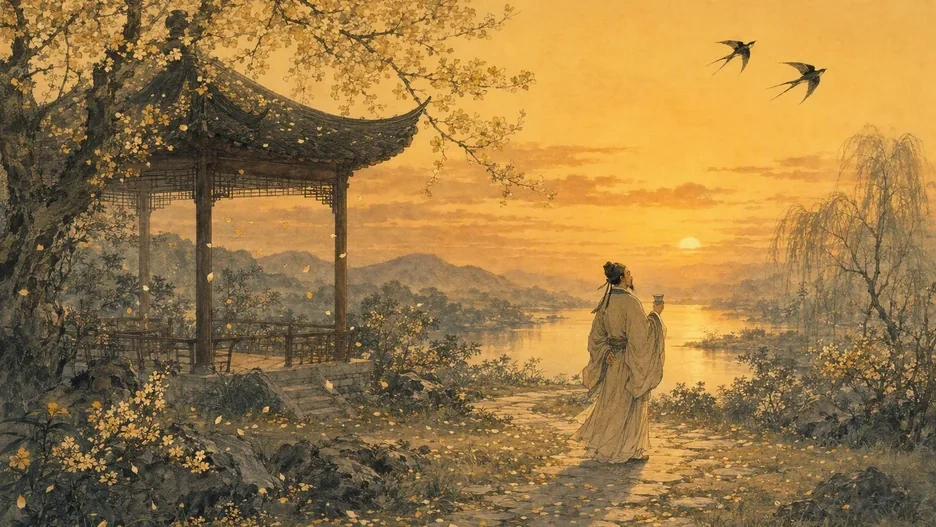
Yan Shu was the Song dynasty's model of the poet-statesman: a child prodigy who entered court at fourteen, a chancellor who governed calmly, a patron who employed half the literary talent of his generation, and a man who said he only wrote poems after a good dinner, with the table cleared and the guests settled. His ci are famous for exactly that atmosphere — wealth, quiet, and a melancholy so well-mannered it never raises its voice. Silk-Washing Stream (Huan Xi Sha, 浣溪沙) is his masterpiece: forty-two characters about time, and the most quoted couplet of the eleventh century.
The scene is almost nothing: a cup of wine, a new song, the same weather as last year, the same pavilion. The poem's subject is the almost.
English Rendering
One new song, one cup of wine; / last year's weather, the old pavilion. / The sun goes down in the west — when will it come back?
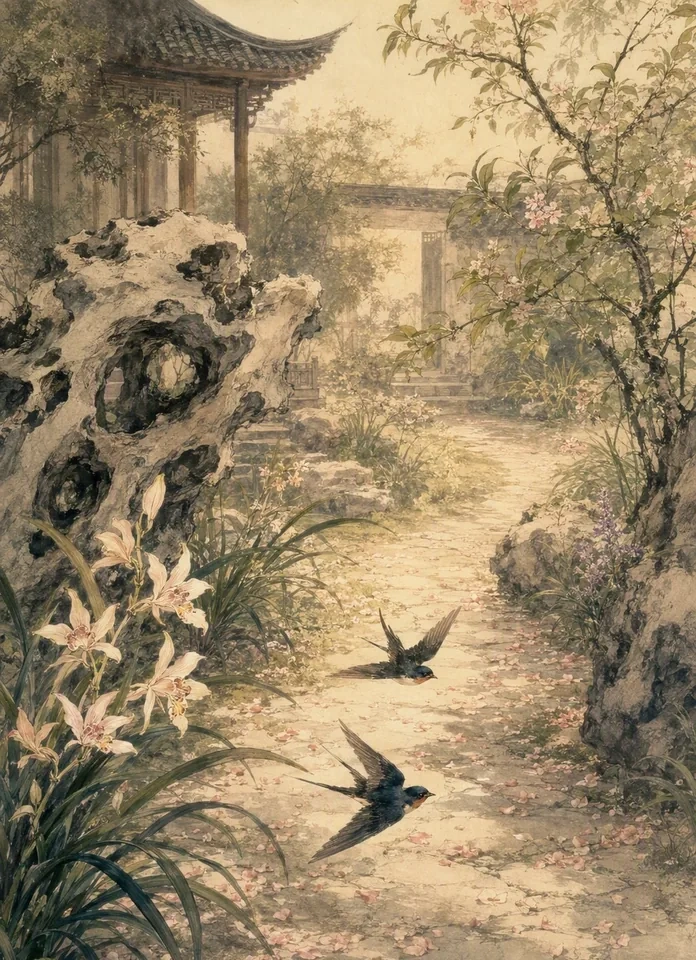
Nothing to be done: the flowers fall; / something half-remembered: the swallows return. / Through the small garden, on the fragrant path, I wander alone.
The World of the Poem: Yijing 意境
The conception is loss and return held in the same hand, without either being allowed to win. The famous couplet is a perfect scale: on one side, wu ke nai he — "nothing to be done" — the flowers fall, and no administration, however competent, can legislate against gravity and April. On the other, si ceng xiang shi — "seemingly familiar" — the swallows come back, but only seemingly: these are not last year's birds, only birds like them, and return is a pattern, not a repetition. The couplet's grammar enacts its philosophy: two lines of identical structure, one recording irreversibility, one recording recurrence, neither permitted to answer the other.
And the ending is the mood's final calibration. The garden is small, the path is fragrant with the fallen petals themselves, and the poet paihuai — paces, lingers, walks back and forth: the body's verb for a mind that has accepted and not accepted in the same hour. There is no protest and no consolation, only attention, elegantly kept. This is the Song lyric's aristocratic mode at its purest: grief with perfect posture, and the insight that time is both thief and pattern, in the same breath.
About the Poet
Yan Shu (991–1055) rose from a modest Jiangxi family to the chancellorship and became the era's great talent-spotter — his protégés included Fan Zhongyan and Ouyang Xiu. As a poet he worked in the late-Tang manner refined into Song restraint, and his ci collection, the Shan Zhai Ji, reads like a demonstration that power and delicacy can cohabit. He is the calm against which the stormier careers of Su Shi and Xin Qiji later defined themselves.
Why It Endures
"无可奈何花落去,似曾相识燕归来" is one of the language's permanent couplets, quoted whenever loss and recurrence arrive together — which readers report is often. The ci also fixed the template for the philosophical small poem: a domestic scene, one unanswerable question ("when will it come back?"), and a closing image of solitary attention instead of an answer.