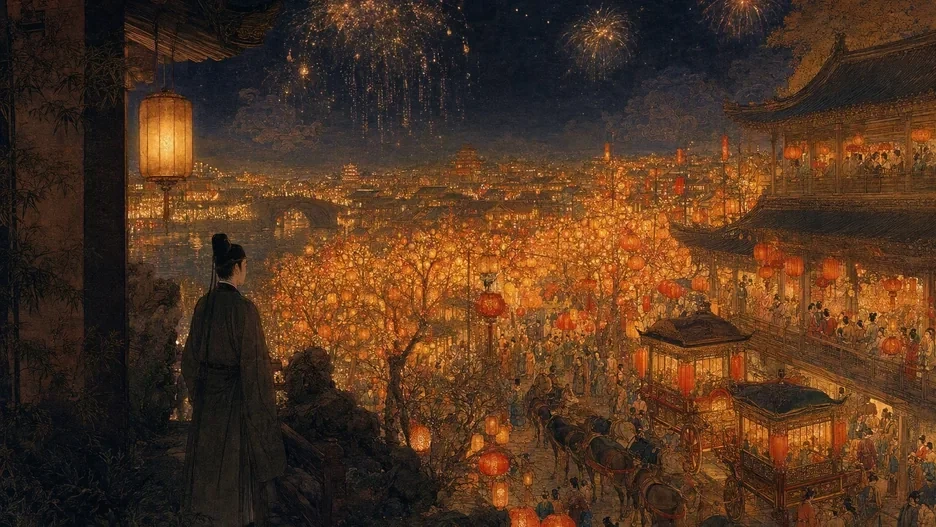
The Lantern Festival — the fifteenth night of the first month — was the one evening of the year when the Song capital genuinely let go: tens of thousands of lanterns, fireworks, dragon dances, perfume, and crowds in which, for one night, strangers could meet. Into this maximum of spectacle, Xin Qiji placed a minimum of plot: a search, a failure, a turn of the head, a discovery at the edge of the light. Green Jade Cup: The Lantern Festival (Qing Yu An · Yuan Xi, 青玉案·元夕) is the most famous ci about looking for someone, and the most argued-about ci about what the someone means.
Xin Qiji wrote it in his thirties, in the southern capital, a northern soldier without a war to fight — which is the key to everything he ever wrote.
English Rendering
East wind at night opens a thousand trees of flowers, / blows more down — a rain of stars. / Fine horses, carved carriages, fragrance flooding the road; / the phoenix flute stirs, the jade moon turns, / and all night the fish and dragon lanterns dance.
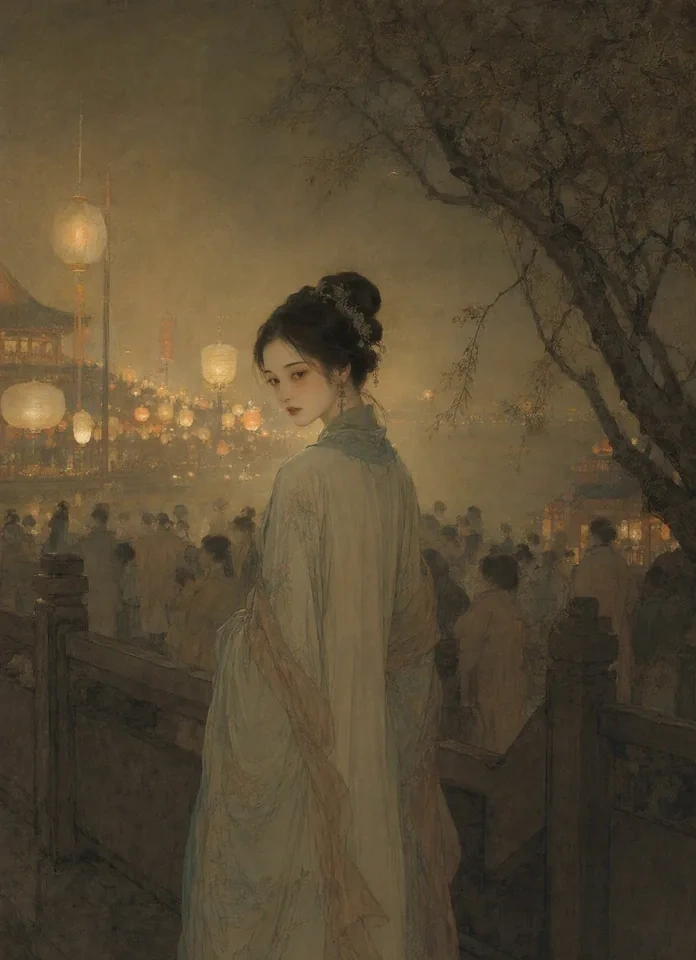
Moth pins, snow-willow sprays, threads of gold; / laughing voices, sweet and full, drift past with hidden perfume. / In the crowd I search for her a thousand times — / and suddenly, turning my head, / there she is: where the lantern light grows thin and fails.
The World of the Poem: Yijing 意境
The conception is a contrast engine. The entire first stanza, and the opening of the second, is accumulation: lanterns like blossoming trees, fireworks like star-rain, carriages, perfume, music, moonlight, dancing fish and dragon lamps, women in gold-threaded ornaments drifting past with laughter. The poem spends its whole budget on brightness and noise — and then locates its subject in the one place the budget did not reach: deng huo lan shan, where the lantern light thins out and dies. The person sought was never in the spectacle. The search had to fail everywhere bright before the head could turn.
Readers have taken "that person" three ways, and the poem holds all three without cracking. As a love ci, it is the perfect romance grammar: the beloved is defined not by description but by position — apart, unlit, unbothered by the crowd. As a political allegory, it is Xin Qiji's self-portrait: a man of the north, sidelined by a court that preferred festival to recovery, standing deliberately where the light of favor does not fall. And as philosophy, Wang Guowei made the closing lines the third and final stage of every great endeavor — the stage after long searching when understanding arrives unforced, in a glance, at the edge of attention. A poem that can be a love scene, a career, and a theory of insight simultaneously is doing what only the best ci do: keeping the referent open and the feeling exact.
About the Poet
Xin Qiji (1140–1207) was born in the occupied north, rode into Jin territory at twenty-three to execute a traitor and bring him south in chains, and spent the remaining four decades of his life being given ceremonial offices by a court that had no intention of using his sword. The frustration became the Bold school's (haofang, 豪放) greatest ci — military imagery, historical thunder, and, as here, sudden tenderness. He is the tradition's proof that a "martial" poet and a "lyric" poet can be the same man, on the same page.
Why It Endures
"众里寻他千百度" and "灯火阑珊处" are working idioms today — the first for any long search, the second for the quiet place where what matters actually waits. Wang Guowei's use of the lines as the final realm of scholarship made the ci required reading in every discussion of craft and insight. Few love poems have this kind of second life as epistemology.