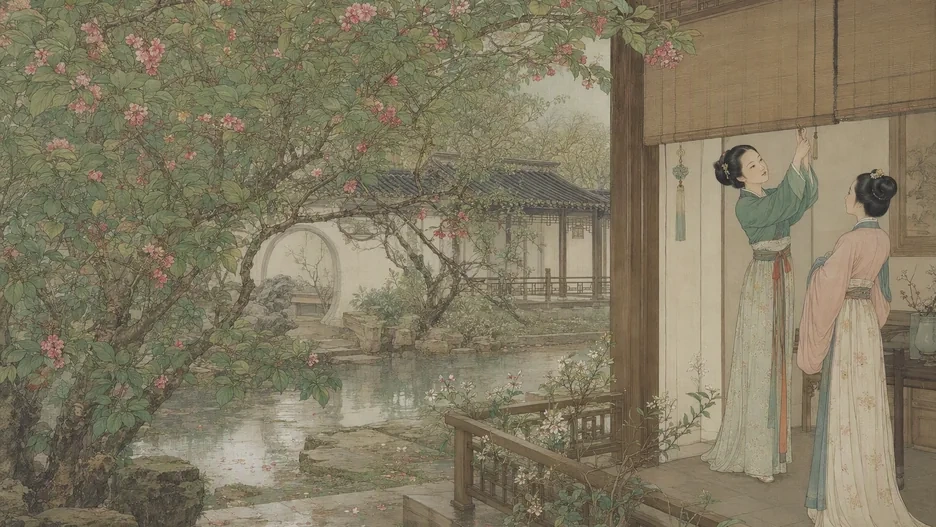
Thirty-three characters. A night of rain and wind, a deep sleep that failed to sleep off the wine, one question asked of the maid rolling up the blinds, one wrong answer, one correction. Li Qingzhao's Like a Dream (Ru Meng Ling, 如梦令) is the smallest perfect machine in Chinese poetry — a ci written by a young woman of the capital, probably before she was twenty, that made her famous in her own lifetime and immortal after it.
The scene is a morning-after conversation, and the subject is a flower the poet never gets out of bed to look at. Everything happens through a doorway and a report. That distance is the poem.
English Rendering
Last night the rain was sparse, the wind sudden; / deep sleep did not finish off the wine. / I try asking the maid rolling up the curtain — / she says the crabapples are just as they were. / Doesn't she know? Doesn't she know? / By now the green should be fat and the red thin.
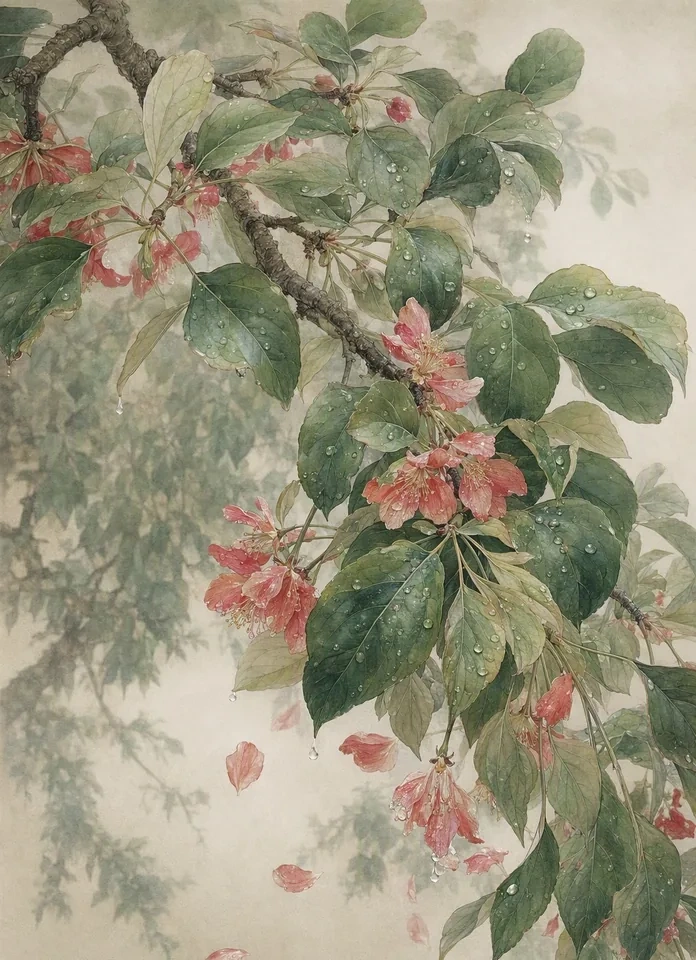
The translation that matters is the last line's: lü fei hong shou — green fat, red thin. Leaves swollen with rain and new growth; blossoms beaten down and fewer. Two body-words, fat and thin, doing the work of a botanical survey, a weather report, and an elegy at once.
The World of the Poem: Yijing 意境
The conception is perception as class and character. The maid looks at the crabapples and sees crabapples: "just as they were." The mistress, without leaving her bed, sees the arithmetic of loss: after that wind, after that rain, there cannot be as many flowers as there were yesterday. The poem is about two kinds of attention — the practical eye that reports, and the poetic eye that infers — and the correction "doesn't she know?" is delivered with the amused, wine-tinged impatience of someone whose inner weather is finer than the outer one.
Underneath the charm runs the standard Chinese current: flowers falling are time passing, and a young woman counting blossoms is, whether she says so or not, counting her own springs. The poem never says it. It ends on the flowers, fat green and thin red, and lets the reader feel the second meaning arrive one beat later — the technique of hanxu (含蓄), suggestiveness, the Graceful school's highest virtue. That a teenage girl owned this technique completely is part of what the tradition never got over.
About the Poet
Li Qingzhao (1084–c. 1155) is the greatest woman writer in the Chinese tradition and, by many accounts, one of its greatest writers without qualification. Her early years in the capital, married to the epigrapher Zhao Mingcheng, were a partnership of book-collecting and mutual delight; the ci of that period — this one among them — sparkle with wine, flowers, and controlled wit. After the Jin invasion drove the court south, her husband died, her collections were scattered in war, and her later ci became the deepest grief-lyrics in the language. She also wrote the finest critical prose on the ci form itself, judging every male predecessor with total confidence. History has not overturned her verdicts.
Why It Endures
"绿肥红瘦" left the poem and entered the dictionary: it is now a fixed idiom for late spring's look, and for any beauty on the turn. The ci remains the standard first meeting between readers and Li Qingzhao — and the standard proof that thirty-three characters, perfectly placed, can out-argue an epic.