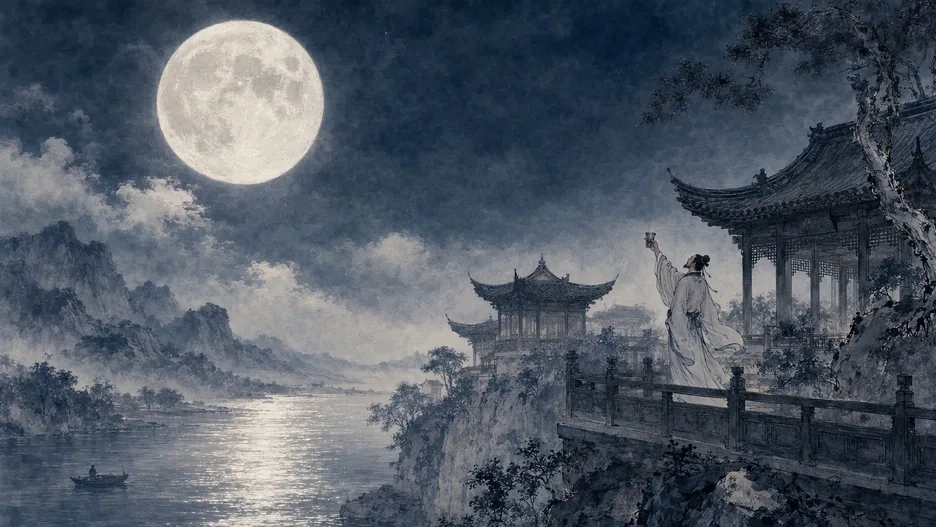
On the Mid-Autumn night of 1076, in the small northern posting of Mizhou, a man who had drunk until dawn wrote a song lyric about the moon and his younger brother. The man was Su Shi — Su Dongpo — the most complete genius of the Song dynasty. The brother was Su Zhe, whom he had not seen in seven years. The lyric, set to the old tune "Water Melody Head" (Shui Diao Ge Tou, 水调歌头), has been the official voice of the Mid-Autumn Festival ever since.
A Song critic put it bluntly centuries later: after this ci appeared, every other Mid-Autumn poem was waste paper. The judgment sounds like hyperbole until you read the field; then it sounds like reporting.
English Rendering
Bright moon — how long have you been there? / I raise my cup and ask the blue sky. / I do not know what year it is, tonight, / in the palaces and towers of heaven. / I want to ride the wind and go home there — / and yet I fear those jade towers and crystal palaces, / too high, too cold to bear. / I rise and dance with my pale shadow: / heaven, after all, is not this world.
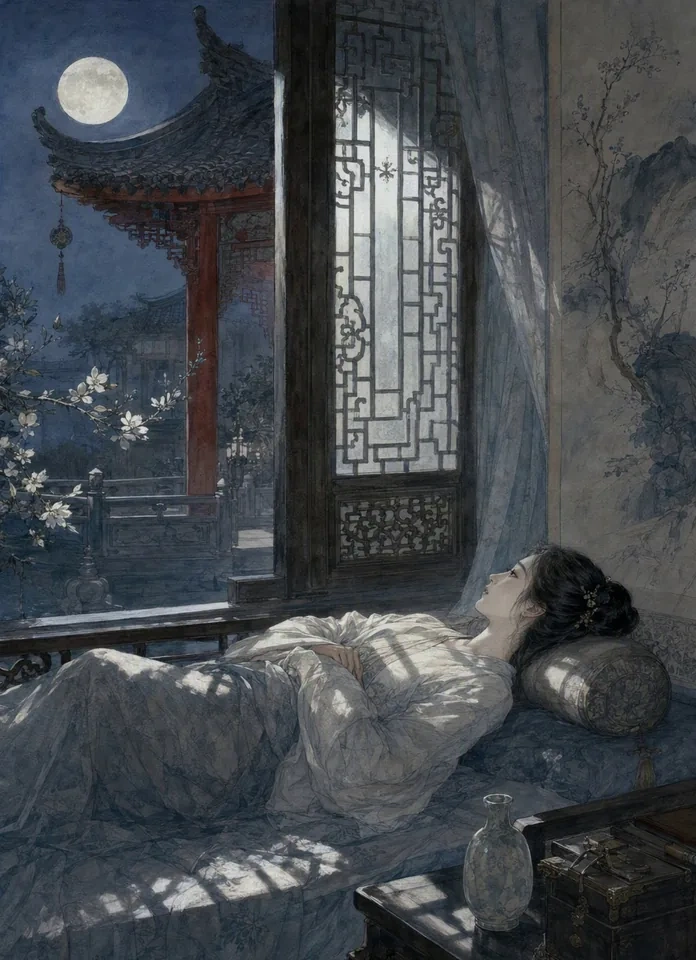
The moon rounds the vermilion pavilion, / sinks low through the carved windows, / and finds the sleepless one. / It cannot owe us any grudge — / so why is it always full when we are parted? / People have grief and joy, parting and meeting; / the moon has dark and bright, fullness and hollow. / This has never been otherwise, not since ancient times. / May we each live long — / and share this moon's beauty, a thousand li apart.
The World of the Poem: Yijing 意境
The ci is a negotiation with perfection, conducted in three movements. First, escape: drunk and moonstruck, the poet imagines himself a banished immortal and wants to ride the wind home to heaven — then catches himself on a domestic detail of doubt: it must be cold up there. The jade towers are beautiful and uninhabitable; heaven is a place with bad heating. The joke is the pivot. He chooses the world of shadows and dance, and the word "human world" (人间) lands like a toast.
Second, complaint: the moon, rolling past the carved window to find him sleepless, is accused — gently, absurdly — of spite: why are you always full exactly when we are apart? It is the oldest trick of the bereaved, to charge the universe with scheduling crimes, and the poem lets the charge stand for exactly one line. Third, resolution: the famous settlement. People have partings; moons have waning; nothing is whole in all directions at once, and never has been. From that acceptance — not a surrender, a treaty — rises the closing wish, the line that ends every Mid-Autumn message in the Chinese-speaking world: may we live long, and share the moon a thousand li apart. The conception's genius is that separation is not denied or defeated; it is out-scaled. Distance becomes a shared sky.
About the Poet
Su Shi (1037–1101) is the figure Chinese literati most wanted to be: poet, painter, calligrapher, essayist, engineer, gourmet, magistrate, and perpetual exile — a man whose political career was a ladder pointed downward and whose writing got greater with every rung removed. His optimism was not innocence but discipline: banishment to Huangzhou produced his finest ci and his invented pork dish; exile to Hainan, the farthest edge, produced letters of unbroken curiosity. He died within a year of his pardon, having out-written, out-cooked, and out-lived his persecutors.
Why It Endures
"但愿人长久,千里共婵娟" is the sentence the moon hears every year: on greeting cards, in text messages, on lantern riddles, in the mouths of news anchors at festival time. The ci also fixed the Mid-Autumn Festival's emotional grammar — reunion as the ideal, shared moonlight as its substitute — and remains the single most anthologized song lyric in the language.