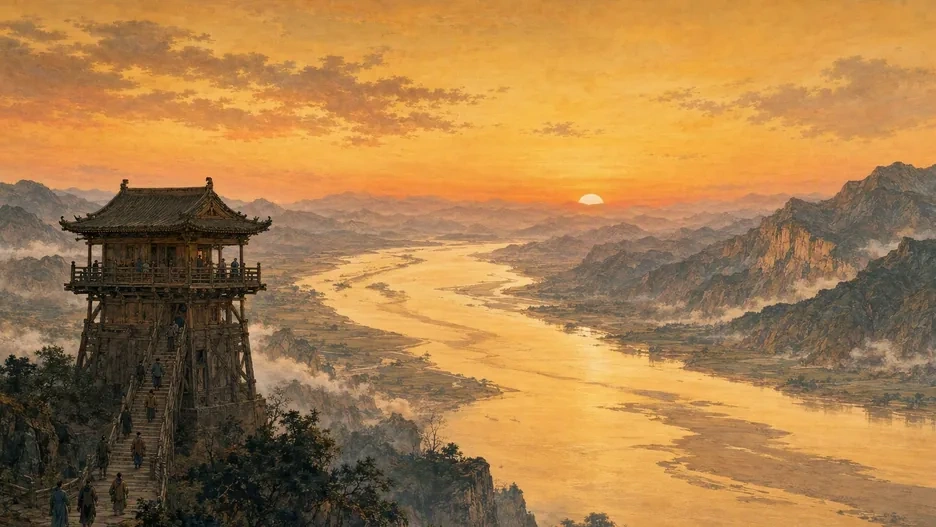
At Puzhou, on the great bend of the Yellow River, stood a tower where storks nested — the Stork Tower, one of the scenic high points of the Tang empire, and a magnet for poets with something to say about distance. Around 723 CE, Wang Zhihuan climbed it and produced twenty characters so efficient that they ended the argument: of the hundreds of poems written on the Stork Tower, his is the one China remembers.
Only six of Wang Zhihuan's poems survive. Two of them — this one and "Beyond the Border" — are among the most famous quatrains of the entire Tang. It is the ultimate proof that in Chinese poetry, as in archery, one perfect shot outlives a thousand near misses.
English Rendering
The white sun leans on the mountains and ends; / the Yellow River flows into the sea. / If you want to see as far as a thousand li — / climb one more story of the tower.
The first couplet is a panorama in two strokes, and the strokes are opposites: the sun going down behind the western ranges (vertical light, ending), the river running east to the sea (horizontal water, endless). Between them the poem has drawn the whole visible world — height and distance, ending and continuation. The second couplet turns from seeing to wanting: the eye is not satisfied with the horizon it has, and the body answers the desire with a staircase. The poem ends mid-ascent, on a step, not a summit.
The World of the Poem: Yijing 意境
The conception fuses landscape with ambition so tightly that the two have never been separable since. The setting sun is beautiful and finite; the river is beautiful and unstoppable; the observer, standing between them, refuses melancholy. Where a lesser poem would mourn the dying light, this one converts it into an instruction: the day is ending, so climb. The last two lines are the poem's engine — desire (欲, "if you want") followed by effort (更上, "climb one more") — and they turned a sightseeing quatrain into a philosophy of self-extension.
Chinese readers experience the poem as both picture and proverb simultaneously. "To穷 the thousand-li eye" is to exhaust the horizon, to see to the limit of seeing; and "one more story" is the permanent Chinese formula for ambition at every scale — study, career, recovery, understanding. Wang Guowei borrowed its logic for his theory of poetic realms; graduation cards, office walls, and New Year speeches borrow it still. The mood is not triumph but appetite: the world is wide, the light is going, and there is always one more floor.
About the Poet
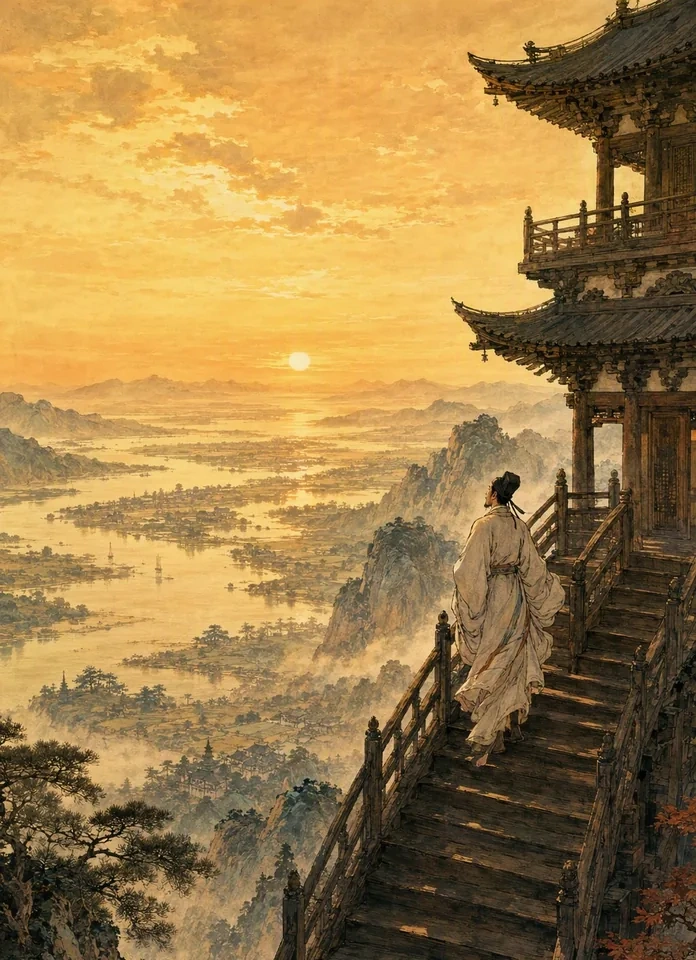
Wang Zhihuan (688–742) was a minor official with a major reputation among his fellow poets — a member of the circle that included Wang Changling and Gao Shi, famous for drinking, swordplay, and the legendary contest in which singers chose whose verses to perform. History kept almost nothing of his work; what it kept is enough. His two surviving masterpieces sit in every anthology, and his name rides with them.
Why It Endures
"欲穷千里目,更上一层楼" is among the most quoted lines in the language — used to encourage students, athletes, diplomats, and startups alike. The poem is also the classic exhibit of the Tang quatrain's economy: a universe in the first couplet, a life lesson in the second, and not one wasted character between.