Tang Poetry 唐诗

For three centuries the Tang dynasty ran the largest, most confident civilization on earth — and it wrote. Its poetry is the summit of the Chinese lyric: quatrains and regulated verses in which a moonlit floor, a ruined capital, a beam of light on moss, or a staircase above a river carry the full weight of a human life. Four of its most beloved poems live here, each with its original, its meaning, and its world.

Tang poetry (Tang shi, 唐诗) is the golden age of Chinese verse the way the Renaissance is the golden age of European painting — not merely a period but the standard by which all other periods are measured. The anthology that defines it, the Three Hundred Tang Poems, sits in Chinese homes the way a Bible or a Shakespeare sits in Western ones: the first book a child memorizes from, and the last one a grandmother quotes.

The form is short — twenty or forty characters to a quatrain — and the ambition is total: a scene, a feeling, and a philosophy, fused so tightly that none can be extracted without breaking the others. The four poems gathered here are gateway poems, the ones the tradition itself hands to beginners, chosen because each opens onto the whole: homesickness, war, emptiness, and ambition — the four rooms of the Tang house.

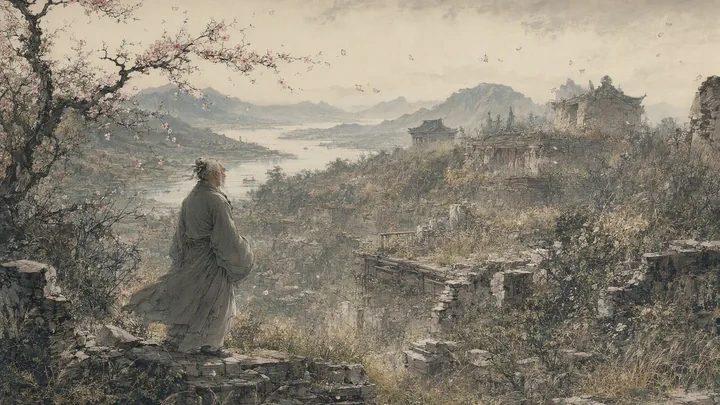
The ruined walls of Chang'an in springtime with wild grass over broken terraces and a sorrowful white-haired poet amid the ruins

春望 (Spring View) — Du Fu

In the summer of 755 CE the general An Lushan turned his frontier armies against the Tang throne, and within two years the greatest city on earth had fallen. Chang'an — a million people, the terminus of the Silk Road, th…

757 CE · 杜甫 Tang Poetry
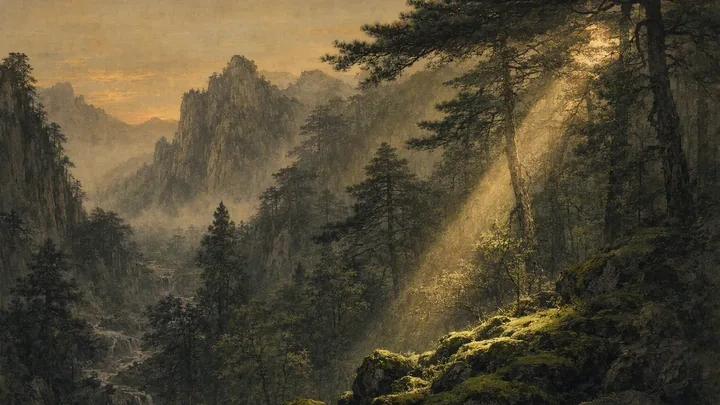
An empty mountain forest at dusk with a single beam of golden sunlight illuminating green moss on dark rocks

鹿柴 (Deer Park) — Wang Wei

Somewhere in the Zhongnan mountains south of Chang'an, on the estate Wang Wei called Wangchuan — "the River Valley" — there was a deer enclosure, a lu chai (鹿柴). Around 740 CE, in the half-retirement he built fo…

c. 740s CE · 王维 Tang Poetry
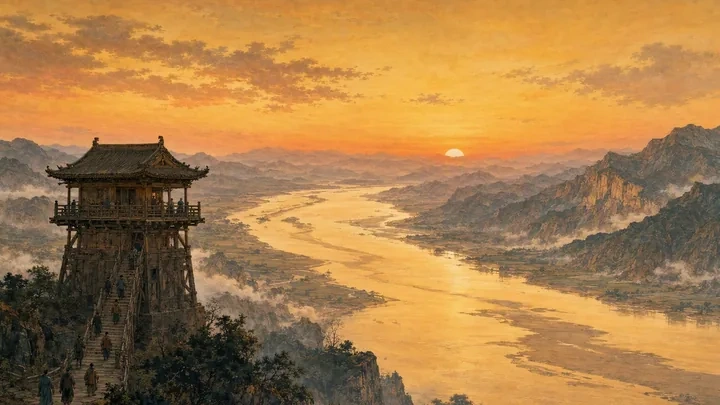
View from a tall tower over the Yellow River at dusk, the setting sun sinking behind mountains and the golden river flowing east

登鹳雀楼 (Climbing the Stork Tower) — Wang Zhihuan

At Puzhou, on the great bend of the Yellow River, stood a tower where storks nested — the Stork Tower, one of the scenic high points of the Tang empire, and a magnet for poets with something to say about distance. Around…

c. 723 CE · 王之涣 Tang Poetry
FAQ · Frequently Asked Questions
Why is Tang poetry considered the golden age of Chinese verse?
The Tang is to Chinese poetry what the Renaissance is to European painting: not merely a period but the standard by which all other periods are measured.
Which Tang poems are featured in this section?
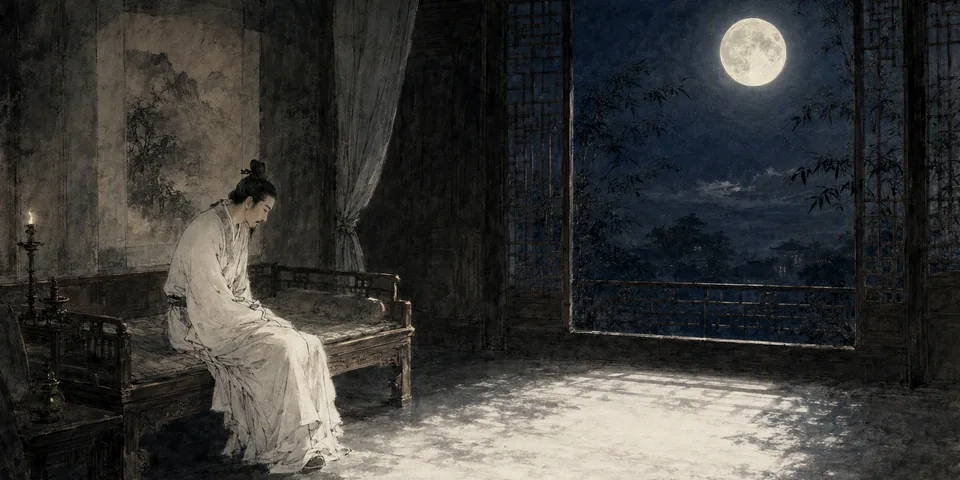
Li Bai's Quiet Night Thoughts on homesickness, Du Fu's Spring View on war, Wang Wei's Deer Park on emptiness, and Wang Zhihuan's Climbing the Stork Tower on ambition: four gateway poems, each opening onto the whole tradition.
What is the Three Hundred Tang Poems anthology?
The anthology that defines the golden age, sitting in Chinese homes the way a Bible or Shakespeare sits in Western ones: the first book a child memorizes from, and the last one a grandmother quotes.
What are Tang quatrains like?
They run just 20 or 40 characters, yet the ambition is total: a scene, a feeling, and a philosophy fused so tightly that none can be extracted without breaking the others.