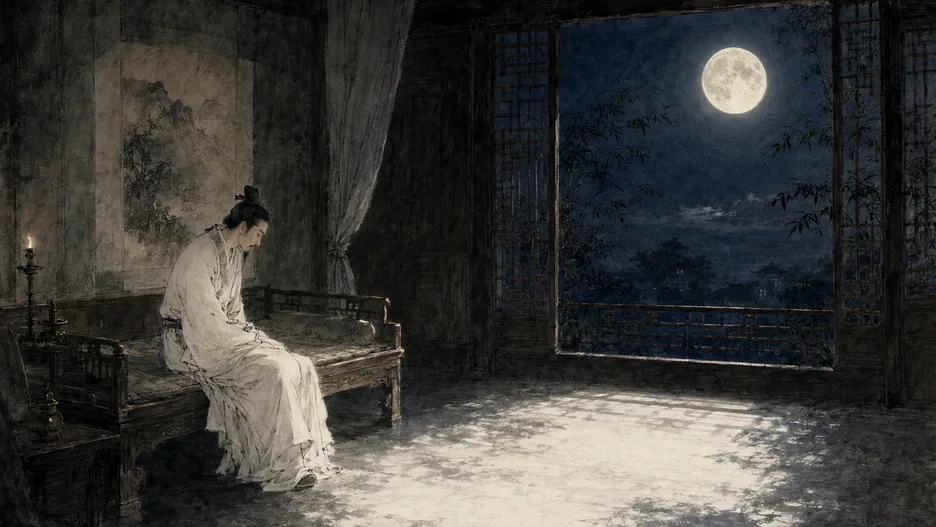
There is a poem that nearly every Chinese speaker learns before they can properly write their own name. It is twenty characters long, takes ten seconds to recite, and has been doing the work of a thousand unsent letters for thirteen centuries. A traveler, a bed, a moon, a thought of home — Li Bai's Quiet Night Thoughts (Jing Ye Si, 静夜思) is the most memorized poem in the Chinese language, and quite possibly the most memorized poem on earth.
It was written around 726 CE, when Li Bai was about twenty-five and far from the Sichuan home of his youth, lodging in the river town of Yangzhou. Nothing in the poem names the place, the season, or the occasion. That omission is the poem's entire genius: it is a homesickness so precisely emptied of detail that every reader who has ever been away from home can step into it.
English Rendering
Moonlight before my bed — / I wonder if it is frost on the ground. / I raise my head and watch the bright moon; / I lower my head and think of home.
The poem moves in two gestures. The first is a mistake of perception: waking in the dark, the poet sees a white sheet of light on the floor and half-believes it is frost — the season's cold made visible. The second is a correction that becomes a confession: it is only moonlight, and the moon is the one object in the sky that is visible, at this same moment, to the family he left behind. To look up is to look toward them; to look down is to carry them with him. The whole poem is a hinge between those two directions, and the word for home is the last thing it touches.
The World of the Poem: Yijing 意境
The artistic conception — the yijing (意境) — of the poem rests on a single optical illusion. Frost is cold, transient, and a little unreal: it appears overnight and is gone by noon. By letting the moonlight be mistaken for frost, Li Bai charges the room with a chill that is never stated. The reader feels the temperature of the poem before understanding its subject. This is the technique Chinese criticism calls qing jing jiao rong (情景交融), "feeling and scene fused": the emotion is not described, it is installed in the scenery.
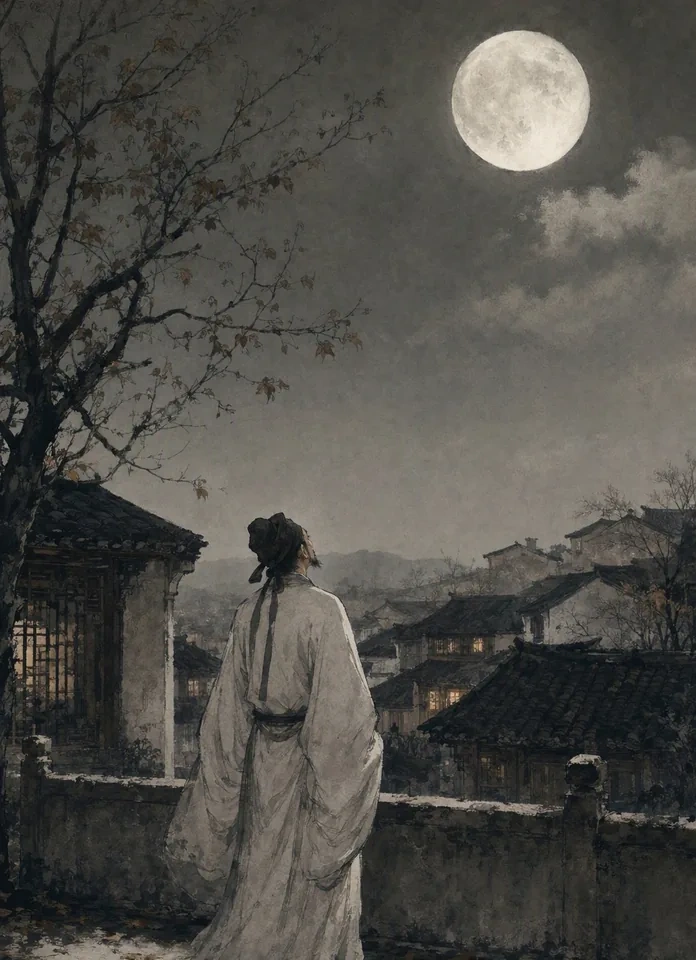
Then there is the choreography. Raising the head, lowering the head — two small movements, no bigger than a breath, and between them the entire distance from a rented room in Yangzhou to a home a thousand li away. Chinese readers instinctively note the moon's role as the poem's true medium: in a culture without reliable long-distance contact, the shared moon was the one "screen" on which separated people could watch the same image at the same time. Li Bai did not invent this association, but after this poem, no one could use the moon innocently again. Every later moonlit night in Chinese poetry is, in some quiet way, a reply to these twenty characters.
About the Poet
Li Bai (701–762), the "Poet Immortal" (shixian, 诗仙), is the romantic pole of Tang poetry — where Du Fu is conscience, Li Bai is flight. He wandered for decades with a sword at his side and a wine cup in his hand, served briefly and disastrously at the imperial court, and wrote with a speed and ease that produced the legend that his best poems arrived already drunk. Of the roughly a thousand poems that survive, many are about the moon, wine, and departure; almost all of them move as if gravity were optional.
Why It Endures
The poem's afterlife is everywhere: it is the first Tang poem taught in Chinese primary schools, the most translated, most quoted, and most parodied line-set in the tradition. Its phrases — "raising my head" (举头), "thinking of home" (思故乡) — are shorthand for homesickness itself. And its method, feeling delivered through a scene of perfect simplicity, remains the working definition of what a Chinese lyric is for.