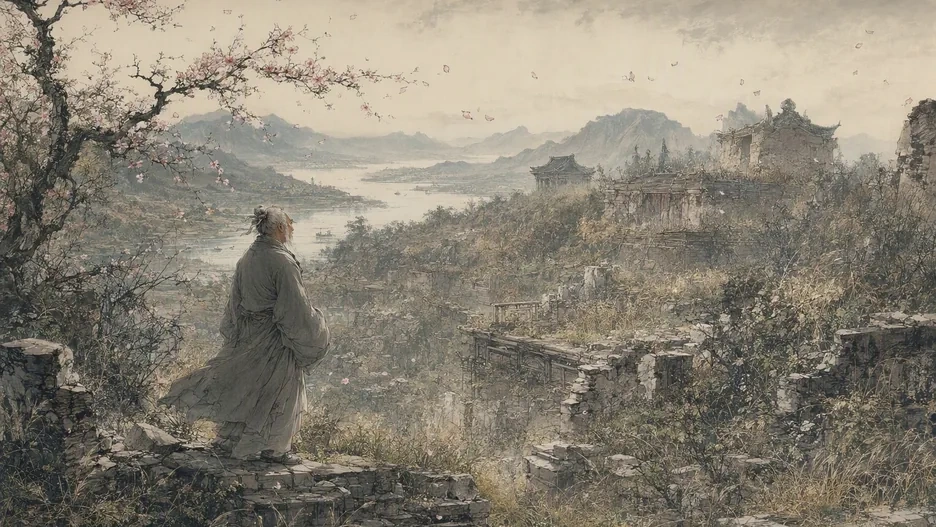
In the summer of 755 CE the general An Lushan turned his frontier armies against the Tang throne, and within two years the greatest city on earth had fallen. Chang'an — a million people, the terminus of the Silk Road, the model capital of East Asia — was occupied, looted, and burned. Du Fu, trying to reach the fugitive court, was captured and brought back to the conquered city, where he spent the spring of 757 as a prisoner watching the season bloom over the wreckage. Spring View (Chun Wang, 春望) is what he saw.
Eight lines, forty characters, perfectly regulated — and arguably the finest example of the regulated verse form (lüshi, 律诗) ever written under the pressure of lived catastrophe. This is not a poem about war from a safe distance. It is a report from inside a fallen capital, by a man whose family is on the other side of the lines.
English Rendering
The state is broken; mountains and rivers remain. / The city turns to spring; grass and trees grow deep. / Moved by the times, the flowers splash tears; / hating parting, the birds startle the heart. / Beacon fires have burned for three months straight; / a letter from home would be worth ten thousand in gold. / My white head, scratched, grows thinner still — / soon there will not be hair enough to hold a hairpin.
Every couplet balances a beauty against a wound. The mountains and rivers survive — the only citizens the rebellion could not kill — while the state that owned them is gone. Spring arrives on schedule and, with no one to sweep the streets, vegetation reclaims the capital: "grass and trees deep" is the sound of a city going quiet. Even the flowers and birds, traditional carriers of delight, are conscripted into grief — either weeping themselves or startling a heart that can no longer bear surprises.
The World of the Poem: Yijing 意境
The poem's conception is built on the cruelest of nature's habits: indifference. Spring does not mourn; it blooms. The deeper the grass, the prettier the ruin — and the prettier the ruin, the worse the grief. Chinese criticism names this device yi le jing xie ai qing (以乐景写哀情), "writing sorrow through joyful scenery," and this poem is its classic exhibit. The second couplet is famously ambiguous — are the tears the poet's or the flowers', the startled heart the bird's or the man's? The grammar refuses to decide, and the refusal is the point: in a ruined city, inner and outer weather become one system.
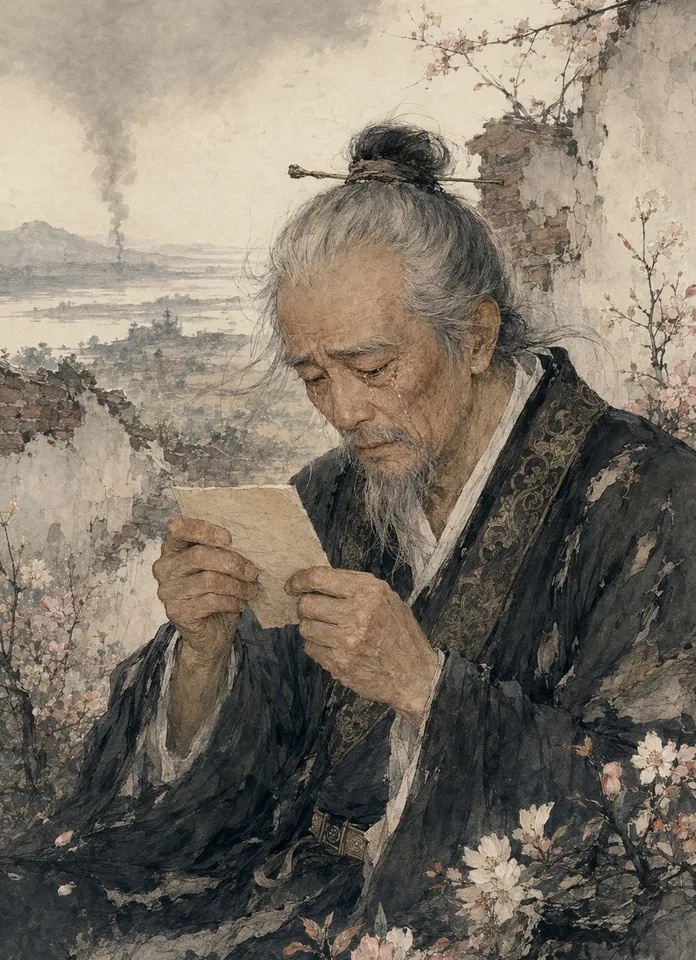
Then the poem narrows, couplet by couplet, from the panoramic to the intimate: from mountains and rivers, to a city, to flowers and birds, to beacon fires on the horizon, to a letter that never comes, and finally to a single white head, scratched in anxiety until the hairpin — the marker of an adult man's dignity and office — no longer has anything to hold. The ending is almost unbearably small, and that is its power. The fall of a dynasty, rendered as a man checking his thinning hair. History enters this poem the way it enters lives: not as an event, but as a body.
About the Poet
Du Fu (712–770), the "Poet Sage" (shisheng, 诗圣), is the moral center of the Chinese tradition — the poet who made lyric verse a register of history, conscience, and compassion. Where Li Bai flies, Du Fu stays: stays with the conscripted, the starving, the displaced, and records. His technical mastery of regulated verse is considered unsurpassed, and his influence on every poet after him, in China, Japan, and Korea, is comparable to Shakespeare's on English — except that he is also, by long consensus, a better man.
Why It Endures
"A letter from home is worth ten thousand in gold" (家书抵万金) left the poem centuries ago and lives as a free-standing idiom, quoted in every war, every lockdown, every separation. The poem itself anchors the Chinese understanding that poetry's highest office is witness: beauty recorded precisely, grief recorded precisely, and the two refused any easy reconciliation.