Somewhere in the Zhongnan mountains south of Chang'an, on the estate Wang Wei called Wangchuan — "the River Valley" — there was a deer enclosure, a lu chai (鹿柴). Around 740 CE, in the half-retirement he built for himself after a career of court service and political disaster, Wang Wei wrote a sequence of twenty quatrains about the places on that property. This one, the second in the set, is twenty words long and contains, by common reckoning, an entire religion.
Wang Wei was a devoted Buddhist of the Chan (Zen) tradition, and Deer Park is the poem Chinese teachers reach for when they want to show what emptiness (空, kong) looks like from the inside — not as a doctrine, but as an afternoon.
English Rendering
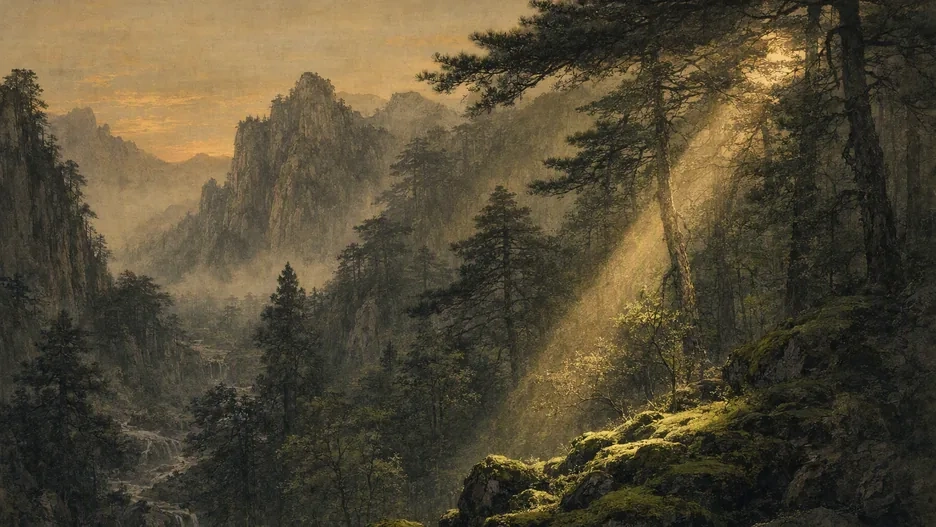
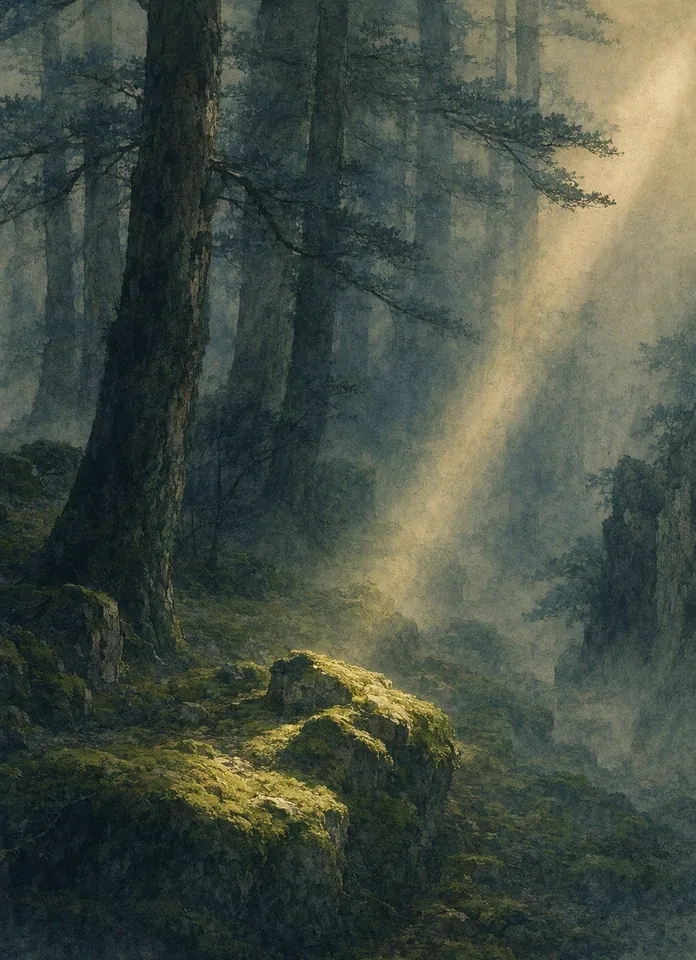
Empty mountain — no one to be seen; / only the echo of human voices. / The returning light enters the deep forest / and falls once more upon the green moss.
The poem performs a double negative. First it empties the mountain of people; then it lets a sound in — voices, but voices without bodies, heard but never seen, so that the emptiness is confirmed rather than broken. Then it does the same with light: this is "returning" sunlight, the last slanted beam of evening, brief and already leaving, falling on moss — the smallest, lowest, most overlooked surface in the forest. What the poem notices is almost nothing. The almost is everything.
The World of the Poem: Yijing 意境
The conception is presence through absence. The mountain is empty, yet it is full of sound; the forest is dark, yet one beam of light is in it; no person is visible, yet human voices and human attention saturate the scene. Chan Buddhism taught that emptiness is not a void but the open condition in which things appear as they are — and Wang Wei stages exactly that: a world perceived without the interference of a self insisting on being the center. The poet never says "I." He is the ear, the eye, the moss receiving light.
There is also a painter's logic at work — Su Shi famously said of Wang Wei that "in his poems there is a painting, and in his paintings there is a poem." The last two lines are composed like a scroll: a vast dark field, one diagonal of gold, a small green accent at the bottom. The light is "returning" (返景), which means it is leaving; the poem's single illumination is also its sunset. Beauty here is inseparable from transience, and the mood — serene, attentive, ungrasping — is the emotional signature of Zen: to watch the light go without asking it to stay.
About the Poet
Wang Wei (699–759) held high office, buried his ambition with his wife's early death, and spent his later years between the Chang'an court and the Wangchuan estate, painting, writing, and practicing Chan Buddhism. He founded the Southern School of landscape painting as surely as he founded the nature-lyric line in poetry. After the An Lushan rebellion forced him into a collaboration that shamed him, his poems turned even further inward; the empty mountain became his true address.
Why It Endures
Deer Park is the standard gateway into Chinese poetry for readers of other languages — its minimalism reads as modern everywhere, and it has been translated, imitated, and set to music more than almost any Tang quatrain. In the Chinese classroom it is the first demonstration that a poem can be great by leaving out: no self, no argument, no conclusion — only a mountain, an echo, and light on moss.