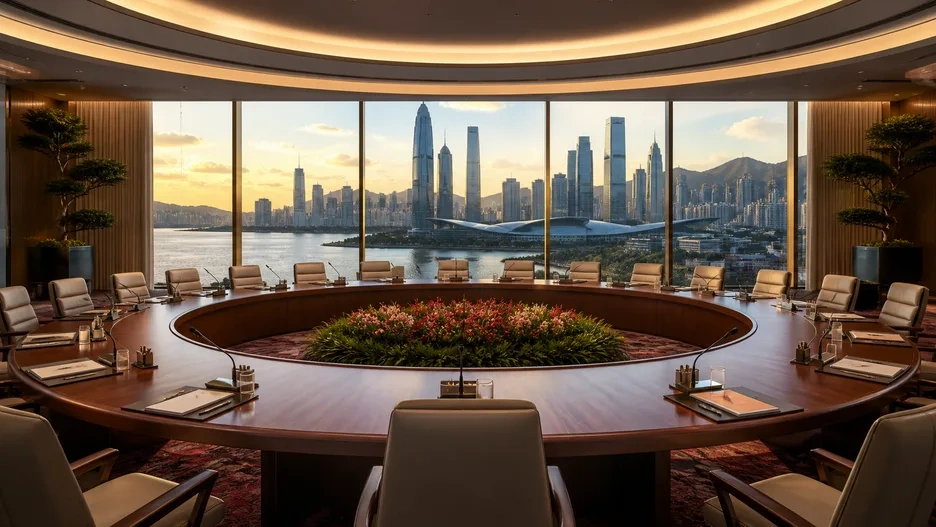
The APEC year reaches its highest political level in Shenzhen on November 18 and 19, when the economic leaders of APEC's 21 member economies are scheduled to meet. The gathering concludes a process that began with informal senior officials in Shenzhen in December 2025 and moved through hundreds of meetings and activities across China during 2026.
Official announcements place the leaders' meeting within a wider Economic Leaders' Week. Supporting events include the APEC CEO Summit and the joint ministerial meeting of foreign and trade ministers. The concluding senior-officials process also feeds the final recommendations and documents upward. Shenzhen is therefore hosting an interconnected week, not an isolated two-day photo opportunity.
What the Leaders' Meeting Does
APEC economic leaders meet annually to give strategic direction to regional economic cooperation. They consider work prepared by senior officials and ministers, exchange views on the economic environment, and set priorities that guide the forum after the host year ends. A leaders' declaration normally communicates the shared direction and the areas where consensus has been achieved.
The word “informal,” often used in the Chinese title, describes APEC's consultative format; it does not mean casual or unimportant. APEC's decisions are non-binding and consensus-based, so the political value lies in finding common ground among highly diverse economies and turning it into voluntary action, practical cooperation and longer-term work plans.
The 2026 Frame: Openness, Innovation, Cooperation
The year's theme — “Building an Asia-Pacific Community to Prosper Together” — gives the November discussion its broad destination. China's three priorities shape the route:
- Openness: regional economic integration, trade and investment facilitation, connectivity and support for an open economic environment.
- Innovation: digital transformation, artificial intelligence, new growth drivers and the ability of businesses and people to participate in technological change.
- Cooperation: policy coordination, capacity building and shared responses to challenges such as food security, sustainable growth and economic resilience.
These priorities have already been worked through in meetings on trade, digital and AI policy, tourism, forestry, women and the economy, food security and other areas. The leaders' meeting is where that dense technical year is distilled into a concise regional message.
What to Watch in November
Before outcomes are negotiated and published, the responsible way to describe them is as work in progress. China's Foreign Ministry has said the host year is preparing a Shenzhen leaders' declaration and has highlighted trade, connectivity, innovation and development as four pillars for looking toward the Asia-Pacific community goal. Final wording will depend on consensus among all 21 economies.
Watch four layers of output:
- Leaders' direction: the final declaration and any endorsed initiatives or road maps.
- Ministerial results: the joint foreign and trade ministers' statement and connections to earlier sectoral work.
- Business input: themes and recommendations emerging from the CEO Summit and the APEC Business Advisory Council.
- Implementation signals: which projects, principles or capacity-building efforts are assigned follow-up beyond 2026.
Why Shenzhen?
Few cities embody the host-year priorities as directly as Shenzhen. The city grew through openness: it became China's first special economic zone in 1980 and developed beside Hong Kong into a major center for manufacturing, trade, finance and global business. Innovation is visible in its technology industries, dense entrepreneurial networks and rapid urban experimentation. Cooperation is built into its position at the heart of the Guangdong-Hong Kong-Macao Greater Bay Area.
Shenzhen also offers a contemporary image of the Asia-Pacific city: globally connected but regionally rooted, intensely urban yet threaded with parks, bays, mangroves and mountain trails. Hosting the leaders' meeting lets the city present economic modernization and ecological urbanism in the same frame.
A Week, Not Just Two Days
The leaders meet on November 18 and 19, while official APEC materials refer to Economic Leaders' Week during the week of November 16. The surrounding schedule matters because ministerial, senior-officials and business meetings supply context and recommendations. Media activity, bilateral meetings and city programs may also cluster around the core dates, although public access should never be assumed.
Travel in Shenzhen Around Leaders' Week
November is one of Shenzhen's most comfortable travel periods: typically milder and drier than summer, with long park walks and coastal views. Central landmarks include Lianhuashan Park and the Civic Center axis; Shenzhen Bay pairs an urban skyline with waterfront ecology; Nanshan offers museums, design and theme parks; and the Dapeng Peninsula opens a very different Shenzhen of Ming-era coastal defense, villages, beaches and mountains.
The city is large, so plan by district rather than treating every attraction as adjacent. During Leaders' Week, leave extra time for cross-city trips and use official metro and traffic updates. Conference venues are not tourist sights.