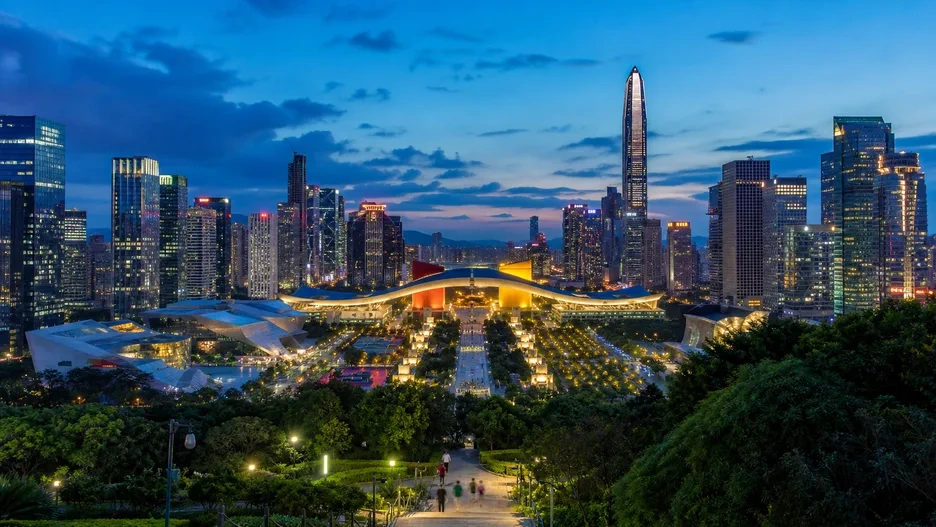
Shenzhen is often reduced to a before-and-after story: fishing settlements, then factories, then a skyline. The real city is more interesting. It is a network of urban centers spread between mountains and the South China Sea, with electronics markets, design museums, mangroves, old military walls, theme parks, beaches and more than a thousand public parks sharing the same map.
On November 18 and 19, 2026, Shenzhen will host the 33rd APEC Economic Leaders' Meeting. The choice focuses attention on the city's trade and technology story, but visitors should also look beyond the conference image. Shenzhen's best experiences come from moving between its different scales: civic axis, neighborhood street, bay and peninsula.
1. Lianhuashan Park and the Civic Center Axis
Lianhuashan Park is the best introduction to central Shenzhen. A gentle climb reaches the summit lawn and a broad view south across the Civic Center toward Futian's towers. From here, the city's planning becomes legible: mountains behind you, government and cultural buildings in the center, commercial districts rising around them and the bay beyond.
Walk down toward the Civic Center, whose sweeping roof has become a city emblem. The Shenzhen Museum's history and folk culture collections nearby help explain the transformation from older Bao'an County communities to the special economic zone. Come in late afternoon and remain for blue hour, when the axis and towers illuminate.
2. Shenzhen Bay and the Mangrove Coast
Shenzhen Bay Park forms a long recreational edge beside the water, popular with walkers, runners and cyclists. The skyline remains visible, yet the mood is ecological: tidal flats, mangroves and migratory birds link Shenzhen's shore to Hong Kong's Mai Po wetlands across the bay.
Choose one section rather than attempting the entire waterfront. The Talent Park and Shenzhen Bay Sports Center area gives an urban panorama; the mangrove sections are quieter and better for birding. Sunrise and the hour before sunset offer softer weather and light.
3. Nanshan: From Nantou to Shekou
Nanshan holds several versions of Shenzhen within a short distance. Nantou Ancient City preserves the footprint of an older walled settlement while mixing historic lanes with small galleries, shops and cafés. It is more a living urban regeneration district than a sealed monument, and that mixture is part of its appeal.
Farther south, Shekou grew as an early experiment in reform-era industrial development. Sea World — centered on the retired ship Minghua — is now a dining and leisure zone, while nearby cultural venues and harbor walks show how the district has reinvented itself. The opening-up story feels less abstract here because it is written into the streets.
4. Huaqiangbei: The Hardware City
Huaqiangbei is one of the world's most concentrated electronics trading districts. Multi-story markets sell components, phones, cameras, lighting, tools and products at every stage between prototype and retail. You do not need to be an engineer to appreciate the density of information and commerce.
Visit during daytime business hours, compare before buying, and treat warranties and compatibility with care. The point is not only shopping; it is seeing how Shenzhen's manufacturing networks translate an idea into a physical object with extraordinary speed.
5. OCT, Design and Theme Parks
The Overseas Chinese Town area combines established theme parks with art and design districts. Window of the World gathers scaled replicas of global landmarks, while Splendid China and the China Folk Culture Villages interpret Chinese geography and cultural traditions through performances and constructed landscapes. They are large, full-day attractions rather than quick photo stops.
For a slower experience, the OCT-LOFT creative area occupies repurposed industrial buildings with galleries, cafés, design shops and event spaces. Check exhibition calendars before making a special trip, since programming determines how active individual venues feel.
6. Dapeng Fortress and the Eastern Peninsula
Dapeng Fortress proves that Shenzhen's history did not begin in 1980. Built in 1394 for Ming coastal defense, the walled settlement preserves gates, lanes, residences and the spatial memory of a garrison town. It is the historical root of Shenzhen's nickname, Pengcheng — the City of the Roc.
The wider Dapeng Peninsula adds beaches, fishing settlements, geological landscapes and mountain-sea scenery. Jiaochangwei offers guesthouses near the fortress; Xichong is known for a long beach and access to the coast; Nan'ao and Yangmeikeng open more views and seafood stops. Travel time from central Shenzhen can be substantial, especially on weekends, so treat Dapeng as a dedicated day trip or overnight stay.
A Practical Two-Day Route
Day 1 · The City Shenzhen Built
Start at Lianhuashan Park, descend to the Civic Center and visit the Shenzhen Museum. Continue to Huaqiangbei in the afternoon, then finish at Shenzhen Bay or the Futian skyline after dark.
Day 2 · Choose a Shenzhen
For urban history and design, pair Nantou Ancient City with Shekou and OCT-LOFT. For family attractions, give most of the day to Window of the World or Splendid China. For older history and the open coast, leave early for Dapeng Fortress and a nearby beach — do not try to combine Dapeng with central sightseeing on a tight schedule.
Food, Weather and Getting Around
Shenzhen's food is not one regional cuisine but an arrival map. Cantonese dim sum and roast meats sit beside Chaoshan beef hotpot, Hakka dishes, seafood, coconut chicken and food from every Chinese province. Neighborhoods such as Shuiwei and the dense commercial districts make it easy to eat across regions in a single day.
October through December is especially comfortable for travel. November generally brings milder temperatures and lower humidity than summer, ideal for parks and waterfront walks. Typhoon risk is lower than in the hot season but weather and coastal conditions should still be checked before a Dapeng trip.
Shenzhen's metro is extensive and is usually the fastest way across central districts. Distances are deceptive: Futian, Nanshan, Bao'an, Yantian and Dapeng are not a compact center. Plan by district, use ride-hailing for final connections, and save Chinese place names in your map app. Dapeng's outer coast relies more heavily on buses and cars.