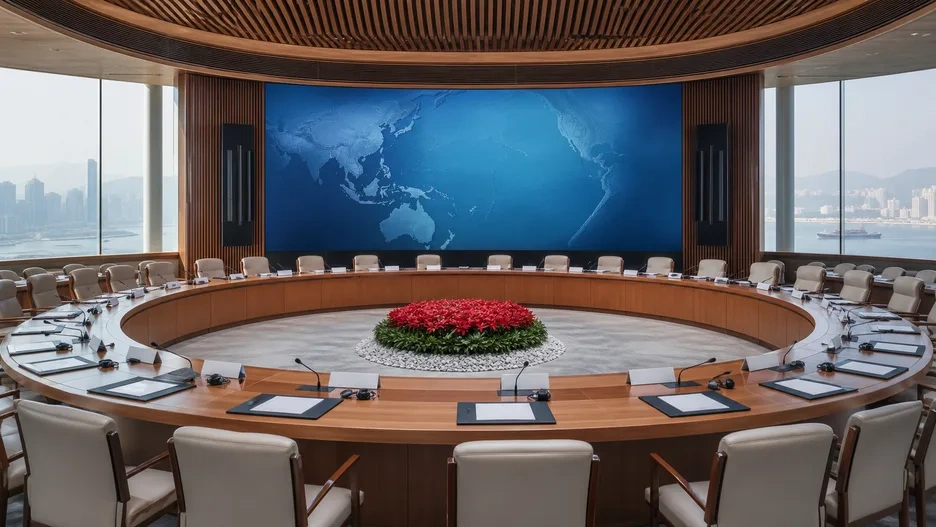
China is the host economy for APEC in 2026, turning the calendar year into a sequence of working-level, ministerial and leaders' meetings across the country. The host year is not a single summit. It is a policy process: officials build proposals over many months, ministers steer sector-specific work, business representatives contribute advice, and economic leaders set the broad direction at the end of the cycle.
What Is APEC?
APEC stands for Asia-Pacific Economic Cooperation. Created in 1989 as an informal dialogue among 12 participants, it has grown into a forum of 21 member economies around the Pacific. APEC uses the term “economies,” rather than “countries,” because its work is centered on trade and economic issues and participants engage as economic entities.
The membership is Australia; Brunei Darussalam; Canada; Chile; the People's Republic of China; Hong Kong, China; Indonesia; Japan; the Republic of Korea; Malaysia; Mexico; New Zealand; Papua New Guinea; Peru; the Philippines; Russia; Singapore; Chinese Taipei; Thailand; the United States; and Viet Nam.
APEC's work has three long-standing pillars: trade and investment liberalization, business facilitation, and economic and technical cooperation. In practice, that means subjects as varied as customs modernization, digital trade, food security, transport, energy, health, tourism, standards, small businesses and workforce development.
The “APEC Way”: Consensus Without a Treaty
APEC is not a treaty organization and does not impose legally binding obligations. Decisions are made by consensus, each economy has an equal voice, and commitments are undertaken voluntarily. This flexible model lets members with very different economic systems and levels of development work together through policy dialogue, peer learning, capacity building and practical projects.
The annual process has several levels. Economic leaders provide the overall direction. Ministers meet both jointly and by portfolio. Senior officials coordinate the year-round agenda and prepare decisions for ministers and leaders. Beneath them, committees, working groups and expert groups turn broad priorities into detailed programs.
Why 2026 Is the “China Year”
Every year, one member economy hosts the meetings and chairs the process. China previously hosted the leaders' meeting in Shanghai in 2001 and Beijing in 2014. The 2026 cycle is therefore China's third APEC host year. Organizers expect roughly 300 meetings and activities in multiple cities, giving the host year a much wider footprint than the November gathering alone.
The 2026 theme is “Building an Asia-Pacific Community to Prosper Together.” Its three priorities are Openness, Innovation and Cooperation. Together they frame discussions on regional economic integration, connectivity, digital technologies and artificial intelligence, inclusive growth, resilient supply chains and sustainable development.
Major 2026 Meeting Calendar
The table below highlights the principal host-year milestones published by the official APEC China 2026 and APEC Secretariat channels. It is a guide to the major clusters and ministerial events, not a list of all individual working-group sessions.
| Date | City | Meeting or milestone |
|---|---|---|
| Dec 11-12, 2025 | Shenzhen | Informal Senior Officials' Meeting; launch of the 2026 host-year process |
| Feb 1-10 | Guangzhou | First Senior Officials' Meeting and Related Meetings (SOM1 cluster) |
| February | Shanghai | Finance and Central Bank Deputies' Meeting |
| May 11-19 | Shanghai | Second Senior Officials' Meeting and Related Meetings (SOM2 cluster), including the Women and the Economy Forum |
| May 22-23 | Suzhou | Ministers Responsible for Trade Meeting |
| June | Chengdu | Senior Finance Officials' Meeting |
| July 10 | Macao SAR | Tourism Ministerial Meeting |
| July 16-29 | Chengdu | Digital Week, Digital and AI Ministerial Meeting and related high-level events |
| July 27-28 | Shenzhen | Ministerial Meeting on Forestry |
| Aug 17-28 | Dalian | Third Senior Officials' Meeting and Related Meetings (SOM3) |
| Aug 24-25 | Hangzhou | Food Security Ministerial Meeting |
| Aug 31-Sep 4 | Guangzhou | Small and Medium Enterprises Ministerial Meeting cluster |
| September | Beijing | Energy Ministerial Meeting and Transportation Ministerial Meeting |
| September | Nanjing | Human Resources Development Ministerial Meeting |
| October | Hong Kong SAR | Finance Ministers' Meeting |
| Week of Nov 16 | Shenzhen | APEC Economic Leaders' Week |
| Nov 18-19 | Shenzhen | 33rd APEC Economic Leaders' Meeting |
What the Year Has Focused On
The three priorities are broad by design, but the first half of the year shows how they translate into policy. “Openness” has covered trade and investment facilitation, regional integration and customs cooperation. “Innovation” has included digital transformation, responsible AI adoption, data infrastructure and productivity. “Cooperation” connects capacity building with food security, environmental resilience, inclusive growth and the participation of small and medium-sized enterprises.
Senior officials carry much of the connective tissue. They review work across committees, narrow areas of disagreement, identify deliverables and prepare material for ministers and leaders. This is why the August SOM3 cluster in Dalian matters: it is the last numbered senior-officials meeting before the concluding meetings in Shenzhen.
Two Cities to Watch
What Visitors Should Know
APEC meetings are professional, diplomatic and accreditation-based; they should not be treated as public festivals. Travelers can still enjoy the host cities, but should expect hotels and transport near major venues to be busier and should monitor official city notices for temporary access or traffic arrangements. Do not rely on speculative venue lists circulating online.
For readers following the policy story, the official APEC and APEC China 2026 websites are the authoritative sources for schedules, statements and outcomes. This special adds plain-language context and links the meetings to independently useful travel guides; it does not replace organizer accreditation or public-security notices.