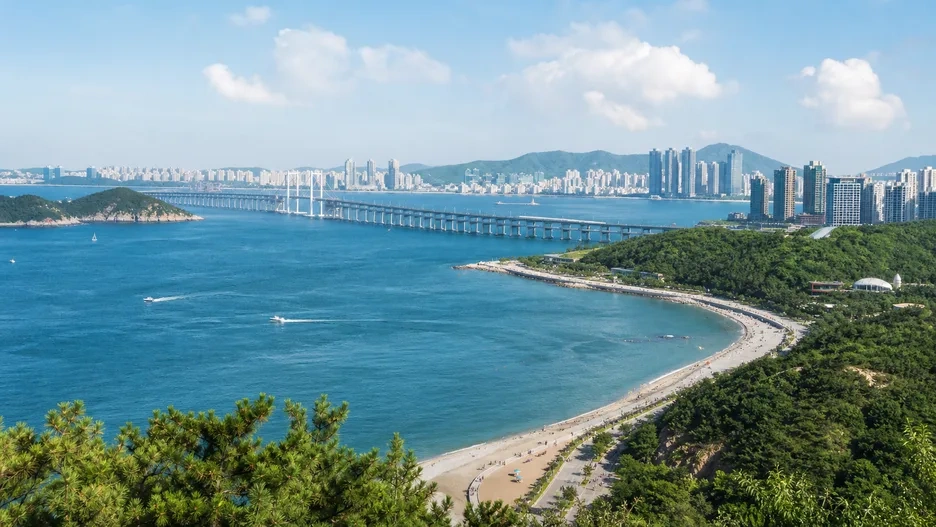
Dalian does not feel like the first city most visitors imagine when they hear “Northeast China.” The streets open suddenly onto blue bays. Pine-covered hills meet beaches and cliff roads. Historic stone buildings face civic squares, while modern towers and port cranes draw the eye back toward the sea. At the southern end of the Liaodong Peninsula, the city is defined by water on three sides.
That maritime setting is also why Dalian matters beyond tourism. It is a major port and Northeast Asian gateway — and from August 17 to 28, 2026, it hosts APEC's Third Senior Officials' Meeting and Related Meetings. For travelers, the timing offers a reason to see the city on its own terms: not merely as a conference backdrop, but as one of northern China's most rewarding urban coastlines.
1. Xinghai Square and Xinghai Bay
Xinghai Square is Dalian's signature public space: an enormous oval opening toward the sea, built in the 1990s and now surrounded by promenades, modern architecture and views across Xinghai Bay. Its scale is best understood by walking rather than photographing. Start near the inland side, cross toward the water, then continue along the shore as the bay and bridge unfold.
Late afternoon is ideal. The hard light softens, residents gather, gulls circle over the waterfront and the bridge begins to catch the evening color. The square itself is free and open, but temporary event arrangements can change access to individual areas.
2. Binhai Road: Dalian's Coastal Spine
Binhai Road is not one attraction but a long scenic thread connecting beaches, forested slopes and viewpoints along Dalian's southern edge. Walking selected sections is more satisfying than trying to cover it all. Popular anchors include Fujiazhuang's shoreline, the overlooks around Yanwoling and the approaches to Tiger Beach.
The road rises and falls, often with the sea on one side and green hills on the other. Comfortable shoes matter, and summer shade is uneven. Use a taxi or ride-hailing car to join two or three chosen segments rather than committing to the entire route.
3. Tiger Beach and the Southern Shore
Laohutan, or Tiger Beach, is best known for its large ocean park, but the wider area also gives access to a rugged piece of southern coastline. Families may want the aquarium and marine attractions; independent travelers can focus on the coastal scenery and connect the visit with Binhai Road.
Tickets, individual venue hours and performance schedules change, so check the attraction's official channel on the day you go. The area is large enough to absorb half a day if the ocean park is included.
4. Donggang and the East Harbor
Donggang presents Dalian's contemporary waterfront: broad promenades, cultural buildings, fountains, marinas and a skyline that feels oriented toward the harbor rather than the old commercial center. It is especially atmospheric after sunset, when the edge of the city becomes a long evening walk.
The canal development often marketed as “Oriental Venice” is nearby. Treat it as a landscaped leisure district rather than a historical quarter. The appeal is the combination of water, cafés, night lighting and easy pedestrian space.
5. Zhongshan Square and the Historic Tram
Dalian's modern history appears most clearly around Zhongshan Square, where a ring of early-20th-century buildings records successive Russian, Japanese and Chinese chapters. The architecture should be read critically, not merely admired: it reflects a period when control of the peninsula was fought over by empires and local lives were shaped by occupation and war.
Dalian is also one of the few Chinese cities where historic-style trams remain part of ordinary urban transport. A short ride through the central districts offers a slower counterpoint to the metro and a tangible link to the city's layered streetscape.
6. Golden Pebble Beach (Jinshitan)
About 50 kilometers northeast of central Dalian, Jinshitan is a national tourist resort and 5A scenic area with roughly 30 kilometers of coastline. The name can be misleading: its strongest draw is not a single beach but a combination of sandy shore, wave-cut rock formations, coastal geology and resort attractions.
Give it most of a day. The coastal geological park and main beach areas are spread out, and individual components may have separate tickets or seasonal hours. Public rail reaches the resort area, with local transfers needed for some sights.
7. Lushun: A Peninsula of Difficult History
Lushun, historically known outside China as Port Arthur, sits southwest of central Dalian. Its strategic harbor became a focal point in the First Sino-Japanese War, the Russo-Japanese War and the era of colonial control. Fort sites, museums, former military facilities and streetscapes preserve that history, often in places with emotionally difficult subject matter.
A day trip is worthwhile for travelers who want to understand why Dalian looks and feels different from other northern Chinese cities. Choose a small number of sites and read their historical context; the district is too dispersed for a rushed checklist.
A Practical Two-Day Route
Day 1 · The Urban Coast
Begin at Xinghai Square, follow a selected stretch of the southern waterfront, and continue by car along Binhai Road toward Fujiazhuang or Tiger Beach. Return to central Dalian for seafood, then walk Donggang after dark.
Day 2 · City Layers
Explore Zhongshan Square and the surrounding historic streets in the morning, take a tram segment, and spend the afternoon in a museum, at another coastal viewpoint or in the East Harbor cultural district. Add a third day for Jinshitan or Lushun rather than squeezing either into this schedule.
Food, Weather and Getting Around
Dalian cooking is built around the Bohai and Yellow seas: scallops, sea urchin, abalone, fish, clams and squid appear steamed, grilled or folded into northern-style dishes. Choose busy, clearly priced restaurants and confirm seafood prices by weight before ordering.
Late April to mid-October is the main sightseeing season. August brings warm swimming weather, higher humidity and peak-season crowds; September and early October are often more comfortable for long walks. Sea fog and sudden coastal weather can change visibility.
The metro connects the airport, major railway stations and many central districts, while suburban rail reaches Jinshitan. Ride-hailing is useful for the fragmented southern coastline. Chinese place names saved in your map app will help drivers: 星海广场 (Xinghai Square), 滨海路 (Binhai Road), 东港 (Donggang), 金石滩 (Jinshitan), and 旅顺口 (Lushun).