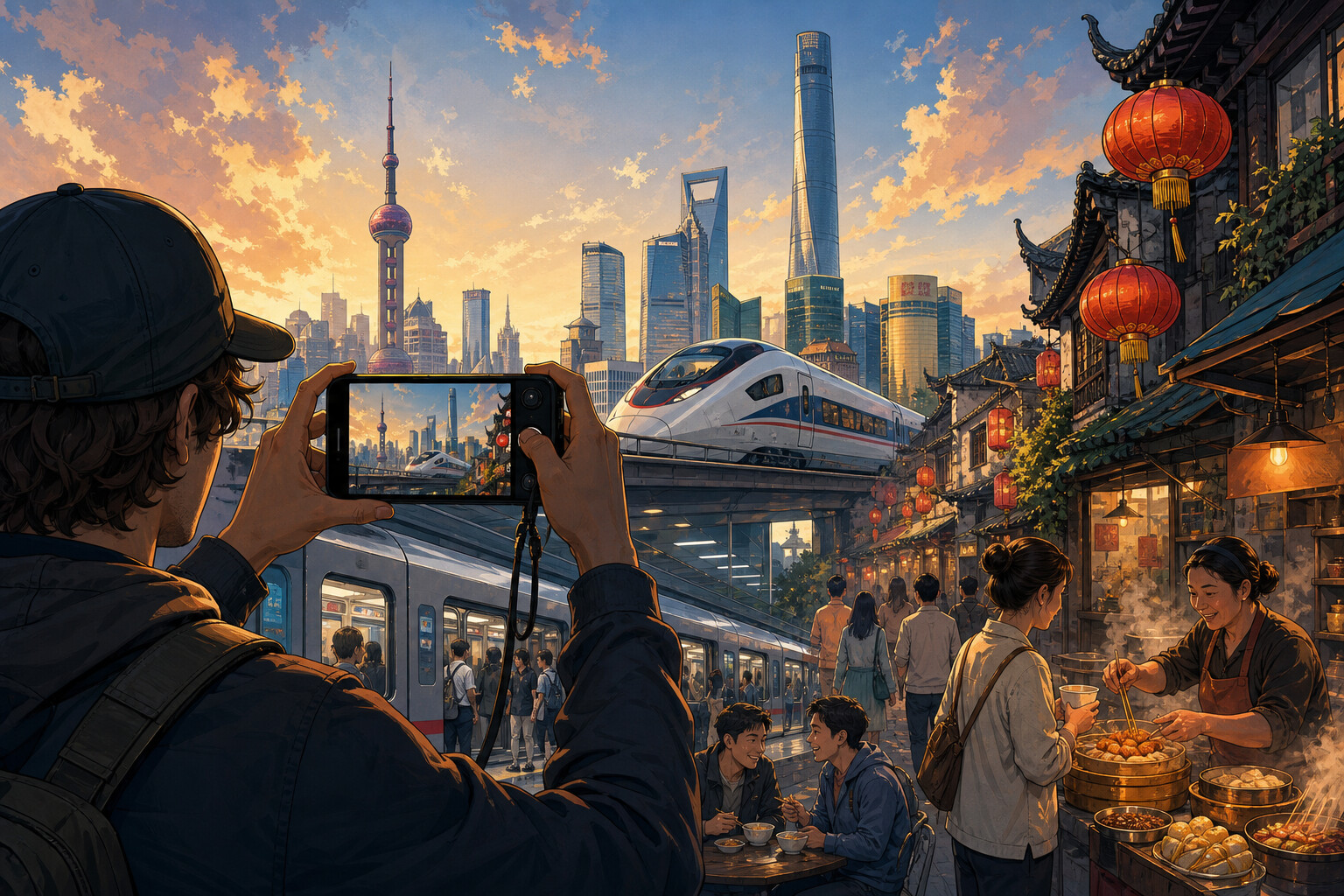
In early 2026, ChinaMaxxing became a shorthand for an unexpected online mood: warm water, house slippers, Chinese brands, city infrastructure, food, tai chi—and a new willingness to look at China with curiosity rather than only through geopolitical headlines. The meme arrived suddenly. The visual habit behind it had been building for years, one travel video at a time.
Before the Word: The Camera Was Already Changing the Story
The suffix -maxxing comes from internet language about taking a habit or identity to its maximum. Attached to China, it became playful permission to admire things that had often been treated as uncool, alien or politically suspect. Reporting by CNA, the Associated Press and the BBC World Service all noted the same tension: cultural curiosity can open a door, but a meme can also flatten a complex society into slippers, soup and futuristic skylines.
Travel vlogs work differently. They still select, edit and dramatize, but they contain friction. A payment app fails. A stranger helps. A station is confusing before it becomes efficient. A creator who arrived with one narrative must narrate what the camera records. The most interesting change is rarely a complete political conversion. It is the smaller, more defensible move from certainty to specificity.
What the creator thinks China will be.
What ordinary movement and public space reveal.
What survives beyond the first-day surprise.
Whether curiosity becomes a second journey.
How millions watch the update happen.
Fi & Nick: Saying “We Were Wrong” Out Loud
Watch the original video on YouTube · Creator: Fi and Nick
Josie Lifts Things: The First-Day Expectation Gap
This video predates the ChinaMaxxing label, which is precisely why it belongs here. Its title makes expectation—not a monument—the central subject. Shanghai’s familiar and unfamiliar details arrive together: an immense skyline, ordinary shopping, movement through public space and small interactions that do not behave like a single ominous story. First-day wonder is not deep expertise, but it creates a psychologically important opening: “not what I expected” is often the sentence that comes before better questions.
Two Mad Explorers: Letting a Series Replace a Verdict
This is not presented as a dramatic conversion video. Its value is methodological. An arrival episode became the beginning of visits to Xi’an, Nanjing, Qingdao, Shanghai, Yunnan and other places. Repetition weakens two easy fantasies at once: that China can be dismissed from afar, and that one glamorous megacity can stand for the whole country. A series lets inconvenience, routine, regional difference and accumulated familiarity enter the frame.
Davai Denis: The Return Trip Is the Stronger Claim
Watch the original video on YouTube · Creator: Davai Denis
“I was wrong” can still be a clickable headline. “So I came back” costs time, travel and attention. That second clause makes this case more persuasive. The creator is not simply surprised once; he chooses renewed contact. A return does not remove bias, and admiration can become its own filter. But behavior carries information: the place has shifted from an object of judgment to somewhere worth encountering again.
IShowSpeed: When the Update Happens Live
Watch the original stream on YouTube · Creator: IShowSpeed
A six-hour livestream is the opposite of a polished tourism commercial. It is noisy, crowded, comic and difficult to control. Viewers see reactions, navigation, fans, fatigue and spontaneous encounters with fewer editorial seams. IShowSpeed’s China tour did not begin as a careful political argument, yet its reach made ordinary urban scenes available to an audience that might never open a documentary. This is the scale at which a perception shift becomes a meme: not through one conclusion, but through millions of people watching the same unexpected details at once.
From Skeptic to Fan—But of Which China?
The phrase “from hater to fan” is emotionally satisfying because it has a clean before and after. Reality is messier. A traveler can admire trains and dislike surveillance; enjoy a city and remain critical of government; meet generous people and still misunderstand their circumstances. Positive experience is evidence, but it is evidence about what happened on a particular route at a particular time.
Creators also work inside an attention economy. Surprise sells. “China was more normal than I expected” is less clickable than “China shocked me.” Hosts, tourism bodies, brand partnerships and platform incentives may shape an itinerary; viewers should check each video description for disclosures. None of this makes the footage worthless. It means the responsible question is not “Is this the definitive real China?” but “What does this video let me observe, and what remains outside its frame?”
How to watch a China travel vlog critically
- Separate title from testimony.
- Does the creator actually describe a changed belief, or is “shocked” only packaging?
- Look for duration and repetition.
- A return visit or multi-city series usually reveals more than a single first-impressions day.
- Notice who is missing.
- Language barriers, rural life, work routines and less photogenic places can disappear from travel content.
- Check disclosure.
- Review the original description for sponsorship, hosted travel or affiliate relationships.
Why These Videos Matter Anyway
No creator can settle an argument about a country of more than a billion people. Yet these videos perform one valuable public service: they put inherited claims in contact with visible life. The camera moves from skyline to subway, from spectacle to breakfast, from a stranger imagined as an abstraction to a stranger offering directions.
That may be the deeper meaning behind ChinaMaxxing’s sudden popularity. The internet did not wake up one morning having agreed on China. It became curious about a China that appeared livable, stylish, technologically capable, historically deep and—most disarming of all—ordinary. The strongest response is neither worship nor dismissal. It is to keep the lens open long enough for certainty to become observation.
Questions about YouTubers, China and ChinaMaxxing
- What does ChinaMaxxing mean?
- ChinaMaxxing is internet slang for enthusiastically adopting or celebrating elements associated with Chinese daily life, culture, products, technology or urban experience. It is a meme and a loose cultural label, not a formal movement.
- Did all these YouTubers dislike China before visiting?
- No. A surprised title does not prove hostility. This article uses skeptic-to-admirer language only where a creator explicitly says they were wrong or demonstrates a changed view by returning.
- Can a travel vlog show the real China?
- It can show a real firsthand encounter, but not the whole country. A creator’s route, editing, language access, hosts and incentives all shape what appears on screen.
- Why embed the original YouTube videos?
- The original uploads let readers inspect each creator’s wording, sequence and context directly instead of relying on a secondhand summary or isolated clip.
Sources, original videos and editorial note
The five case studies link to the creators’ own original YouTube uploads above. Context for the ChinaMaxxing trend was cross-checked against independent reporting:
- CNA: “The rise of ‘Chinamaxxing’: Cultural curiosity or TikTok caricature?”
- Associated Press: “The ‘becoming Chinese’ meme shows China’s soft power moment is here”
- BBC World Service: “Chinamaxxing: The viral trend about ‘being Chinese’”
ChinaMaxxing Editorial did not commission or pay for any featured video. Embedding a video is not an endorsement of every statement in it. Copyright and advertising disclosures remain with the original creators and YouTube.
This is the clearest kind of case because the correction is not imposed by us: it is in the creators’ own title. Their Beijing arrival turns “China” from a preassembled idea into a sequence of things that can be checked—transport, public space, pace, hospitality and the feeling of moving through the city. The useful lesson is not that one good day proves every prior concern false. It is that a confident picture formed at a distance can become less confident after direct contact.