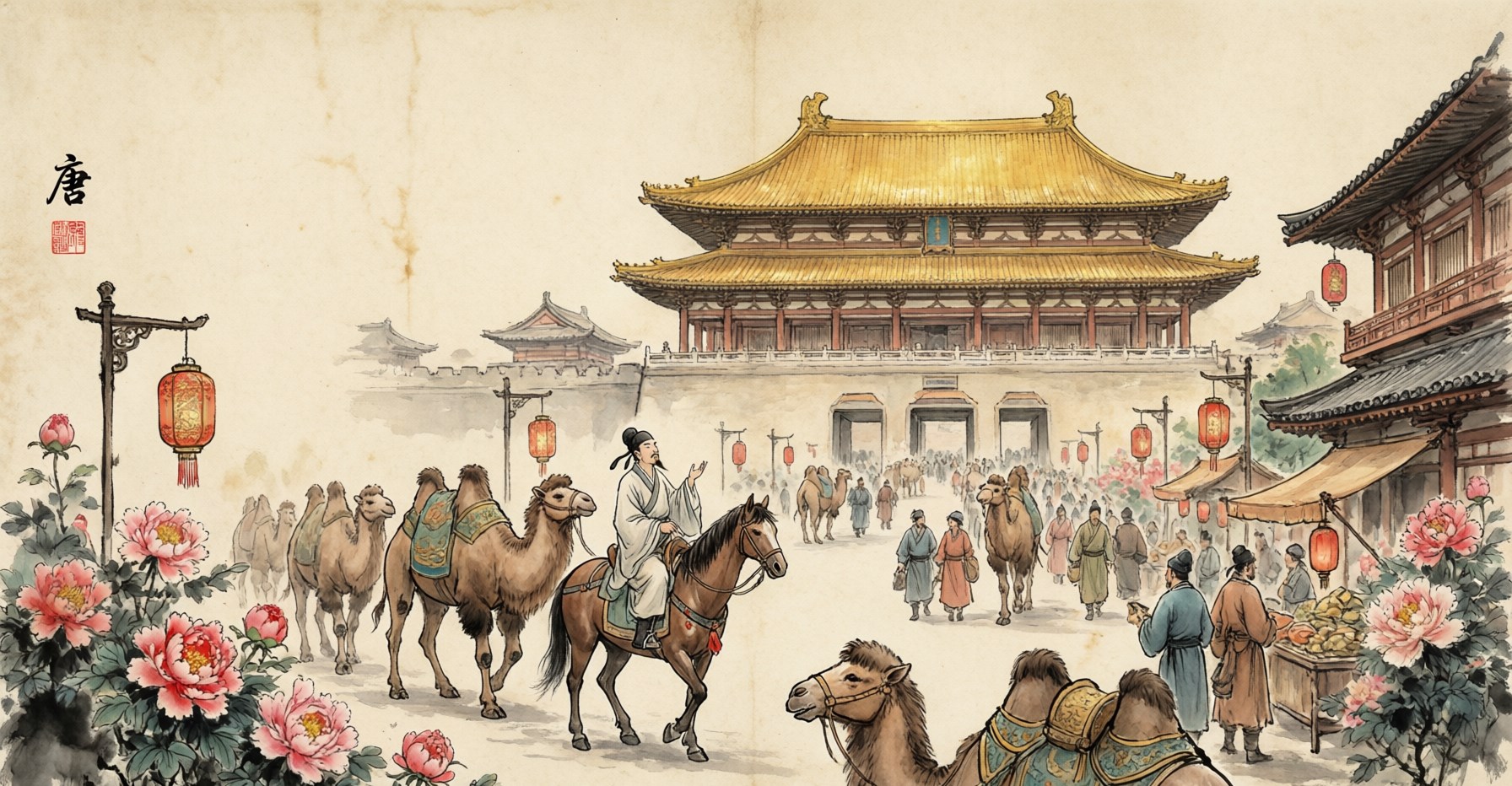
There is a word in Chinese for the places where overseas Chinese have gathered for centuries: Tangrenjie (唐人街) — "Street of the Tang People." Not Han, not Qin, not Ming. Tang. More than a thousand years after the dynasty fell, its name remains the one Chinese communities around the world chose to call themselves by. That single fact tells you something no list of dates can: the Tang Dynasty (唐朝, 618–907 CE) was not merely a period of good government or military power. It was the age in which Chinese civilization felt most fully itself — most confident, most open, most generous to the world and most glorious in return. To speak of China's golden age is, for most Chinese, to speak of the Tang.
From Taiyuan to Chang'an: A Dynasty Forged in Rebellion
The Tang rose, as so many dynasties do, from the wreckage of the one before. The Sui Dynasty had reunited China after centuries of division and built wonders — the Grand Canal, a new capital at Luoyang — but had exhausted the country with ambition and war. When the Sui emperor's campaigns in Korea collapsed and rebellions spread, the empire's own generals turned on him. Among them was Li Yuan (李渊), the governor of Taiyuan in the north, a seasoned aristocrat of mixed Chinese and Turkic blood who commanded a powerful frontier garrison.
In 617, Li Yuan marched south. Within a year he had taken the old Sui capital of Chang'an, installed a puppet emperor, and then, in 618, declared himself the founder of a new dynasty, taking the temple name Gaozu (高祖). But the true architect of Tang greatness was not the father — it was the son. Li Shimin (李世民), the second son of Li Yuan, was a cavalry commander of extraordinary daring who had urged his father to rebel in the first place and who led the armies that crushed rival warlords across the north. In 626, in an episode known as the Incident at Xuanwu Gate, Li Shimin ambushed and killed his two brothers, then compelled his father to make him heir and shortly after to abdicate. He became Emperor Taizong (太宗) — and he would spend the next two decades proving that the blood on his hands had bought something worth having.
The Zhenguan Reign: The Model of Good Government
Taizong's reign, known by its era name Zhenguan (贞观, 627–649), became for all later Chinese rulers the standard against which they measured themselves. It was not a reign of conquest alone — though Taizong's armies extended Tang power deep into Central Asia and brought the Turkic khaganates into a tributary relationship — but of governance. Taizong surrounded himself with blunt, fearless advisers, the most famous being Wei Zheng (魏征), a former servant of his murdered brother whom Taizong kept precisely because he would speak unwelcome truths. The emperor is recorded as saying that Wei Zheng was a mirror in which he could see his own faults.
The Zhenguan government refined the systems the Sui had begun: the three-department bureaucracy that divided policy-making, review, and execution among separate bodies so that no single minister could dominate; the civil-service examinations (科举, keju) that opened official careers to talent rather than birth alone; and a legal code that was, by the standards of its day, remarkably restrained and systematic. The Tang Code would become the model for legal systems across East Asia, from Japan to Vietnam. Taizong's reign was remembered not as a time of perfection — no reign is — but as proof that power could be exercised with restraint, that an emperor could listen, and that good government was a craft that could be learned.
"The ruler is the boat; the people are the water. The water can carry the boat, and the water can capsize it." — Attributed to Emperor Taizong, echoing the Xunzi
Chang'an: Capital of the World
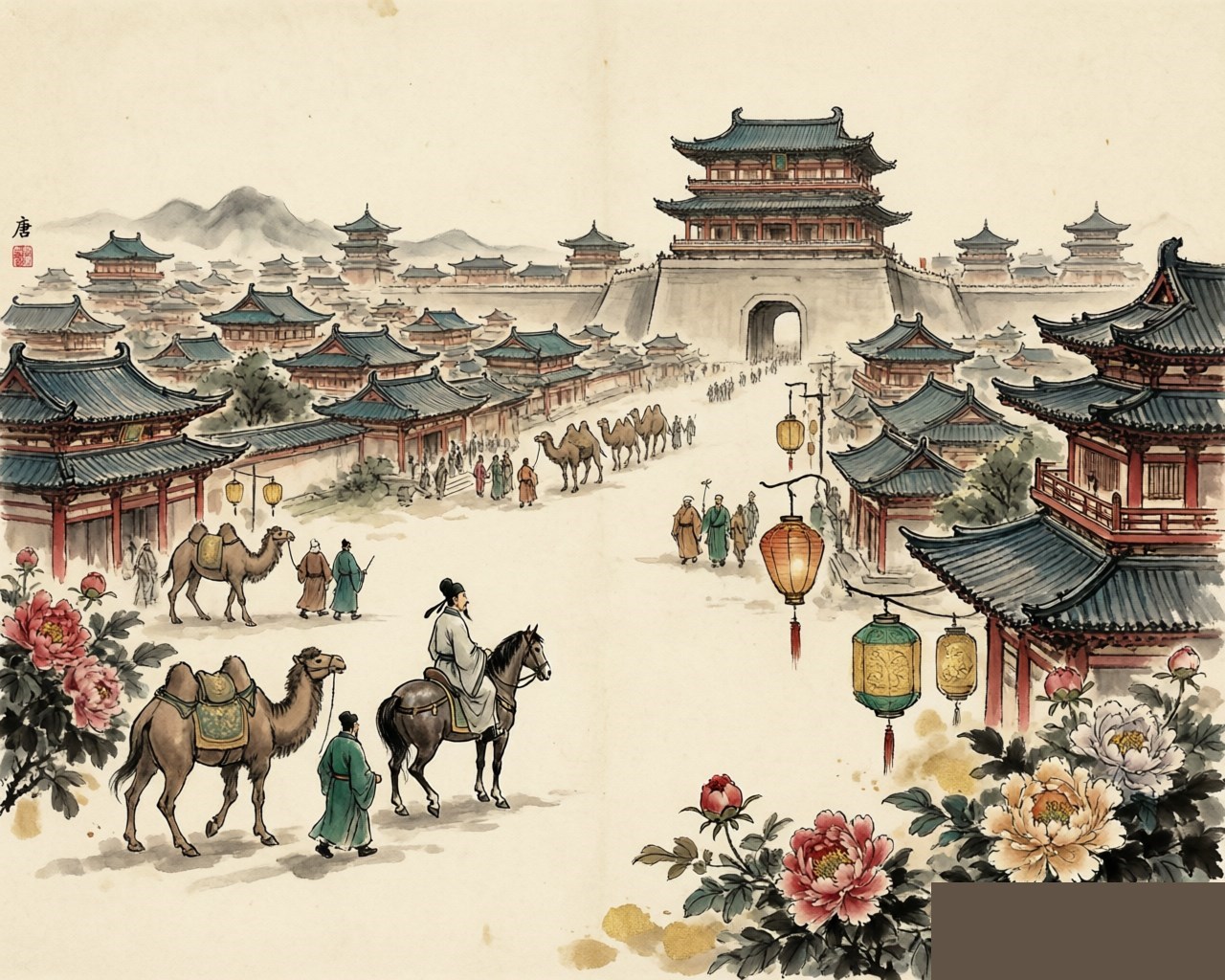
If the Zhenguan reign was the Tang's political achievement, Chang'an (长安, "Perpetual Peace") was its physical one. The Tang capital — modern Xi'an — was, in the seventh and eighth centuries, almost certainly the largest and most cosmopolitan city on earth. Its great grid of broad avenues enclosed an area many times larger than contemporary Rome or Constantinople. At its height, its population numbered in the hundreds of thousands, perhaps exceeding a million within the greater metropolitan area, though precise figures from the period are debated by historians.
What made Chang'an remarkable was not merely its size but its openness. Along the great East Market and West Market, merchants from across Eurasia traded silk, spices, gemstones, horses, and glassware. Persian silversmiths, Arab perfumers, Turkic horse-dealers, Korean monks, Japanese students, Sogdian wine-sellers, and Indian mathematicians all found a place in the Tang capital. The city hosted Zoroastrian fire temples, Nestorian Christian churches (a stele erected in 781 records the arrival of the "Luminous Religion" in China), Manichaean monasteries, and — by the mid-eighth century — mosques. Buddhism, already centuries old in China, reached new heights of institutional wealth and intellectual sophistication under Tang patronage. The monk Xuanzang's legendary seventeen-year journey to India to retrieve Buddhist scriptures — later romanticized as Journey to the West — was undertaken with Taizong's reluctant blessing and celebrated on his return with imperial honors.
This was not tolerance in the modern liberal sense; the Tang state regulated religion, periodically restricted foreign merchants, and could turn suspicious in times of crisis. But by the standards of any medieval civilization, the Tang capital was astonishingly plural. The confidence to welcome the world without fearing it — that was the Tang spirit at its zenith.
The Golden Age of Poetry
No account of the Tang is complete without its poets, for poetry was to the Tang what philosophy was to the Greeks and what drama was to Elizabethan England — the supreme art form, the measure of a cultivated mind, the medium through which joy, grief, friendship, and exile found their most concentrated expression. The civil-service examinations required candidates to compose regulated verse (lüshi, 律诗), so that every aspiring official was, by training, a poet. The result was an outpouring of verse unmatched in Chinese history: the great Qing anthology Quan Tangshi preserves nearly fifty thousand poems by more than two thousand Tang authors.
Three names tower above the rest. Li Bai (李白, 701–762), called the "Poet Immortal" (诗仙), wrote with a wild, wine-soaked freedom — romantic, Daoist, untethered from convention, as if the words poured out faster than decorum could restrain them. Du Fu (杜甫, 712–770), the "Poet Sage" (诗圣), was his opposite and his friend: meticulous, Confucian, haunted by the suffering of common people during the An Lushan Rebellion, his verse a moral witness to history. Wang Wei (王维, 699–759) painted with words and wrote with a painter's eye, his quiet landscape poems fusing Buddhist stillness with the mountains and streams of the natural world. A later generation produced Bai Juyi (白居易, 772–846), whose narrative poems — the "Song of Everlasting Sorrow," the "Ballad of the Pipa Player" — were said to be so clear that even illiterate listeners could weep at their recitation.
To read Tang poetry in the original, even imperfectly, is to hear a civilization speaking at the full stretch of its powers. The images are spare — moonlight on a river, a wild goose crossing an autumn sky, wine shared with a friend before a long parting — but the feeling they carry is inexhaustible. More than a thousand years later, Chinese children still memorize these poems in school, and their lines surface in conversation, in song, in calligraphy on the walls of homes and restaurants across the world.
Wu Zetian: The Woman Who Became Emperor
In the long catalogue of Chinese sovereigns, one figure stands utterly alone. Wu Zetian (武则天, 624–705) is the only woman in more than two thousand years of imperial history to rule China as emperor in her own right — not as regent, not as power behind a throne, but as the Son of Heaven herself, founding her own dynasty (which she called Zhou) and reigning under her own era names for roughly fifteen years at the turn of the eighth century.
Her rise was extraordinary. Entered into Taizong's harem as a young concubine, she survived his death — when custom demanded that childless consorts be confined to a monastery — by becoming the consort of his successor, the gentle Emperor Gaozong. Through intelligence, political ruthlessness, and genuine administrative talent, she accumulated power over decades, first as empress consort, then as regent for her sons, and finally, in 690, as emperor. Traditional Confucian historians, for whom a woman on the throne was an inversion of the natural order, painted her as a monster of cruelty and sexual license. Modern scholarship has complicated the picture: her reign saw the expansion of the examination system, the promotion of talented officials regardless of aristocratic background, and the patronage of Buddhism on a grand scale — including the colossal stone sculptures at Longmen. Whether one judges her a tyrant or a reformer depends heavily on which sources one trusts and which prejudices one brings. What is not in dispute is that she held the greatest power in the world, held it for years, and that no woman before or after her in China would do the same.
The An Lushan Rebellion: The Turning of the Tide
The Tang's long afternoon began on a winter day in 755, when the general An Lushan (安禄山), a Sogdian-Turkic commander who had been entrusted with the defense of the northeastern frontier, raised his armies in revolt. The rebellion that bears his name lasted nearly eight years and is conventionally regarded as the dividing line between the confident, expansive early Tang and the diminished, inward-looking late Tang. The human cost was catastrophic: census figures suggest a dramatic collapse in registered population during the war years, though historians debate how much of this reflects actual deaths, how much reflects the breakdown of the registration system, and how much reflects flight and displacement. What is certain is that the rebellion shattered the political and economic structures of the early Tang and that the dynasty never fully recovered its former vitality.
The emperor at the time, Xuanzong (玄宗), had reigned for more than four decades — the first part brilliant, the latter years sunk into infatuation with his consort Yang Guifei and neglect of government. When An Lushan's armies swept south and took the capital, Xuanzong fled westward; at a relay station called Mawei, his own guards mutinied and demanded the death of Yang Guifei and her family. The emperor, powerless, consented. The episode became one of the great tragic romances of Chinese literature, immortalized in Bai Juyi's "Song of Everlasting Sorrow." Xuanzong eventually abdicated in favor of his son; the rebellion was suppressed with the help of Turkic Uyghur allies and loyal Tang generals, but the cost was a transformed empire. Regional military governors (jiedushi, 节度使) emerged from the crisis with quasi-autonomous power, the Silk Road trade routes were disrupted by the loss of Tang control in Central Asia, and the court's confidence in its own universal mandate was permanently shaken.
Twilight, Fall, and the Name That Endures
The late Tang (roughly 763–907) was not without brilliance. Poetry continued to flourish; the great prose reformers Han Yu and Liu Zongyuan reshaped Chinese literary style; Chan (Zen) Buddhism matured into the tradition that would transform East Asian culture; and the printing of books, still in its infancy, began to spread knowledge beyond the aristocratic elite. But politically the dynasty was in slow retreat. Eunuchs dominated the inner court, warlords carved up the provinces, and peasant rebellions — above all the vast uprising led by Huang Chao in the 870s and 880s — gutted what remained of central authority. In 907, the warlord Zhu Wen forced the last Tang emperor to abdicate, and the dynasty ended as it had begun: in the hands of a general who wanted the throne more than the man sitting on it.
And yet the Tang did not truly end. It passed into the bloodstream of Chinese civilization as an ideal — the age when China was greatest, most open, most creative, most itself. The poetry survived, and with it the sensibility: the love of mountains and moonlight, the ache of parting, the pleasure of wine and friendship, the sense that the world was vast and beautiful and worth singing about. The name survived too. To this day, in Cantonese and in the speech of overseas Chinese communities from San Francisco to Singapore, a Chinese person is a Tangren (唐人), a Chinatown is a Tangrenjie, and traditional Chinese clothing is sometimes called Tangzhuang (唐装). The dynasty lasted 289 years. The name has lasted longer still.
To love the Tang is to love an idea of what civilization can be at its best: generous, curious, unafraid of the foreign, confident enough to learn from everyone and to teach everyone in return. It is no accident that the Tang is the dynasty the Chinese reach for when they want to remember who they are at their finest. In the wine-bright verses of Li Bai, in the quiet compassion of Du Fu, in the stone face of the Longmen Buddha gazing out over the Yi River, the Tang still speaks — and the world still listens.